here
Air sac in a puddle frog species used for visual gesture more than vocalization, probably due to a 'tuned-in' aural predator abundance similar to Hawaiian crickets which lost their song due to predation:
here
Some frogs lack vocal sacs, such as those from the genera Heleioporus and Neobatrachus, but these species can still produce a loud call. Their buccal cavity is enlarged and dome-shaped, acting as a resonance chamber that amplifies their call. The noise of flowing water overpowers any call, so some river frogs communicate by other means.
The main reason for calling is to allow males to attract a mate. Males call either individually or in a group called a chorus. Females of many frog species, for example Polypedates leucomystax, produce calls reciprocal to the males', which act as the catalyst for the enhancement of reproductive activity in a breeding colony.[39] A male frog emits a release call when mounted by another male. Tropical species also have a rain call that they make on the basis of humidity cues prior to a rain shower. Many species also have a territorial call that is used to chase away other males. All of these calls are emitted with the mouth of the frog closed.
A distress call, emitted by some frogs when they are in danger, is produced with the mouth open, resulting in a higher-pitched call. The effectiveness of the call is unknown; however, it is suspected the call intrigues the predator until another animal is attracted, distracting them enough for its escape.
Many species of frog have deep calls, or croaks. The English onomatopoeic spelling is "ribbit". wikipedia
Nature by number: spatial geometry in natural growth patterns
here
New apith skeletons found
Friday, July 3, 2009
Aquatic frog of the Congo

The African dwarf frog, a member of the Pipidae, is an aquatic animal living its life entirely underwater, but needs to rise to the surface to breathe atmospheric air because they have lungs and not gills. They "breathe" water in through their skin. They are fairly small in size and don’t weigh more than a few ounces. (Wikipedia)
They produce vocal clicks and trills, rather than the more typical croaks of more terrestrial/arboreal frogs, due to a lack of long extensible tongue and throat sac.
Jamaican tree frog lacks vocal sac yet vocalizes
"Hyla marianae lacks a vocal sac" yet calls during mating season in arboreal wet bromeliads.
Treefrog without throat sac
So we see a precise parallel regarding water & foraging:
benthic foraging frogs & humans lack throat sac, lack tail
surface foraging frogs & large apes have throat sac, lack tail
arboreal foraging frogs & canopy gibbons lack throat sac, lack tail
benthic foraging salamanders & monkeys lack throat sac, have tail
arboreal foraging salamanders & *monkeys lack throat sac, have tail
*atellid howler monkey.
all wading/swimming/diving monkeys have medium or long tails.
---
Clicking for echolocation by dolphins and humans
http://www.wired.com/wiredscience/2009/06/echolocation/
Frog hydrodynamic streamlining:
Not linear in their resting position, no, but well streamlined and linear at
times when leaping and swimming.
http://www.funfacts.com.au/images/leaping-frog1.JPG
http://www.northrup.org/Photos/frog/low/frog-swimming-underwater.jpg
The frogs legs can spread wide, then clap together while pushing against the water.
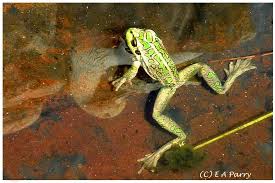
http://t3.gstatic.com/images?q=tbn:oTBfOGA5itQV5M:http://afrogpond.com/files/motorbike-frog-eaparry.jpg
Some frogs/toads walk or gallop briefly rather than hop. Many treefrogs mostly climb on 4 limbs, boreal toads tend to walk more than hop on the ground. The natterjack ground gallops briefly on all four, and burrows into drying salt-mires with forelimbs initially and then rear limbs.
http://scienceblogs.com/tetrapodzoology/2009/10/natterjack_life_and_times.php
This parallels primates/hominoids again, the change from ancestral long-tail locomotion (monkeys/salamanders) to non-tail hydrostatic foraging results in modified locomotion (leaping/swinging) which in some species returns to near-ancestral qpal locomotion in some species (natterjack/knucklewalking apes). The only missing parallel remaining is the possible frog which developed bipedal gait, so far not found in nature. Possibly long-tailed proto-archosaurs (ancestors of crocs, T rex, birds) developed from a coastal arboreal salamandrid, which in the avian line lost the long tail after branch vertical perching and reversed toe evolved.