Gene expression
1 - 4% of genome of anyone derived from outside sub-saharan Africa is shared with neandertal genome.
-
Atlatl spear-throwers include a launcher, a long narrow dart with flint tip, and a stone weight: atlatl
Compare to harpoons, polespears, Hawaiian slings, throwing spears, lances, bow & arrows
paleo art atlatls
-
Grey whale in Mediterranean Sea
here
""Over a lifetime, a gray whale migrates the equivalent distance of a return trip to the moon."
-
Salt springs in the Sahara: Niger has clays rich in salt from ancient seabeds, the salt springs of Teguidda-n-Tessoumt are surrounded by small round pools of brine, where salt crystals form on top slowing evaporation so children sprinkle water to break the crust which then settles at the bottom as crystals, later collected as loaves. Then the salt ponds are cleaned of remaining clay mud and reused, the mud dumped onto manmade hillocks. Much of the salt is traded via desert-edge nomads for use by domestic herds. Trees are very rare in the Sahara, but two trees grow nearby. (from article in Awake! Jan 09)
Showing posts with label healing the rift. Show all posts
Showing posts with label healing the rift. Show all posts
Monday, May 10, 2010


Sunday, April 11, 2010
Stingrays, mollusks, humans in African Rift Valley 1.5ma
First, mangrove, mollusk econiche evolution via tectonic plate rift activity at Tethys shoreline, why SE Asian/west Pacific mangroves more diverse than Africa or So. America mangroves (Ellison):
here
-
African Rift, Lake Turkana - Ileret footprints in mud 1.5ma, shellfish harvesting
picture
Apiths may have dug/finger-raked and consumed floating vegetation, shallow-shore tubers and shallow benthic invertebrates. But only genus Homo submerged fully while foraging, losing the laryngeal air sac and developing oral breathing and flatter hands and longer feet with short toes.
site habitat
"In 1984, the most complete hominin skeleton to date, KNM-WT 15000, was discovered eroding from a hillside at NK III. The specimen, which retained the skull and almost entire postcranial skeleton, belonged to a juvenile male Homo erectus/ergaster. Nicknamed the “Turkana Boy,” the specimen was determined to be 1.5 ma.
NK III site: Turkana Boy and fossil taxa include the freshwater stingray, Dasyatis Africana; the catfish, Synodontis; the extinct pig, Metrodiocherus; two extinct species of hippopotamus, Hippopotamus gorgops and H. aethiopicus; chelonian carapaces (turtle shells); some avian limb bones and phalanges; two species of bovid; sponge spicules; several species of ostracod (a crustacean); cichlids (a family of perciform fish); cyprinids (carps and minnows); and several varanids (monitor lizards). The paleoenvironment of the Nariokotome region during the time of the Turkana Boy has been reconstructed as a temporary marshland formed by the annual flooding of the Omo River with interspersed grassland and patches of woodland. One or more lakes were probably present as well."
anthro site history
-
Archaic Humans: Beavers & cleavers, sea waters & sea otters
Bilzingsleben, Germany, 325,000 years ago, microlith, pebble tools
Hoxne, England, 325,000 years ago - handaxes, extinct beaver, otter
Furze Platt, England, 325,000 years ago - large pointed handaxes, cleavers
Tan Tan, Morocco, 325,000 years ago - Mid Acheulian tools, female figurine
-
Beavers modify their habitat like humans do: Logging, Damming, Lodging
beavers arrested
-
here
A waterway linked the East African Rift Valley with the Indian Ocean 1.9ma, freshwater stingrays evolved there between 1.9 and 1.3ma after a marine incursion, the H erectus/ergaster skeleton Turkana boy was found there at waterside region. Probably Homo species, stingrays and 3 species of mollusks moved from Indian Ocean estuaries into the Rift valley lakes then, during a wet/high sea level period. The same time, Dmanisi, Georgia had H erectus/georgicus occupants living between the Caspian and Black seas. Tectonic plate collisions have uplifted the area since 1.8ma.
-
This site of early hominins is in Republic of Georgia, south of the Caucasus Mountains, east of the Black Sea, west of the Caspian Sea, on a wooded promontory surrounded by steep cliffs and water on three sides, that might have provided an ideal place to drive and ambush game.
Did they speak? Most likely they clicked & hummed/sang:
"
Meyer and his colleagues — David Lordkipanidze and Abesalom Vekua, both of the Georgian State Museum in Tbilisi — compared the size, shape, and volume of the Dmanisi vertebrae with more than 2 200 corresponding bones from people, chimpanzees, and gorillas.
"The Dmanisi spinal column falls within the human range and would have comfortably accommodated a modern human spinal cord," Meyer says.
Moreover, the fossil vertebrae would have provided ample structural support for the respiratory muscles needed to articulate words, he asserts. Although it's impossible to confirm that our prehistoric ancestors talked, Meyer notes, H. erectus at Dmanisi faced no respiratory limitations on speech.
In contrast, the 1984 discovery in Kenya of a boy's 1.6-million-year-old skeleton, identified by some researchers as H. erectus and by others as Homo ergaster, yielded small, chimplike vertebrae. Researchers initially suspected that the ancient youth and his presumably small-spined comrades lacked the respiratory control to talk as people do today." http://www.donsmaps.com/dmanisi.html
Old man with one tooth, cooking or shellfish food?
In the new work, David Lordkipanidze of the Georgian State Museum in Tbilisi and his colleagues describe a skull and jawbone from a hominid male who had lost all but one tooth. The tooth sockets had been resorbed into the skull, suggesting that he had lost the teeth several years before dying. The discovery represents the earliest case of severe masticatory impairment in the fossil record yet found, the researchers say.
Near the site of their latest find, the scientists also uncovered stone artifacts and animal bones with toolmarks on them. In order to survive without the ability to chew or bite meat, the gummy individual would have needed to collect sufficient soft food, including bone marrow, brain matter or soft plant food. Such gathering or processing could have been done alone, but the scientists posit that other individuals may have helped because of the individual's advanced age or illness, either of which could have been responsible for the loss of his teeth. The discovery, the authors conclude, "raises interesting questions regarding social structure, life history and subsistence strategies of early Homo that warrant further investigation." --Sarah Graham
Dmanisi site had both African ostriches, Kudaro macaques and short-necked giraffes and EurAsian wolves, sabercats and EurAsian beavers (skull wider than neolithic Polish beaver which were larger and faster growing than modern EurAsian beavers).
Simple stone pebble tools were used, probably with stick tools. http://www.pjoes.com/pdf/16.5/697-705.pdf
BUR CZAK-ABRAMOWICZ N. The beaver and some other interesting animals in Caucasus. Przegląd Zool. 8, 51, 1964. [in Polish]
Dmanisi seems to have dried out after the pliocene/pleistocene border.
Black Sea beaver species plentiful from Miocene to Pleistocene:
http://docs.google.com/viewer?a=v&q=cache:r7qdVn9-DEwJ:www.isez.pan.krakow.pl/journals/azc_v/pdf/52A(1-2)/52A(1-2)_05.pdf+caucasus+beaver+fossil&hl=en&gl=us&pid=bl&srcid=ADGEEShIHf6nddQWt5r5GQUHg1EpZtgR9lM5aujcurYqi6cwb_4Dx8GUHzXvAW6i5F_x9scKtiMZ-vgjm_PlJvLL8BFK1LhjPFoZpbgUifI-4kzwMxehiRhHHKFM6LGzuo_FxWDPRuwr&sig=AHIEtbTUnw9qk40z-qG1csiS_SzfF0K1TQ
Conjecture: ARC Diving was synchronized tandem Aqua-photic Respiratory Cycle dive foraging, when one partner dove down to the benthos the other backfloated above, communication was retained via clicks (at depth) and tones (at surface) which eventually merged to become uniquely human click-consonant tonal speech. ARC diving included in complement the Mammalian Diving Reflex (MDR), engaged upon submergence optimally conserving oxygen, the Photic Sneeze (or Surfacing) Reflex (PSR), engaged upon emergence at the surface, optimally exchanged carbon dioxide and oxygen-rich air. The combination of descent and ascent reflexes allowed sustained dive foraging for coastal seafood in sub/tropical lagoons, while seasonal inland freshwater herbs/rhyzomes were harvested by shoreside shallow wading, especially around Eurasian beaver-dammed woodland/wetland ponds and Peri-Tethyan estuaries. Caves and rockshelters offered sleeping sites in addition to wood-stick and reed-plastered dome huts.
-
Chicken pox can be spread by humans to apes, per a zoo account. Unknown if mumps are uniquely human, as I conjectured earlier.
-
Borneo frog breathes through skin, lost lungs, better hydrodynamics and less ascents.
A frog that breathes through its skin because it has no lungs, which makes it appear flat. This aerodynamic shape allows the frogs to move swiftly in fast flowing streams.
Neandertal face long, modern human face short: http://www.pnas.org/content/100/14/8142.abstract
here
-
African Rift, Lake Turkana - Ileret footprints in mud 1.5ma, shellfish harvesting
picture
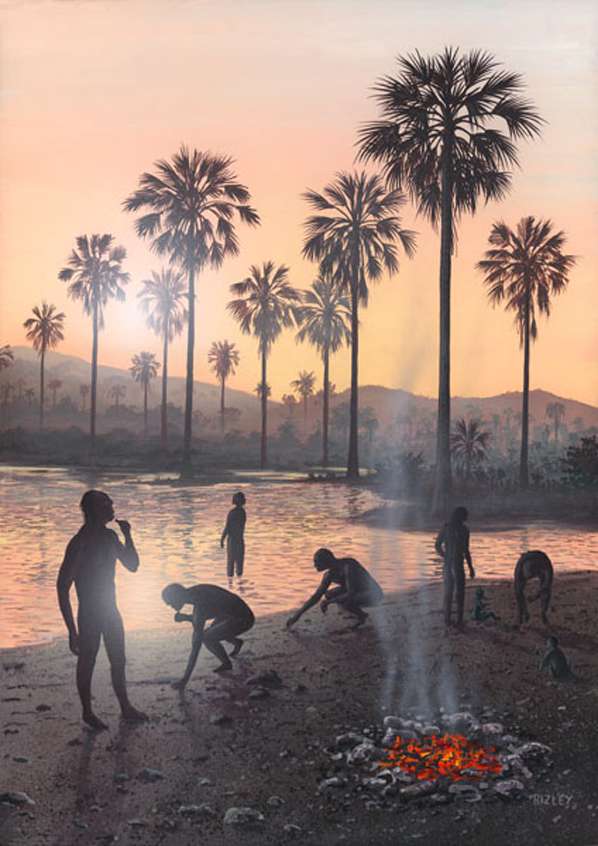
Apiths may have dug/finger-raked and consumed floating vegetation, shallow-shore tubers and shallow benthic invertebrates. But only genus Homo submerged fully while foraging, losing the laryngeal air sac and developing oral breathing and flatter hands and longer feet with short toes.
site habitat
"In 1984, the most complete hominin skeleton to date, KNM-WT 15000, was discovered eroding from a hillside at NK III. The specimen, which retained the skull and almost entire postcranial skeleton, belonged to a juvenile male Homo erectus/ergaster. Nicknamed the “Turkana Boy,” the specimen was determined to be 1.5 ma.
NK III site: Turkana Boy and fossil taxa include the freshwater stingray, Dasyatis Africana; the catfish, Synodontis; the extinct pig, Metrodiocherus; two extinct species of hippopotamus, Hippopotamus gorgops and H. aethiopicus; chelonian carapaces (turtle shells); some avian limb bones and phalanges; two species of bovid; sponge spicules; several species of ostracod (a crustacean); cichlids (a family of perciform fish); cyprinids (carps and minnows); and several varanids (monitor lizards). The paleoenvironment of the Nariokotome region during the time of the Turkana Boy has been reconstructed as a temporary marshland formed by the annual flooding of the Omo River with interspersed grassland and patches of woodland. One or more lakes were probably present as well."
anthro site history
-
Archaic Humans: Beavers & cleavers, sea waters & sea otters
Bilzingsleben, Germany, 325,000 years ago, microlith, pebble tools
Hoxne, England, 325,000 years ago - handaxes, extinct beaver, otter
Furze Platt, England, 325,000 years ago - large pointed handaxes, cleavers
Tan Tan, Morocco, 325,000 years ago - Mid Acheulian tools, female figurine
-
Beavers modify their habitat like humans do: Logging, Damming, Lodging
beavers arrested
-
here
A waterway linked the East African Rift Valley with the Indian Ocean 1.9ma, freshwater stingrays evolved there between 1.9 and 1.3ma after a marine incursion, the H erectus/ergaster skeleton Turkana boy was found there at waterside region. Probably Homo species, stingrays and 3 species of mollusks moved from Indian Ocean estuaries into the Rift valley lakes then, during a wet/high sea level period. The same time, Dmanisi, Georgia had H erectus/georgicus occupants living between the Caspian and Black seas. Tectonic plate collisions have uplifted the area since 1.8ma.
-
This site of early hominins is in Republic of Georgia, south of the Caucasus Mountains, east of the Black Sea, west of the Caspian Sea, on a wooded promontory surrounded by steep cliffs and water on three sides, that might have provided an ideal place to drive and ambush game.
Did they speak? Most likely they clicked & hummed/sang:
"
Meyer and his colleagues — David Lordkipanidze and Abesalom Vekua, both of the Georgian State Museum in Tbilisi — compared the size, shape, and volume of the Dmanisi vertebrae with more than 2 200 corresponding bones from people, chimpanzees, and gorillas.
"The Dmanisi spinal column falls within the human range and would have comfortably accommodated a modern human spinal cord," Meyer says.
Moreover, the fossil vertebrae would have provided ample structural support for the respiratory muscles needed to articulate words, he asserts. Although it's impossible to confirm that our prehistoric ancestors talked, Meyer notes, H. erectus at Dmanisi faced no respiratory limitations on speech.
In contrast, the 1984 discovery in Kenya of a boy's 1.6-million-year-old skeleton, identified by some researchers as H. erectus and by others as Homo ergaster, yielded small, chimplike vertebrae. Researchers initially suspected that the ancient youth and his presumably small-spined comrades lacked the respiratory control to talk as people do today." http://www.donsmaps.com/dmanisi.html
Old man with one tooth, cooking or shellfish food?
In the new work, David Lordkipanidze of the Georgian State Museum in Tbilisi and his colleagues describe a skull and jawbone from a hominid male who had lost all but one tooth. The tooth sockets had been resorbed into the skull, suggesting that he had lost the teeth several years before dying. The discovery represents the earliest case of severe masticatory impairment in the fossil record yet found, the researchers say.
Near the site of their latest find, the scientists also uncovered stone artifacts and animal bones with toolmarks on them. In order to survive without the ability to chew or bite meat, the gummy individual would have needed to collect sufficient soft food, including bone marrow, brain matter or soft plant food. Such gathering or processing could have been done alone, but the scientists posit that other individuals may have helped because of the individual's advanced age or illness, either of which could have been responsible for the loss of his teeth. The discovery, the authors conclude, "raises interesting questions regarding social structure, life history and subsistence strategies of early Homo that warrant further investigation." --Sarah Graham
Dmanisi site had both African ostriches, Kudaro macaques and short-necked giraffes and EurAsian wolves, sabercats and EurAsian beavers (skull wider than neolithic Polish beaver which were larger and faster growing than modern EurAsian beavers).
Simple stone pebble tools were used, probably with stick tools. http://www.pjoes.com/pdf/16.5/697-705.pdf
BUR CZAK-ABRAMOWICZ N. The beaver and some other interesting animals in Caucasus. Przegląd Zool. 8, 51, 1964. [in Polish]
Dmanisi seems to have dried out after the pliocene/pleistocene border.
Black Sea beaver species plentiful from Miocene to Pleistocene:
http://docs.google.com/viewer?a=v&q=cache:r7qdVn9-DEwJ:www.isez.pan.krakow.pl/journals/azc_v/pdf/52A(1-2)/52A(1-2)_05.pdf+caucasus+beaver+fossil&hl=en&gl=us&pid=bl&srcid=ADGEEShIHf6nddQWt5r5GQUHg1EpZtgR9lM5aujcurYqi6cwb_4Dx8GUHzXvAW6i5F_x9scKtiMZ-vgjm_PlJvLL8BFK1LhjPFoZpbgUifI-4kzwMxehiRhHHKFM6LGzuo_FxWDPRuwr&sig=AHIEtbTUnw9qk40z-qG1csiS_SzfF0K1TQ
Conjecture: ARC Diving was synchronized tandem Aqua-photic Respiratory Cycle dive foraging, when one partner dove down to the benthos the other backfloated above, communication was retained via clicks (at depth) and tones (at surface) which eventually merged to become uniquely human click-consonant tonal speech. ARC diving included in complement the Mammalian Diving Reflex (MDR), engaged upon submergence optimally conserving oxygen, the Photic Sneeze (or Surfacing) Reflex (PSR), engaged upon emergence at the surface, optimally exchanged carbon dioxide and oxygen-rich air. The combination of descent and ascent reflexes allowed sustained dive foraging for coastal seafood in sub/tropical lagoons, while seasonal inland freshwater herbs/rhyzomes were harvested by shoreside shallow wading, especially around Eurasian beaver-dammed woodland/wetland ponds and Peri-Tethyan estuaries. Caves and rockshelters offered sleeping sites in addition to wood-stick and reed-plastered dome huts.
-
Chicken pox can be spread by humans to apes, per a zoo account. Unknown if mumps are uniquely human, as I conjectured earlier.
-
Borneo frog breathes through skin, lost lungs, better hydrodynamics and less ascents.
A frog that breathes through its skin because it has no lungs, which makes it appear flat. This aerodynamic shape allows the frogs to move swiftly in fast flowing streams.
Neandertal face long, modern human face short: http://www.pnas.org/content/100/14/8142.abstract
Thursday, October 1, 2009
Marine-Rift Conduit

Ardi at Yardi: fossil hominin http://blogs.discovermagazine.com/loom/2009/10/01/ardipithecus-we-meet-at-last/
http://www.npr.org/templates/story/story.php?storyId=113387960
Proconsul, Morotopith: Uganda, 21-20ma, upright spine
Orangs split 20ma
Gorilla split 8ma
Oreopithecus: Sardinia island, 9 - 7ma, very long arms, tree climbing, stilted biped.
Sahelanthropus: Chad, 7 - 6ma (SN: 7/13/02, p. 19)
Orrorin: 6ma (SN: 7/14/01, p. 20)
Ardipithecus ramidus: 4.4ma Rift - Afar
Kenyanthropus 3.5ma: (SN: 3/24/01, p. 180)
Ardipithecus kadabba: 5.8 - 5.2ma
Australopithecus afarensis: 3.2ma Lucy, Selam
Homo 2.4ma
ardi pic

http://www.sciencenews.org/view/feature/id/52228/title/Evolution%E2%80%99s_Bad_Girl
-
Best article on MSC: MSC
-
Shallow-water habitats as sources of fallback foods for hominins
R Wrangham, D Cheney, R Seyfarth & E Sarmiento 2009 AJPA 140:630-642
Underground/underwater Storage Organs (rhyzomes) consumed
by hominins could have included both underwater and underground storage
organs, ie, from both aquatic and terrestrial habitats. Shallow aquatic
habitats tend to offer high plant growth rates, high densities, and
relatively continuous availability throughout the year.
This study differs from traditional savanna chimpanzee models
of hominin origins by proposing that access to aquatic habitats was a
necessary condition for adaptation to savanna habitats. It also raises the
possibility that harvesting efficiency in shallow water promoted adaptations
for habitual bipedality in early hominins.
-
Similarities of African apes and dolphins in group behavior
http://escholarship.org/uc/item/5gv9w4jw#
But note this from Molly: Why is the discussion always between chimps and humans? Orangs are more intelligent than chimps and we share a type C viral gene with them that other apes don’t have. How do they fit in the ancestor picture?
-
Scientists have tallied up genes that were accidentally duplicated in our lineage, for example, so that we now have more copies of them than do other primates. They've also identified genes that became pseudogenes. And some genes in humans got their start as noncoding DNA in other primates. Recently Aoife McLysaght of the Smurfit Institute of Genetics at Trinity College Dublin discovered three proteins produced by humans that aren't found in our closest non-human relatives. McLysaght then discovered that the genes for these three human proteins correspond almost precisely to stretches of noncoding DNA in the other species. It appears that mutations transformed these pieces of genetic material into genes capable of making proteins. (per Carl Zimmer) http://www.pbs.org/wgbh/nova/beta/evolution/ten-great-advances-evolution.html

This image was added by magellan on Aug 2, 2003 7:55 AM, Dave's Garden http://davesgarden.com/guides/pf/showimage/21902/
"Hardy Water Lily \\\'Arc en Ceil\\\' best known for its unusual variegated green leaves mottled with pink, cream and sometimes red. Produces many blooms which open light pink and change to off white."
Goubbat al Kharab (Gebt/Gulf from Indian Ocean) to Awash (A!k'wa'sh) River to Rift Valley, recent volcanic uplift changed watersheds
http://www.volcano.si.edu/world/volcano.cfm?vnum=0201-126&volpage=photos&photo=104004
http://scienceblogs.com/eruptions/2009/09/mvp_5_ardoukoba_djibouti.php
http://earthobservatory.nasa.gov/NaturalHazards/view.php?id=12065
http://fotobank.ru/image/JW00-5676.html
Women with ornate shell hairstyles harvesting water lily bulbs at Awash River ("nymphs from Afar?") gather nymphaea (water lilies) in the presence of dragonfly nymphs (larvae) which feed on pond mosquito larvae, see story about remarkable journey taken by these Dragonflies from India over the Indian Ocean to Africa: http://the-arc-ddeden.blogspot.com/2009/07/migration-lemurs-dragons-wings.html
Backfloating on Awash River
http://herc.berkeley.edu:16080/jdesmond_clark_memorial/jdc03.jpg

http://www.panoramio.com/photo/10877665
Post-volcanic Awash R watershed
http://gridnairobi.unep.org/chm/waterbasins/Awash%20River%20Basin-11-03-08.jpg

Post-volcanic Abbe R / Tana L watershed in Ethiopia
http://gridnairobi.unep.org/chm/waterbasins/Abbay_River_Basin-11-03-08.jpg

Note: Lake Tana & Blue Nile (Abbay) River, Ethiopia is NOT Tana river delta, Kenya coast. They are different regions. Lake Abbe (Abhe Bad) also differs, being the final depository of the Awash River on the border between Ethiopia and Djibouti.
Lake Abbe, end of Awash River
Lake Abbe, Djibouti
Tana river-delta on the Kenya coast:
Tana delta, Kenya

Lake Tana: highland source of Ethiopia Blue Nile (Abbay) River:
Lake Tana, Ethiopia
Both are linked to early human evolution and civilization.
Homo sapiens developed cane canoes, rafts, boats
Lake Tana papyrus canoe
Lake Baringo ambatch canoe
But before these composite boats evolved, simple bundles of reeds were used as floats, and wood-hafted stone axes as weights, during cyclic submersion while foraging for plant rhyzomes, cichlids, catfish, crustaceans, shellfish etc.
Kelp Highway, Blue Highway
http://the-arc-ddeden.blogspot.com/2008/05/human-ancestors-at-waterside.html
http://www.sciencenews.org/view/generic/id/48574/title/Droughts_gave_early_h
University of Texas at Austin anthropologist John Kappelman presented this counterintuitive idea October 19 in a talk titled “Blue Highways,” which followed his fossil digs along the Blue Nile tributaries in Ethiopia. Early humans are thought to have taken one of two routes out of Africa: along the Red Sea, or along the Nile Valley and out across Eurasia. But “there’s been very little testing on the ground, recovering fossils and sites that actually permit us to evaluate either one of those two hypothetical migration events,” Kappelman said. Most fossils found to date come from the rift valley on the eastern side of the continent, where dry, flat, exposed land makes for good fossil hunting. In the late 1990s, Kappelman started exploring the tributaries on the western side of the Nile, where no one had looked for fossils before. The last record of western exploration there was from British naturalist Sir Samuel Baker in the 1860s.
“This area that was a blank slate for Africa is finally starting to fill in,” Kappelman said.
Samuel Barker noticed something key: The rivers are dry for most of the year, but every summer the water rushes back “like freight cars,” Kappelman said. The torrent of water gouged out deep holes that retained water even during the dry season, leaving a necklace of isolated pools.
And the pools were full of fish. “The fish were literally in a bucket,” Kappelman says. If early humans stayed near these water holes, they could feast all through the dry season without working too hard. “We think of dry seasons as a time of adversity. We’re proposing that these were the easy times,” Kappelman says.
Kappelman and his team found double-edged blades that were probably used as arrow heads and evidence of hearth fires in several sites around the Nile. He thinks using these water holes could have taught early humans crucial skills, like fishing with nets or bow and arrow, that helped them survive seasonal and climate changes after migration to other parts of the world.
“It honed the behavioral foraging habits of early humans, and taught them to exploit a wide range of food,” Kappelman said.
(Ainu culturally derived) coastal Ama divers
The traditional Ama divers of Japan south coast spent part of the year tending freshwater rice paddies and part diving at the seashores with pry tools and basket floats.
The Moken (okeos) Andaman Sea people have wooden boat communities, children dive for shellfish. http://en.wikipedia.org/wiki/Moken
Notes on tropical/fragrant water lily: Seed, tuber, buds as food
http://www.innvista.com/health/foods/seeds/waternut.htm
In times of drought in the waterlilies natural habitat what happens is the pads will die off and the tuber will remain below the soil and becomes quite nut-like, protecting the tuber through the dry season. Once the rains return and the tuber becomes moist again it will send up new growth from the terminal crown and a new plant will be born. http://www.victoria-adventure.org/waterlilies_images/sean_tuber_tutorial/page1.html
Water lilies reproduce by seed and also by new plants sprouting from the large spreading roots (underground stems called rhizomes). A planted rhizome will cover about a 15-foot diameter in about five years.
Fragrant water lily has an interesting pollination strategy. Each white or pink flower has many petals surrounding both male and female reproductive parts, and is only open during the daytime for three days. On the first morning, the flowers produce a fluid in the cup-like center and are receptive to pollen from other flowers. However, they are not yet releasing pollen themselves. Pollen-covered insects are attracted by the sweet smell, but the flower is designed so that when they enter the flower, they fall into the fluid. This washes the pollen off their bodies and onto the female flower parts (stigmas) causing fertilization. Usually the insects manage to crawl out of the fluid and live to visit other flowers, but occasionally the unfortunate creature will remain trapped and die when the flower closes during the afternoon. On the second and the third days, the flowers are no longer receptive to pollen, and no fluid is produced. Instead, pollen is released from the stamens (the flexible yellow match-shaped structures in the flower center). Visiting insects pick up the pollen and transport it to flowers in the first day of the flowering cycle. After the three days the flowers are brought under water by coiling their stalks. The seeds mature under water and after several weeks are released into the water. Water currents or ducks, which eat the seeds, distribute them to other areas. This flowering regimen is followed nearly throughout the summer, producing many eye-pleasing blooms and a large supply of seeds.
In addition to reproducing by seeds, water lilies spread by rhizomes. Anyone who has tried to curtail this plant's growth in front of their dock knows how tenacious these root systems are. Also, if pieces of the rhizome are broken off during control efforts, they will drift to other locations and establish a new patch of lilies.
The fragrant water lily was utilized in many ways by Native Americans in the eastern United States. Roots of this and other water lilies were used medicinally as a poultice for sores and tumors, internally for many aliments including digestive problems, and rinse made for sores in the mouth. The leaves and flowers were also used as cooling compresses. In addition, the rhizomes were occasionally used as food and the young leaves and lower buds were eaten as a vegetable. Even the seeds were fried and eaten or ground into flour. Wildlife, including beaver, muskrat, ducks, porcupine, and deer also will eat the leaves, roots, or seeds. http://www.ecy.wa.gov/Programs/wq/plants/weeds/lily.html
Jordan Valley frog bit Hydrocharis morsus-ranae
http://www.wildflowers.co.il/english/plant.asp?ID=750
Jordan Valley white water lily
http://www.flowersinisrael.com/Nymphaeaalba_page.htm
Jordan Valley yellow pond lily
http://www.flowersinisrael.com/Nupharlutea_page.htm
India pink lotus
http://en.wikipedia.org/wiki/Nelumbo_nucifera
Egyptian blue water lily
http://www.egyptianmyths.net/lotus.htm
The Egyptian Blue Water-lily, N. caerulea, opens its flowers in the morning and then sinks beneath the water at dusk, while the Egyptian White Water-lily, N. lotus, flowers at night and closes in the morning.
Tana river delta nymphaea
http://www.feow.org/ecoregion_details.php?eco=567
http://answers.yahoo.com/question/index?qid=20070604230442AA91zkq
Okavango Delta: termite, tree, hippo
http://ngm.nationalgeographic.com/ngm/0412/feature3/fulltext.html
Congo Mbeli bai, Ndoki swamp lowland gorilla eat floating frogbit hydrocharis (92%) & some sedges (8%)
http://www.springerlink.com/content/d66v4990r452721p/fulltext.html
http://www.arkive.org/western-gorilla/gorilla-gorilla/video-go08.html
http://sci.tech-archive.net/Archive/sci.anthropology.paleo/2008-08/msg00063.html
http://books.google.com/books?id=ZcTP7Kb01NAC&pg=PA365&lpg=PA365&dq=Hydrocharis+chevalieri&source=bl&ots=b6deCmBDmQ&sig=vhg4uBxNyqaoMfZFmBNaw9t4SM0&hl=en&ei=dnnFSon1HJHcsgOA7OGhBQ&sa=X&oi=book_result&ct=result&resnum=3#v=onepage&q=Hydrocharis%20chevalieri&f=false
Picture shows superficial resemblance of Hydrocharis and water lily, but hydrocharis roots float free with stolons at surface (easily dredged from above surface by gorilla standing or sit-floating upright with inflated laryngeal air sacs), while the water lily has anchored benthic roots and horizontal rhyzomes at a depth 6"-10" below soil substrate far below the water surface, often requiring facial submersion and combined with benthic shellfish foraging).
Nassarius marine mud snail shells used for ornamentation inland
http://www.pnas.org/content/106/38/16051.full
http://taos-telecommunity.org/epow/EPOW-Archive/archive_2009/EPOW-090119.htm
Hydrocharis storage turion buds into new plant
http://commons.wikimedia.org/wiki/File:HydrocharisBaby.jpg
Comparatives:
Butterfly (Nymphalids) 90ma & Angiosperm (flowering plants) 100ma evolution
http://www.abhishek-tiwari.com/2009/10/butterfly-phylogenetics.html
Frog 125ma & Archeafructus 125ma (water lily predecessor?) North East China
(see earlier posts)
Human ancestors: India 3ma (see Yohn & Todaro: African primate-only viruses between 3-5ma) (also see India origin of malaria 3ma), Djibouti (unique Tuberculosis 2ma), myosin mutation 2.4ma reduced jaw muscles & brain size constraint
2ma Asian pseudogene RRm2p4 nucleotide polymorphism on human X chromosome
http://mbe.oxfordjournals.org/cgi/content/abstract/22/2/189
http://www.eurekalert.org/pub_releases/2004-03/uopm-mmp032204.php
In an effort to find the remaining genes that govern myosin--the major contractile protein that makes up muscle tissue Penn researchers have found one small mutation that undermines an entire myosin gene. Their estimated dating for the appearance of this mutation places it at about 2.4 million years ago, just prior to a period of major evolutionary changes in the hominid fossil record. These include the beginning of larger brain size, so important in making us human. Anthropologists have long debated how humans evolved from ancestors with larger jaw muscles and smaller brains. This newly discovered mutation seems responsible for the development of smaller jaw muscles in humans as compared to non-human primates. Did this genetic mutation lift an evolutionary constraint on brain growth in early humans? MYH16 on chromosome 7 They found the gene-inactivating mutation in all modern humans sampled, with the same inherited muscle "disease." However, the mutation was not present in the DNA of seven species of non-human primates, including chimpanzees. macaque chewing and biting muscles are nearly ten times as large as in humans, which correlates with the fact that MYH16 protein is made in macaques and not in humans. researchers calculated that the inactivating mutation appeared in a hominid ancestor about 2.4 million years ago, after the lineages leading to humans and chimpanzees diverged. Shortly thereafter, roughly 2.0 million years ago, the less muscled, larger brained skulls of the earliest known members of the genus Homo start to appear in the fossil record.
From this the investigators postulated that the first early hominids born with two copies of the mutated MYH16 gene would show many effects from this single mutation--most notably a reduction in size and contractile force of the jaw-closing muscles, some of which exert tremendous stress across and/or cause deposition of additional bone atop growth zones of the braincase. "The coincidence in time of the gene-inactivating mutation and the advent of a larger braincase in some early Homo populations may mean that the decrease in jaw-muscle size and force eliminated stress on the skull, which 'released' an evolutionary constraint on brain growth,
Ice age glacial sea level 100m drops as Yemen gateway to south Asia and Sahara-Sinai desert gateway to Europe.
http://tech.groups.yahoo.com/group/AAT/message/54756
Based on this, we know that Ardi & Lucy were not likely to have been direct human ancestors, but possible chimp ancestors or extinct relatives which shared many phenotypical traits with early human ancestors.
---
other items
Neandertals at Gibralter, Anglo Saxons of eastern England feasted on dolphin
http://groups.google.co.uk/group/sci.archaeology/browse_thread/thread/ea500d5e8628fcce#
http://anthropology.net/2009/09/16/neanderthal-hearths-at-el-salt-reveal-plant-and-fish-remains/#comment-15042
Stone/wood beaters used on tree bark cloth felt (cf Mongolian wool felt pulled/bounced behind horse, egyptian papyrus pith paper) in China, Vietnam, Tonga, Mexico.
Judith Cameron, Archaeology and Natural History, Australian National Univ.
http://dspace.anu.edu.au:8080/bitstream/1885/47191/1/ch13.pdf
Flora and fauna, fish hook and sewn plank canoe transmission between Asia and America pre-Colombian
ON LINGUISTICS AND CASCADING INVENTIONS: A COMMENT ON
ARNOLD’S DISMISSAL OF A POLYNESIAN CONTACT EVENT IN
SOUTHERN CALIFORNIA
Terry L. Jones and Kathryn A. Klar
http://cla.calpoly.edu/~tljones/AQ74(1)%20Jones%20+%20Klar.pdf
http://books.google.com/books?hl=en&lr=&id=8-OilJCX1moC&oi=fnd&pg=PA238&dq=archaeology+%22pre-Columbian+contact%22&ots=PB_vZlY7vy&sig=NKJwE9osSyqBM8UMjEN__3G4zFk#v=onepage&q=archaeology%20%22pre-Columbian%20contact%22&f=false
Zizyphus fruit tree of Eurasia, short stemmed: http://www.citizendia.org/Jujube
Nutrition at waterside: http://tech.groups.yahoo.com/group/AAT/message/54785
Cattle domestication at Mehrgarh, Indus above Indus delta.
http://www.citizendia.org/Mehrgarh
-
Plausible? He only at rift & coast, not interior, Hs pre-domesticated along Levant-Indus coast, then returned to Africa as pastoralist/agriculturalist H&G only (pygmy/san/onge/kusunda?)...explains why megafauna remained in Africa long after mammoths and other megafauna all extinct throughout EurAsia.
Parallel: Further north, the Rift in the Jordan Valley, at paleo-lake Ubeidiya (3 km So of Sea of Gallilee), a large shallow freshwater lake at 100m below sea level, many acheulean hand axes found from 1.5ma. "Originally the site was on the edge of a small sweet-water lake; this accounts for the abundance of bones of mammals, reptiles, fish and birds. The hominids living at the site were hunters and scavengers. They made distinctive chopping tools of flint and spheroids of limestone, as well as hand-axes of flint and to lesser degree of basalt" (also almond and pond lily nuts). 20? km east of the Medit. along Jezreel valley, north of Dead Sea. During the Neogene, the Mediterranean penetrated into the Jordan Valley. The end of the Pliocene marks the creation of the Rift valley, cover basalt from 5ma to 3ma underlie the interesting layers. See page 11/31 at this pdf:
www.paleoanthro.org/dissertations/Miriam%20Belmaker.pdf
http://www.sitesandphotos.com/catalog/images/455911.jpg
http://adsabs.harvard.edu/abs/1966Natur.209.1268M
IN 1959 Dr, G. Haas, of the Department of Zoology of the Hebrew University of Jerusalem, was sent some fossil animal bones which had been turned up by a bulldozer levelling a field near Tell Ubeidiya in the Jordan Valley near Lake Tiberias. In this material, Dr. Haas identified bones of extinct mammalia and ``a human incisor and two small fragments of a hominid calvarium of very great thickness''1.
http://www3.interscience.wiley.com/journal/118911262/abstract?CRETRY=1&SRETRY=0
The large carnivores from ‘Ubeidiya (early Pleistocene, Israel)
Of specific importance is the presence of the African origin saber tooth Megantereon cf. M. whitei and the Eurasian origin canids Canis moschbachensis and Lycaon lycoanoides. Hippo tusk, mammoth molar at Ubeidiya:
http://digitool.haifa.ac.il/R/?func=dbin-jump-full&object_id=88799&local_base=GEN01
http://digitool.haifa.ac.il/R/?func=dbin-jump-full&object_id=88785&local_base=GEN01
http://www.gsi.gov.il/Eng/_Uploads/141Reactivation-of-the-Levant-passive.JPG
http://www.topo-europe.eu/3-the-natural-laboratory-concept/3-7-the-caucasus-and-levant/3-7-4-crustal-structure-and-physiography
Peritethyan and Pannonian Seas of Europe 10ma
http://images.google.com/imgres?imgurl=http://upload.wikimedia.org/wikipedia/commons/thumb/a/a8/MSC_basin_hypotheses.svg/350px-MSC_basin_hypotheses.svg.png&imgrefurl=http://en.wikipedia.org/wiki/Messinian_salinity_crisis&usg=__DZ63mmr9Wjv7sZ9LyhOuf7dsN5w=&h=364&w=350&sz=14&hl=en&start=34&sig2=Q1CH8sJ688ieeTITF3depQ&um=1&tbnid=81PvmHgYbY8IXM:&tbnh=121&tbnw=116&prev=/images%3Fq%3Dlevant%2Bbasin%26ndsp%3D20%26hl%3Den%26client%3Dfirefox-a%26rls%3Dorg.mozilla:en-US:official%26sa%3DN%26start%3D20%26um%3D1&ei=XwflSqKRDpDQswPlvqCwBA
The Pannonian Sea existed for about 9 million years. Its last remains disappered in the middle of Pleistocene Epoch, about 600,000 years ago. The water of the Pannonian Sea actually ruptured its way through the modern Đerdap Gorge on the Danube river and flowed through the gorge leaving behind a large plain known as the Pannonian Plain.
-
Snail fossils suggest semiarid eastern Canary Islands were wetter 50,000 years ago
Isotopic measurements performed on fossil land snail shells resulted in oxygen isotope ratios that suggest the relative humidity on the islands was higher 50,000 years ago, then experienced a long-term decrease to the time of maximum global cooling and glaciation about 15,000 to 20,000 years ago, according to new research by Yurena Yanes, a post-doctoral researcher, and Crayton J. Yapp, a geochemistry professor, both in the Roy M. Huffington Department of Earth Sciences at Southern Methodist University in Dallas, Texas. With subsequent post-glacial climatic fluctuations, relative humidity seems to have oscillated somewhat, but finally decreased even further to modern values.
Consequently the eastern Canary Islands experienced an overall increase in dryness during the last 50,000 years, eventually yielding the current semiarid conditions. Today the low-altitude eastern islands are characterized by low annual rainfall and a landscape of short grasses and shrubs, Yanes says. The research advances understanding of the global paleoclimate during an important time in human evolution, when the transition from gathering and hunting to agriculture first occurred in the fertile Middle East and subsequently spread to Asia, North Africa and Europe.
http://www.eurekalert.org/pub_releases/2009-10/smu-sfs102709.php#at
Via Elaine at AAT, from Dawkins site: [Recall that Queen Hatsheput, Pharaoh of Egypt that voyagedd the Red Sea to Punt met Queen Ati there who had steatopygya as did her daughter, showing a continuum from South African Namakwa KhoiSan to Andamaners, also seen in early Hs Euro mother Venus sculptures]
"One very interesting feature is Steatopygia -- extreme obesity in women during
pregnancy, often occur in Andamanese. It's considered as a disorder, but i
suspect it's an aquatic "adaptaion" -- for that pregnant women need more energy
storage and buoyancy (u may link it to water birth), or also, as the photo show,
a "platform" for the baby staying near water surface. (well this sounds
ridiculous, but it could contribute to higher survival rate if they were that
aquatic)" The photo shows and infant standing on the protuding buttocks of the mother
hanging on to her neck... and re. buoyancy: "Human buoyancy is very close to optimal for aquatic mammals. More importantly perhaps, our center of buoyancy is compatible with marine, not terrestrial mammals (Slijper 1976). This gives us the ability to maintain a horizontal attitude near the surface of the water with minimal energy expenditure."
Asian genes
Parallel: East Asian people have reduced body and facial hair with fu manchu beard, West Asian & African people have facial hair with full beard. East Asian tigers have only small fu manchu beard, West Asian & African lions have large mane and full beard.
India/Tibet has both types of people and lions-tigers. Why? Tigers more aquatic-arboreal or colder climate?
Marcel on marine kidneys, oreopith, AHV: http://www.bautforum.com/science-technology/94562-elaine-morgan-says-we-evolved-aquatic-apes-3.html
MSC: 6ma - 5.5ma Mediterranean dried out. Last common ancestor of chimpanzee and Homo is dated to around 5.5 Mya. Papio/gelada divergence at 4 (3.99) Mya.
Wood eating crabs at depth, as well as wood boring molluscs and isopods, there are crustaceans which eat plant matter which sinks to the ocean floor, including old wooden boats and tools (so its even harder to get evidence of ancient coastal tool use!).
http://www.oceanleadership.org/2009/the-deep-sea-crab-that-eats-trees/
Seeing fish at depth: http://www.fishbase.org/photos/depth.cfm?PicName=Lamer_j0.jpg

Wednesday, April 22, 2009
From sit-float-feeding to backfloat-dive-feeding to boat-net-feeding
AAT ~20ma initiation, 5ma immersion, 2ma dive/backfloating
I've no argument with Hardy's 20ma and Filler's date of ~20ma as initial aquatic
era, in an evolutionary sense. Upright posture, proconsul/morotopith wetland
sit-float-feeding as a change from its predecessor of upright dry sitting
(geladas) indicates daily aquatic foraging (surface feeding with gradually
enlarging air sacs and shrinking tail, maintained even in today's lowland
gorillas).
Homo Genus 5ma developing estuarine submersion foraging (crouch plucking), 3ma
seashore diving, 1.5ma diving/backfloating ARC cycle around the Levant and
former peri/tethys and upper Rift, gradual increase in waterside group ambush
improved tool technologies, which eventually took them to cooler rougher
predator-filled waters where rafts and boats were advantageous.
-
This from PZ's blog:
http://scienceblogs.com/pharyngula/2009/07/the_evolution_of_hedgehog.php#more
"As usual, it starts on a sound foundation of confirmed, known evidence, makes a reasonably hypothesis on the basis of the facts, and then proposes a series of research avenues with predicted results that would confirm the idea."
Re: From sit-float-feeding to backfloat-dive-feeding to boat-net-feeding
PAs can argue forever about details when evidence is scattered and lacking, and
topography and climate changes at varying rates.
I've produced a simple explanation, of how hominoids differentiated from other
primates (tail loss, air sacs), how Homo differentiated from other hominids (ARC
diving, low UV saltwater backfloating), and how Homo sapiens differentiated from
other Homo (mass harvesting -> trade -> transport).
Of the question 'What happened?' the missing pieces of the puzzle have been
found and placed, they fit.
Other explanations for the unique characteristics of humans compared to our genetic kin fall short by not taking into account various behaviors and vestigial traits common to humans but not to other primates. That doesn't mean they are insignificant or incorrect, just incomplete.
The story is a bit more complete now.
Prose of human speciation
Hominoids vs other primates (sit/float/eat, tail loss, air sacs),
Homo vs other hominids (ARC diving, low UV saltwater backfloating),
Homo sapiens vs other Homo (mass harvesting/transport).
---
Hominoids sit/floating on flooded ground,
hands to pluck/peel/pull/pinch,
calls/splashes/thumps to warn,
sleep in tree hollows, forks (damp), beaver dens
eat meat without bones (eggs, pith, larvae, seeded fruit)
Homo going deeper into water/caves, while apes went higher,
Homo crafted long/sharp fangs/claws of sticks/stones/shells.
Using pebbles to crack, flakes to cut, bifacials to bait, branches to bash,
spears to probe/pry/poke, lords of the ring/pond/pool
eat meat/nuts with shells/bones to be removed and reused.
Hs brought sunlight into cold night (fire),
and dark into hot day (shelter), and wet into dry.
Bags/baskets/boats processed (cut, woven) to transport, harpoons/atlatls to
launch spears/darts.
Meats/grains to guide/process (planting/herding), grinding masses, soaking,
heating, storing, exchanging, comparing.
Rings concentrically ordered, become overly congested and condense into
rectilinear patterns and vertical double-storied dwellings and overlapped social
groupings and finally oral-named individuals become anonymously writ-numbered
cells in the spherical body of humankind and beyond.
Compare these two shelters: entry routes, protection from bears/cold
link
link
Mammoth bone lodge of Central Russian floodplain 15ka, summer doorway
link
22ka camp huts & bedding at upper Rift waterside link
seal ancestors link
DDeden
I've no argument with Hardy's 20ma and Filler's date of ~20ma as initial aquatic
era, in an evolutionary sense. Upright posture, proconsul/morotopith wetland
sit-float-feeding as a change from its predecessor of upright dry sitting
(geladas) indicates daily aquatic foraging (surface feeding with gradually
enlarging air sacs and shrinking tail, maintained even in today's lowland
gorillas).
Homo Genus 5ma developing estuarine submersion foraging (crouch plucking), 3ma
seashore diving, 1.5ma diving/backfloating ARC cycle around the Levant and
former peri/tethys and upper Rift, gradual increase in waterside group ambush
improved tool technologies, which eventually took them to cooler rougher
predator-filled waters where rafts and boats were advantageous.
-
This from PZ's blog:
http://scienceblogs.com/pharyngula/2009/07/the_evolution_of_hedgehog.php#more
"As usual, it starts on a sound foundation of confirmed, known evidence, makes a reasonably hypothesis on the basis of the facts, and then proposes a series of research avenues with predicted results that would confirm the idea."
Non-scientists take note: this is a category of paper that is usually titled "hypothesis" or "insight," as opposed to a peer-reviewed research paper or a literature review, although it is more similar to the latter. PLoS Biology uses the term "unsolved mystery:"
Unsolved Mysteries discuss a topic of biological importance that is poorly understood and in need of research attention.-
Re: From sit-float-feeding to backfloat-dive-feeding to boat-net-feeding
PAs can argue forever about details when evidence is scattered and lacking, and
topography and climate changes at varying rates.
I've produced a simple explanation, of how hominoids differentiated from other
primates (tail loss, air sacs), how Homo differentiated from other hominids (ARC
diving, low UV saltwater backfloating), and how Homo sapiens differentiated from
other Homo (mass harvesting -> trade -> transport).
Of the question 'What happened?' the missing pieces of the puzzle have been
found and placed, they fit.
Other explanations for the unique characteristics of humans compared to our genetic kin fall short by not taking into account various behaviors and vestigial traits common to humans but not to other primates. That doesn't mean they are insignificant or incorrect, just incomplete.
The story is a bit more complete now.
Prose of human speciation
Hominoids vs other primates (sit/float/eat, tail loss, air sacs),
Homo vs other hominids (ARC diving, low UV saltwater backfloating),
Homo sapiens vs other Homo (mass harvesting/transport).
---
Hominoids sit/floating on flooded ground,
hands to pluck/peel/pull/pinch,
calls/splashes/thumps to warn,
sleep in tree hollows, forks (damp), beaver dens
eat meat without bones (eggs, pith, larvae, seeded fruit)
Homo going deeper into water/caves, while apes went higher,
Homo crafted long/sharp fangs/claws of sticks/stones/shells.
Using pebbles to crack, flakes to cut, bifacials to bait, branches to bash,
spears to probe/pry/poke, lords of the ring/pond/pool
eat meat/nuts with shells/bones to be removed and reused.
Hs brought sunlight into cold night (fire),
and dark into hot day (shelter), and wet into dry.
Bags/baskets/boats processed (cut, woven) to transport, harpoons/atlatls to
launch spears/darts.
Meats/grains to guide/process (planting/herding), grinding masses, soaking,
heating, storing, exchanging, comparing.
Rings concentrically ordered, become overly congested and condense into
rectilinear patterns and vertical double-storied dwellings and overlapped social
groupings and finally oral-named individuals become anonymously writ-numbered
cells in the spherical body of humankind and beyond.
Compare these two shelters: entry routes, protection from bears/cold
link
link
Mammoth bone lodge of Central Russian floodplain 15ka, summer doorway
link
22ka camp huts & bedding at upper Rift waterside link
seal ancestors link
DDeden
Subscribe to:
Posts (Atom)