First, mangrove, mollusk econiche evolution via tectonic plate rift activity at Tethys shoreline, why SE Asian/west Pacific mangroves more diverse than Africa or So. America mangroves (Ellison):
here
-
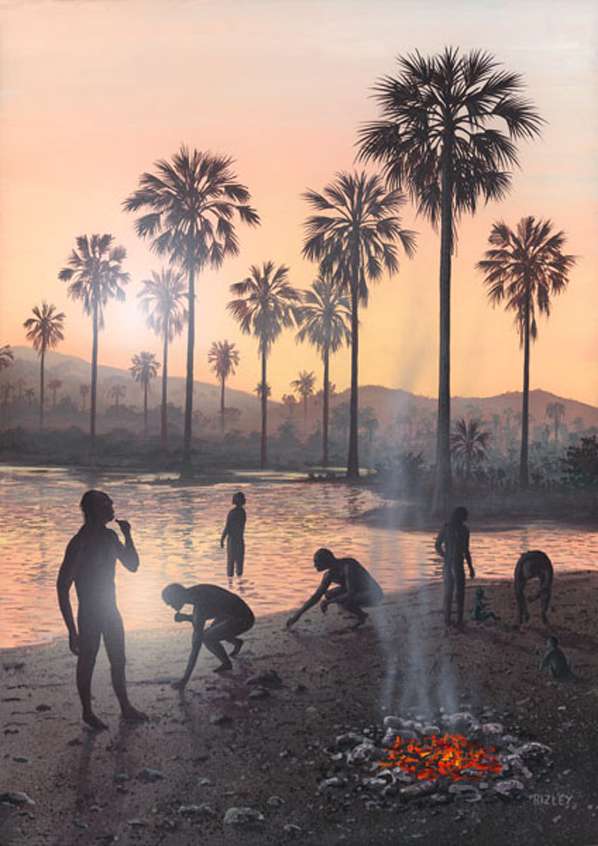
African Rift, Lake Turkana - Ileret footprints in mud 1.5ma, shellfish harvesting
picture
Apiths may have dug/finger-raked and consumed floating vegetation, shallow-shore tubers and shallow benthic invertebrates. But only genus Homo submerged fully while foraging, losing the laryngeal air sac and developing oral breathing and flatter hands and longer feet with short toes.
site habitat
"In 1984, the most complete hominin skeleton to date, KNM-WT 15000, was discovered eroding from a hillside at NK III. The specimen, which retained the skull and almost entire postcranial skeleton, belonged to a juvenile male Homo erectus/ergaster. Nicknamed the “Turkana Boy,” the specimen was determined to be 1.5 ma.
NK III site: Turkana Boy and fossil taxa include the freshwater stingray, Dasyatis Africana; the catfish, Synodontis; the extinct pig, Metrodiocherus; two extinct species of hippopotamus, Hippopotamus gorgops and H. aethiopicus; chelonian carapaces (turtle shells); some avian limb bones and phalanges; two species of bovid; sponge spicules; several species of ostracod (a crustacean); cichlids (a family of perciform fish); cyprinids (carps and minnows); and several varanids (monitor lizards). The paleoenvironment of the Nariokotome region during the time of the Turkana Boy has been reconstructed as a temporary marshland formed by the annual flooding of the Omo River with interspersed grassland and patches of woodland. One or more lakes were probably present as well."
anthro site history
-
Archaic Humans: Beavers & cleavers, sea waters & sea otters
Bilzingsleben, Germany, 325,000 years ago, microlith, pebble tools
Hoxne, England, 325,000 years ago - handaxes, extinct beaver, otter
Furze Platt, England, 325,000 years ago - large pointed handaxes, cleavers
Tan Tan, Morocco, 325,000 years ago - Mid Acheulian tools, female figurine
-
Beavers modify their habitat like humans do: Logging, Damming, Lodging
beavers arrested
-
here
A waterway linked the East African Rift Valley with the Indian Ocean 1.9ma, freshwater stingrays evolved there between 1.9 and 1.3ma after a marine incursion, the H erectus/ergaster skeleton Turkana boy was found there at waterside region. Probably Homo species, stingrays and 3 species of mollusks moved from Indian Ocean estuaries into the Rift valley lakes then, during a wet/high sea level period. The same time, Dmanisi, Georgia had H erectus/georgicus occupants living between the Caspian and Black seas. Tectonic plate collisions have uplifted the area since 1.8ma.
-
This site of early hominins is in Republic of Georgia, south of the Caucasus Mountains, east of the Black Sea, west of the Caspian Sea, on a wooded promontory surrounded by steep cliffs and water on three sides, that might have provided an ideal place to drive and ambush game.
Did they speak? Most likely they clicked & hummed/sang:
"
Meyer and his colleagues — David Lordkipanidze and Abesalom Vekua, both of the Georgian State Museum in Tbilisi — compared the size, shape, and volume of the Dmanisi vertebrae with more than 2 200 corresponding bones from people, chimpanzees, and gorillas.
"The Dmanisi spinal column falls within the human range and would have comfortably accommodated a modern human spinal cord," Meyer says.
Moreover, the fossil vertebrae would have provided ample structural support for the respiratory muscles needed to articulate words, he asserts. Although it's impossible to confirm that our prehistoric ancestors talked, Meyer notes, H. erectus at Dmanisi faced no respiratory limitations on speech.
In contrast, the 1984 discovery in Kenya of a boy's 1.6-million-year-old skeleton, identified by some researchers as H. erectus and by others as Homo ergaster, yielded small, chimplike vertebrae. Researchers initially suspected that the ancient youth and his presumably small-spined comrades lacked the respiratory control to talk as people do today." http://www.donsmaps.com/dmanisi.html
Old man with one tooth, cooking or shellfish food?
In the new work, David Lordkipanidze of the Georgian State Museum in Tbilisi and his colleagues describe a skull and jawbone from a hominid male who had lost all but one tooth. The tooth sockets had been resorbed into the skull, suggesting that he had lost the teeth several years before dying. The discovery represents the earliest case of severe masticatory impairment in the fossil record yet found, the researchers say.
Near the site of their latest find, the scientists also uncovered stone artifacts and animal bones with toolmarks on them. In order to survive without the ability to chew or bite meat, the gummy individual would have needed to collect sufficient soft food, including bone marrow, brain matter or soft plant food. Such gathering or processing could have been done alone, but the scientists posit that other individuals may have helped because of the individual's advanced age or illness, either of which could have been responsible for the loss of his teeth. The discovery, the authors conclude, "raises interesting questions regarding social structure, life history and subsistence strategies of early Homo that warrant further investigation." --Sarah Graham
Dmanisi site had both African ostriches, Kudaro macaques and short-necked giraffes and EurAsian wolves, sabercats and EurAsian beavers (skull wider than neolithic Polish beaver which were larger and faster growing than modern EurAsian beavers).
Simple stone pebble tools were used, probably with stick tools. http://www.pjoes.com/pdf/16.5/697-705.pdf
BUR CZAK-ABRAMOWICZ N. The beaver and some other interesting animals in Caucasus. Przegląd Zool. 8, 51, 1964. [in Polish]
Dmanisi seems to have dried out after the pliocene/pleistocene border.
Black Sea beaver species plentiful from Miocene to Pleistocene:
http://docs.google.com/viewer?a=v&q=cache:r7qdVn9-DEwJ:www.isez.pan.krakow.pl/journals/azc_v/pdf/52A(1-2)/52A(1-2)_05.pdf+caucasus+beaver+fossil&hl=en&gl=us&pid=bl&srcid=ADGEEShIHf6nddQWt5r5GQUHg1EpZtgR9lM5aujcurYqi6cwb_4Dx8GUHzXvAW6i5F_x9scKtiMZ-vgjm_PlJvLL8BFK1LhjPFoZpbgUifI-4kzwMxehiRhHHKFM6LGzuo_FxWDPRuwr&sig=AHIEtbTUnw9qk40z-qG1csiS_SzfF0K1TQ
Conjecture: ARC Diving was synchronized tandem Aqua-photic Respiratory Cycle dive foraging, when one partner dove down to the benthos the other backfloated above, communication was retained via clicks (at depth) and tones (at surface) which eventually merged to become uniquely human click-consonant tonal speech. ARC diving included in complement the Mammalian Diving Reflex (MDR), engaged upon submergence optimally conserving oxygen, the Photic Sneeze (or Surfacing) Reflex (PSR), engaged upon emergence at the surface, optimally exchanged carbon dioxide and oxygen-rich air. The combination of descent and ascent reflexes allowed sustained dive foraging for coastal seafood in sub/tropical lagoons, while seasonal inland freshwater herbs/rhyzomes were harvested by shoreside shallow wading, especially around Eurasian beaver-dammed woodland/wetland ponds and Peri-Tethyan estuaries. Caves and rockshelters offered sleeping sites in addition to wood-stick and reed-plastered dome huts.
-
Chicken pox can be spread by humans to apes, per a zoo account. Unknown if mumps are uniquely human, as I conjectured earlier.
-
Borneo frog breathes through skin, lost lungs, better hydrodynamics and less ascents.
A frog that breathes through its skin because it has no lungs, which makes it appear flat. This aerodynamic shape allows the frogs to move swiftly in fast flowing streams.
Neandertal face long, modern human face short: http://www.pnas.org/content/100/14/8142.abstract
Showing posts with label marine. Show all posts
Showing posts with label marine. Show all posts
Sunday, April 11, 2010


Wednesday, December 16, 2009
Skull density in hominids
Gauld SC 1996 AJPA 100:411-426
Allometric patterns of cranial bone thickness in fossil hominids
Skull thickness in He is more than twice that of other primates of
comparable body size, Hn is intermediate, Hs is still above most other
primates, and A.africanus is somewhat above other equally-sized primates,
but I need more figures of other apiths, esp. robust ones.
Extraordinarily thick skull vaults are typically (AFAIK exclusively) seen in
shallow slow parttime diving animals. Slow divers in sea water (density c
1.024) are expected to have much thicker skulls than those in freshwater.
Alan Shabel found that in dentitions & enamel thickness apiths resembled
mungoes & other carnivores that fed (partly) on hard-shelled invertebrates.
Might africanus (& other apiths??) have parttime dived (or ducked) for
bottom shell+crayfish in the wetlands & swamp forests where they lived??
We need a lot more measurements of skull thicknesses esp. of fossil
hominids, but also of other animals.
I made a graph (somebody did it for me) with
- x-axis = the cubic root of the body weight of different primate spp,
- y-axis = their skull thickness.
It was almost a straight line, with small spp a bit below that line,
medium-sized a bit above (esp.orang & chimp), and very large ones (gorilla)
a bit lower.
But there were 3 obvious exceptions:
- He was far above that line (but it might have been heavier than the usual
estimation of c 50 kg),
- Hs was clearly above it,
- A.africanus was also clearly above it (depending on its body weight, which
might be a bit higher IMO than usu.estimated).
Other data suggest Hn was intermediate between He & Hn, but I still lack
enough comparable data on apiths, Ardipith etc.
Does anybody know where to find more data? MV @ AAT
-
This fits the pattern -
early hominoid, foraging on pond surface AHV aquatic herbs, congo lowland gorillas raking high-protein hydrocharis and yanking up sedges for their rhyzomes, not dunking their faces nor seeking benthic foods, with large inflatable laryngeal air sacs for partial flotation, with lightweight skulls. Apith afarensis similar, but in Rift valley, less fruit trees, more sedges.
Apith africanus ate more water lily rhyzomes, reaching below water so smaller air sacs and denser skull, more invertebrate foods crayfish/snails and small vertebrates, more high fruit trees. Rift - So. Africa shallow lakes?
Human ancestors similar, but more tidal saltwater, lost air sacs and gained dense skull, ate tidal mangrove oysters at lagoons, more shrub berries, less high fruit trees, Medit. zone?
-
Myrica gale is a flowering plant native to Europe, with sweet resinous scent, and is a traditional insect repellent, used by campers to keep biting insects out of tents. Sweet Gale can grow in a narrow band in the intertidal zone, especially if it has some logs, washed down into the estuary on which to establish itself. It is a favorite food of beavers and low beaver dams can be found in the intertidal zone if sufficient sweet gale is present. The ponds thus formed are often completely submerged at high tide but retain water at low tide and provide deep enough water to provide a refuge for fish, including juvenile salmon where the water is too deep for predation by wading birds. wiki
-
Ear wax & Scent: Difference of appocrine sweat glands in Europeans, Africans and Asians
scent, ear wax
rice, milk, alcohol in ancient Eurasians
-
Gorilla hybrids, Ardi party @ Lawnchair anthropology
-
Molars in hominoids
Gorilla and chimp molars evert earlier than orang and human due to more forest ground foraging (parallel with knucklewalking), orang probably has primitive hominoid condition, human also but even more so do to beaver lodge - hut/cave nesting & aquatic foraging & mainly food processing & cooking.
Speaking of dense bones and waterside herbivores, article on neolithic dugong & fishing rituals:
http://gulfnews.com/news/gulf/uae/general/excavation-uncovers-ritual-site-1.523925
Wednesday, October 8, 2008
Princess Taiping arrives, departs

http://www.times-standard.com/ci_10657648?source=most_viewed
The junk "Princess Taiping" arrived here in Kuala Walu Wiki (Humboldt Bay) from Taiwan yesterday, and is now sailing to San Francisco. Junk is derived from the Javanese word Jong (ship with slatted sails).
http://www.youtube.com/watch?v=w_AmSgeAzW4
A central Vietnam Champa boat sailing and bailing
http://www.youtube.com/watch?v=9x-2ndRzoHA
Saturday, July 5, 2008
Local - Eureka, Humboldt, California coast


Local beaches & lagoons geology/hydrology (note photos at bottom right)
http://www.northcoastjournal.com/issues/2008/07/03/lagoons-and-beaches/
Local swimming pools closing? http://www.northcoastjournal.com/issues/2008/06/19/pool-stories/
Swimming great exercise, but doesn't reduce fat, so cross-train with jogging, walking.
http://www.northcoastjournal.com/issues/2008/07/03/everybody-pool/
Eureka is 8th best town in America? (BUT water is too cold! I'd rather be tropical.)
http://ncjournal.wordpress.com/2008/06/27/eureka-declared-one-of-the-best/
Saturday, November 17, 2007
Earth = Home. Can't just throw it away & buy a new one.

Videos, pics, articles on human ancestry along sea coasts and whale evolution
humans and dolphin link
Some of the lines of Siddhidas Mahaju(N.S.987-N.S.1050) read as follows
सज्जन मनुष्या संगतनं मूर्ख नापं भिना वै
पलेला लपते ल वंसा म्वति थें ल सना वै
which state that even a moron can improve with the company of good people just like even a drop of water appears like a pearl when it descends upon the leaves of a lotus plant.
(my last blog post for now, can't predict the future)
Thursday, July 26, 2007
Marine Bio Lab established at Gulf in Dubai

http://www.deeperblue.net/newsfull.php/1538
Dubai: A marine biology laboratory is being developed by real estate giants Nakheel and the United Nations University to enhance environmental monitoring of the Arabian Gulf and assess water quality. The United Nations University - International Network for Water, Environment and Health (UNU-INWEH) is a United Nations entity created to strengthen global water management capabilities.
A Memorandum of Understanding was signed between Nakheel and Environment Health and Safety (EHS), the regulatory arm of Dubai World to sustain the analysis undertaken across all Nakheel marine developments.
UNU-INWEH will train staff on the latest ecological monitoring technology and provide unbiased and objective analysis. The new marine biology laboratory, and major new analytical instrumentation at the existing lab, EHS will have the resources needed for coastal monitoring activities in Dubai waters and the wider region.
Coral Reef Monitoring at Dubai UAE in association with World Wildlife Fund and Nat'l Coral Reef Ctr in Florida
http://forums.deeperblue.net/travel-places-dive/72786-coral-reef-monitoring-fujairah.html
Subscribe to:
Posts (Atom)