"Intensive woodworking and tree-felling was a phenomenon that only appeared with the onset of the major changes in human life, including the transition to agriculture and permanent villages," says Dr. Barkai, whose research was published in the journal PLoS One. Prior to the Neolithic period, there is no evidence of tools that were powerful enough to cut and carve wood, let alone fell trees. But new archaeological evidence suggests that as the Neolithic age progressed, sophisticated carpentry developed alongside agriculture.
http://www.eurekalert.org/pub_releases/2012-08/afot-nmt080912.php
Evolution of axes
The use of functional tools in relation to woodworking over the course of the Neolithic period has not been studied in detail until now. Through their work at the archaeological site of Motza, a neighbourhood in the Judean Hills, Dr. Barkai and his fellow researchers, Prof. Rick Yerkes of Ohio State University and Dr. Hamudi Khalaily of the Israel Antiquity Authority, have unearthed evidence that increasing sophistication in terms of carpentry tools corresponds with increased agriculture and permanent settlements.
The early part of the Neolithic age is divided into two distinct eras — Pre-Pottery Neolithic A (PPNA) and Pre-Pottery Neolithic B (PPNB). Agriculture and domesticated plants and animals appear only in PPNB, so the transition between these two periods is a watershed moment in human history. And these changes can be tracked in the woodworking tools which belong to each period, says Dr. Barkai.
Within PPNA, humans remained gatherers but lived in more permanent settlements for the first time, he says. Axes associated with this period are small and delicate, used for light carpentry but not suited for felling trees or other massive woodworking tasks. In PPNB, the tools have evolved to much larger and heavier axes, formed by a technique called polishing. The researchers' in-depth analysis of these tools shows that they were used to cut down trees and complete various building projects.
"We can document step by step the transition from the absence of woodworking tools, to delicate woodworking tools, to heavier woodworking tools," Dr. Barkai says, and this follows the "actual transition from the hunter-gatherer lifestyle to agriculture." He also identifies a trial-and-error phase during which humans tried to create an axe strong enough to undertake larger woodworking tasks. Eventually, they succeeded in creating a massive ground stone axe in PPNB
.
Home makeover
Whether the transition to an agricultural society led to the development of major carpentry tools or vice versa remains to be determined, says Dr. Barkai, who characterizes it as a "circular argument." Whatever the answer, the parallel changes led to a revolution in lifestyle.
Beyond the change from a hunter-gatherer to an agricultural economy, a new form of architecture also emerged. Not only did people begin to live in permanent villages, but the buildings in which they lived literally took a different shape. The round and oval structures of earlier domiciles were replaced by rectangular structures in PPNB, explains Dr. Barkai. "Evidence tells that us that for each home, approximately 10 wooden beams were needed. Prior to this, there were no homes with wooden beams." In addition, humans began to produce limestone-based plaster floors for their homes — which also represented a growing use of wood, since plaster is manufactured by heating limestone.
These architectural developments, along with building pens and fences for domesticated animals, also necessitated the felling of trees in large quantities.
Showing posts with label traditional human technology. Show all posts
Showing posts with label traditional human technology. Show all posts
Thursday, August 9, 2012


Wednesday, April 25, 2012
Archaic Belts: functions
I'm asking for some input. I just connected some ideas relating to the archaic use of belts:
Indian guy climbing tall coconut tree with ankles bound, crawling like an 'inchworm' up the tree. (30 sec. video) [When in Malaysia, I tried climbing a coconut palm but failed, I hadn't known this trick.]
http://www.youtube.com/watch?v=KgW-926XtFs&feature=related
Chinese girl swimming dolphin-style with ankles bound so as to allow 'dolphin tail' undulations.
http://the-arc-ddeden.blogspot.com/2007/10/10-year-old-chinese-girl-dolphin.html
[River dolphins in Yangtze river, dugongs as visual model for early human swimmers?]
Wrist bracelets/necklaces/vests/skirts with shells, beads, holed coins as visible wealth and counters (primitive abacus/calendar such as a thread bracelet with 28 beads to represent lunar month).
Diving belt: kelp/vine/water lily stem or folded cloth sarong (linen/silk/palm fiber/pounded tree bark (tapa cloth of Hawaii/Samoa); wrapped (rappel?) / lashed (leash?) around belly/shoulders/calves (depending on function)
-notched & clipped mongongo or salt-crusted mangrove leaves for hut shingles (origin of salt trade, barter gift exchange between women who constructed their own dome huts)
-net (or skin) bag/basket clipped/strung to belt to hold foods/shells or as woven or inflated floating basket
-used around calves as coconut palm climbing strap (cloth tube sarong not knotted, depends on fiber friction)
-used around ankles as dolphin tail for more efficient long-term swimming (not short dives)
-used as baby backpack (I saw an Indonesian woman swaddle her infant in a square cloth, piggy-back style, then easily switch to nursing postion, far more simply practical than today's baby backpacks)
-used to hold short sharp (bamboo) stick spear/prybar and flint/razorclam blade, hand-axe holder/handle/hook while swimming/climbing/walking to keep hands and legs free for movements.
-AmerIndians used wampum belts of shells on strings: http://en.wikipedia.org/wiki/Wampum
for quipu, tokens and memory devices, highly valued. Other materials used porcupine quills. pounded goldleaf etc.
http://tech.groups.yahoo.com/group/AAT/message/364
-possibly after deep dive descent (while negatively buoyant) a (woven short sarong/skirt) could open parachute-like between ascending strokes to slow descent and then close during each arm/leg stroke phase to allow faster ascent. (from DeeperBlue.com message: This is how a dive works: Because of the air in our lungs, we are buoyant on the surface and remain so until about fifteen metres. The weight that a constant-weight diver wears around the neck helps him or her overcome the resistance at this depth. (Campbell wears about four pounds.) Between fifteen and thirty metres, most people are neutrally buoyant, and after thirty metres they are negatively buoyant, which means they sink. "Deeper than thirty metres, nobody swims," Marco Nones, a dive instructor in Sharm al-Sheikh, told me. "Fall down, fall down. Every diver slips." At the bottom of a deep dive, a diver is very heavy, because the lungs are so radically contracted. To return to neutral buoyancy, he must labor against this. Sometimes, on no-fins dives, he actually sinks while gliding between strokes and has to work to recover lost ground.
http://forums.deeperblue.com/general-freediving/84091-deepest-dive-new-yorker-article-sara-campbell.html.
When ascending at depth, one can't just propel up, one must brake downwards gravity effect, to stop sliding back down. This is like climbing a coconut palm tree without a foot strap, one tends to slip downwards after each step up, unlike climbing a ladder where you ratchet upwards each step and can't sink down (more like wearing long fins or monofin). One must brake the fall between strokes while allowing the glide up.
Any momentary rest, one must slow the descent by parachuting like a jellyfish*, or by becoming more horizontal. Probably spiral climbing is more efficient, like a tight corkscrew, each hand stroke vertically pulled down and pushed down but finished with horizontal outward flick to brake a second, then pulling hands inwards (and downwards slightly) and then forwards smoothly along body to far front and flick out hands again to brake before doing another stroke.
DDeden
Indian guy climbing tall coconut tree with ankles bound, crawling like an 'inchworm' up the tree. (30 sec. video) [When in Malaysia, I tried climbing a coconut palm but failed, I hadn't known this trick.]
http://www.youtube.com/watch?v=KgW-926XtFs&feature=related
Chinese girl swimming dolphin-style with ankles bound so as to allow 'dolphin tail' undulations.
http://the-arc-ddeden.blogspot.com/2007/10/10-year-old-chinese-girl-dolphin.html
[River dolphins in Yangtze river, dugongs as visual model for early human swimmers?]
Wrist bracelets/necklaces/vests/skirts with shells, beads, holed coins as visible wealth and counters (primitive abacus/calendar such as a thread bracelet with 28 beads to represent lunar month).
Diving belt: kelp/vine/water lily stem or folded cloth sarong (linen/silk/palm fiber/pounded tree bark (tapa cloth of Hawaii/Samoa); wrapped (rappel?) / lashed (leash?) around belly/shoulders/calves (depending on function)
-notched & clipped mongongo or salt-crusted mangrove leaves for hut shingles (origin of salt trade, barter gift exchange between women who constructed their own dome huts)
-net (or skin) bag/basket clipped/strung to belt to hold foods/shells or as woven or inflated floating basket
-used around calves as coconut palm climbing strap (cloth tube sarong not knotted, depends on fiber friction)
-used around ankles as dolphin tail for more efficient long-term swimming (not short dives)
-used as baby backpack (I saw an Indonesian woman swaddle her infant in a square cloth, piggy-back style, then easily switch to nursing postion, far more simply practical than today's baby backpacks)
-used to hold short sharp (bamboo) stick spear/prybar and flint/razorclam blade, hand-axe holder/handle/hook while swimming/climbing/walking to keep hands and legs free for movements.
-AmerIndians used wampum belts of shells on strings: http://en.wikipedia.org/wiki/Wampum
for quipu, tokens and memory devices, highly valued. Other materials used porcupine quills. pounded goldleaf etc.
http://tech.groups.yahoo.com/group/AAT/message/364
-possibly after deep dive descent (while negatively buoyant) a (woven short sarong/skirt) could open parachute-like between ascending strokes to slow descent and then close during each arm/leg stroke phase to allow faster ascent. (from DeeperBlue.com message: This is how a dive works: Because of the air in our lungs, we are buoyant on the surface and remain so until about fifteen metres. The weight that a constant-weight diver wears around the neck helps him or her overcome the resistance at this depth. (Campbell wears about four pounds.) Between fifteen and thirty metres, most people are neutrally buoyant, and after thirty metres they are negatively buoyant, which means they sink. "Deeper than thirty metres, nobody swims," Marco Nones, a dive instructor in Sharm al-Sheikh, told me. "Fall down, fall down. Every diver slips." At the bottom of a deep dive, a diver is very heavy, because the lungs are so radically contracted. To return to neutral buoyancy, he must labor against this. Sometimes, on no-fins dives, he actually sinks while gliding between strokes and has to work to recover lost ground.
http://forums.deeperblue.com/general-freediving/84091-deepest-dive-new-yorker-article-sara-campbell.html.
When ascending at depth, one can't just propel up, one must brake downwards gravity effect, to stop sliding back down. This is like climbing a coconut palm tree without a foot strap, one tends to slip downwards after each step up, unlike climbing a ladder where you ratchet upwards each step and can't sink down (more like wearing long fins or monofin). One must brake the fall between strokes while allowing the glide up.
Any momentary rest, one must slow the descent by parachuting like a jellyfish*, or by becoming more horizontal. Probably spiral climbing is more efficient, like a tight corkscrew, each hand stroke vertically pulled down and pushed down but finished with horizontal outward flick to brake a second, then pulling hands inwards (and downwards slightly) and then forwards smoothly along body to far front and flick out hands again to brake before doing another stroke.
DDeden
Wednesday, February 15, 2012
Tent stakes
-referencing:
http://www.metmuseum.org/toah/hd/malt/hd_malt.htm
http://en.wikipedia.org/wiki/Mal
http://en.wikipedia.org/wiki/File:Buretj_(venus_figurine).gif
http://news.bbc.co.uk/2/hi/south_asia/4381893.stm
"There are many interpretations of the figurines, often based on little argument or fact. Like many prehistoric artifacts, the cultural meaning of these figures may never be known. Archaeologists speculate, however, that they may be emblems of security and success, fertility icons, pornographic imagery, or even direct representations of a mother goddess or various local goddesses. The female figures, as part of Upper Palaeolithic portable art, appear to have no practical use in the context of subsistence. They are mostly discovered in settlement contexts, both in open-air sites and caves; burial contexts are much more rare.
At Gagarino in Russia, seven Venus figurines were found in a hut of 5 m diameter; they have been interpreted as apotropaic amulets, connected with the occupants of the dwelling. At Mal'ta, near Lake Baikal, figurines are only known from the left sides of huts." (wikipedia)
[I think a typical couple's hut had 2, a female venus figurine at left of doorway, a male bird/phallus figurine at right of doorway, both acting as ritual symbolic tent stakes/house posts/totem poles. Possibly the male figurine was kept outside the entry at right, the female figurine just inside at left.]
"unlike those found in Europe, some of the Venus figurines from Mal’ta were sculpted with faces. Most of the figurines were tapered at the bottom, and it is believed that this was done so they could have been stuck into the ground or otherwise placed upright some other way."
This "Tibetan ancient tent peg" has some resemblance to the Mal'ta male & female figurines of ivory, has any similar items been found in Altai or Beringia?
http://alphaclassics.com/product_info.php?cPath=22_31&products_id=136
Except for scale it appears to resemble west coast totem poles:
http://upload.wikimedia.org/wikipedia/commons/thumb/3/32/Wrangell_Kiksadi_Totem_Pole.JPG/250px-Wrangell_Kiksadi_Totem_Pole.JPG
A Tlingit totem pole memorializing a woman (note closed wings, perhaps open wings represent male (cf etymology of ball & wing very similar pali/pari/pela, both fly, both related to 'pair').
http://www.historylink.org/index.cfm?DisplayPage=output.cfm&file_id=2076
" The word totem is derived from the Ojibwe word odoodem, "his kinship group"" (wikipedia) [also odoodeman]
totem
"animal or natural object considered as the emblem of a family or clan, 1760, from Algonquian (probably Ojibwa) odoodeman "his sibling kin, his group or family," hence, "his family mark;" also attested in French c.1600 in form aoutem among the Micmacs or other Indians of Nova Scotia. Totem pole is 1808, in reference to west coast Canadian Indians."
[Very interesting etymology, possibly linked to 'awtad', 'doodad', 'wood', dado (wood cutting blade), dem-duom-domus-home; in many nomad H&G cultures, the woman is responsible for hut/tipi/tent construction, while in sedentary agricultural cultures the man is the home builder while the woman is the caretaker/homemaker.]
The ancient Egyptian djed/tet column was raised annually, symbollically by the Pharoah who had the was staff.
Very likely the European Maypole was based on similar rituals long ago. Compare to the winter yule log and the standing tannenbaum/christmas tree. Perhaps the new (Swedish) midsummerstang/(Dutch/German) maisbaum/(Anglo Saxon) maegbole/(English) maypole was the dried-out tannenbaum of last winter (trimmed of needles and branches and with added symbols/feathers/ribbons), which then became the next winters yule log? This would provide a sensible recycling notion, but I don't know if it was actually done, perhaps authorized and administered by Druids? (Druids: forest-priest watershed managers, see earlier post on Ethiopian church forests). This would parallel the Egyptian priests involved with the Pharoah's djed column raising. The recent cultural practice of girls weaving ribbons around the Maypole might descend from ancestral nomadic (eg. Beduin-like) girls pounding the stakes of the goat-hair tent, while men lifted the poles.
http://en.wikipedia.org/wiki/Yule_log
." James George Frazer in his work on anthropology, The Golden Bough (p. 736) holds that "the ancient fire-festival of the winter solstice appears to survive" in the Yule log custom. Frazer records traditions from England, France, among the South Slavs, in Central Germany (Meiningen) and western Switzerland (the Bernese Jura).
My opinion: Note that tent stake was a kinship signal was traditional for archaic nomadic Hebrew/Arab tent dwellers, and that large totem poles are found only associated with people who lived in split plank houses, not tent/ tipi dwellers. The tent stake signalled "I/we dwell here" (temporary land ownership), and so did the totem pole. Perhaps the narrow figurines indicate active tent use (functional), while fat figurines indicate cave or timber shelters (lost function). Many ornately carved ivory/bone/wood figurines/Venuses/Dakota peace pipes/ritual spears may have originated as kinship signals/symbols, and only later (or never except as interpreted by extra-cultural observers?) became 'spirit/goddess' idol/symbols.
"And, while 18th-century accounts of European explorers along the
coast indicate that poles existed prior to 1800, they were *smaller*
and few in number. The freestanding poles seen by the first European
explorers were likely preceded by a long history of monumental
carving, particularly of interior house posts. The scholar Eddie Malin
has proposed that totem poles progressed from house posts, funerary
containers, and memorial markers into symbols of clan and family
wealth and prestige. He argues that the Haida people of the Queen
Charlotte Islands originated carving of the poles.." (wikipedia)
So were Mal'ta figurines equal to tent stakes & totem poles, or were they dolls, idols or sex objects or what?
Social markers (sign/signal/symbol) identifying spatial/temporal ownership & position within the community seems to be the original function.
Note that at Medit. island of Malta, more venuses existed much later.
Possibly: Mal'ta was old word for "waterside trade dwelling", equal to Ma'dan, Mandan (both used boats & hunted buffalo)
Among great plains Amer Indians, women assembled to craft the Tipi cover, and set it.
Among Beduin tent dwellers: young girls pound in the tent pegs, men lift the poles.
"In Genesis 3:15 God declares that the Woman will bring forth the Seed who will crush the Serpent's head" (just genesis blog)
tent, serpent, tent peg, serpent head ?
(Mal'ta site had a carving of 3 snakes with large cobra heads)
http://donsmaps.com/images24/maltahermitageplateback.jpg
Compare words: stick/stake/(strength/string) snake/rake/peck/peg/pick/pike/spike/spigot/
dig/pig/pin/punji/punt/poke/push/pull/plug/pluck/plow (bullocks pulling plows originated from pegs driven into soil and sharpened sticks used to pull up tubers, related to pig cloven/claw hoof), and paralleling pig was hog/hock/hoof/hook/crook/hoe/hole/hoick/hoist, related to peg insertion & removal.
Pharoah of Egypt: translated as "great house" or "Dominion of the tent stake" Awtad
"‘Awtad’ comes from the Arabic Root: 'WAW-TA-DAL' [note phonetic similarity to awl, idol & doll] which does indeed mean: Stakes, Pegs, Tent Poles or to drive in a stake (into ground or wall) as a literal understanding."
http://quransmessage.com/articles/pharaoh%20-%20lord%20of%20the%20stakes%20or%20pyramids%20FM3.htm
http://donsmaps.com/images11/malta0203.jpg notice photo of people next to "totem pole?" at Mal'ta site.
OBeLisK (OBa [Lith=stone] (am)?), SHiVa LingG(am), Totem pole (OD ooD(em)), Abrams' father Terah's ((O? al?)TeRaPH(im)), similar sounds (doll, idol to "-adal"), all derived from the ancestral humble tent peg (awtad, wAWTaDaL). Note too the similarity in sound in English of mother goddess, mothers' address and home post (-box) & host & guest. Compare Micmac 'aoutem' (kin) to both Eskimo dogsled (komatik) & Cree dog (atim) as that used to pull family's property.
English maypole from maeg bole (kin beam) paralleling Dutch/German mais baum. Bole/bone (rib)/boom/beam used in tents, huts, sleds & boats.
Between Arab awtad and Micmac autim we find English taut/tie/tether (bind) and knot/naut, and in Tamil katu (bind, as in katumaram-catamaran: bound logs) and nao/prahu (boat), and Malay tali (rope) and perau (boat).
Cupola (inverted 'cup-bowl' above roof, chimney cover) relates to BaMbuti mongolu and Sanskrit bungalo dome huts, derived via qupholu/kebhala or so (Persian qupha = bowlboat, Greek hoplon = round shield), where initially the 'cup-bowl' was a portable open round basket & later hidebound roundshield/bullboat.
In Japan, the red Shinto shrine gates are torii, in India, Buddhist temple gates are toran, and in the Jewish torah (see previous post), all represent the (communal) entry (door way/portal), just as the ritually carved symbolic house post/tent peg represented the front door entrance.
Anubis amulets (Amu(rru)/Anu?) of Egypt, probably via Syria/Slovenia:
http://www.flickriver.com/photos/25396001@N04/4248506587/
((D)Anubians: from Blue Danube of Slovenia (Swabia-Slavia) & Anu (Lake Tana & Tana delta) of Blue Nile of Nubia, J(Y)ordan, Sud(d)an, Aldan/Jana rivers of east Siberia, Danes of Denmark, Swedes of Sweden), Ma'dan, Mandan, Dhannu/Denu (OE & Sanskrit) river shore floodplains/terraces/traders.
Compare Anubis 3ka to Lion Man of Hohlenstein (possibly brought from Africa?) cave 32ka:
http://en.wikipedia.org/wiki/File:Anubis_standing.svg
http://www.showcaves.com/english/explain/Archaeology/Loewenfrau.html
Anubis: Associated with funeral/grave/mummification
(Note right hand holds was tent peg remover? Jackal form from older cave lion form (sphynx)?
http://en.wikipedia.org/wiki/Anubis
http://en.wikipedia.org/wiki/Lion_man_of_the_Hohlenstein_Stadel
In N America, the Plains Cree people called the travois-pulling dog atim, [note pole/pull/pulka 1/2sledge-1/2boat of Volga/Bulghar/Saami], the horse misatim "big dog", while the James Bay Cree called the lion misatim. So the Egyptian jackal form of Anubis may have transformed from the ancient cave lion in mythology.
http://moniyawlinguist.wordpress.com/2010/12/27/atimw-animal-that-pulls-your-stuff/
Note bowl/dome basket/hut/boat on travois. Early form of Eskimo sled komatic or Lapp pulka sledge-boat?
http://www.sila.nu/data?atom_id=dogsled_entry&l=en
Komatic: eskimo dog sled ("kam-u-tic")
Kom: (old Dutch) bowl cf kofa/qufa roundboat, koppe/cup
-atic? related to atim?
Northern Plains Cree people called the travois-pulling dog atim ("u-tim")
Choctaw of lower Mississippi: itti homma = boundary marker pole/tree painted red
Muskogee of Florida: yat kitischee = red people (ochre?)
Hebrew, 'staff of life/bread' = matteh lechem http://concordances.org/hebrew/4294.htm
Oldest wheel & axle found in Slovene Ljubjanska/Lyubyana swamp/lake 5.3ka (same neolithic period as Otzi the ice man mummy found 150 miles away), note similarity to travois, but employed "pegs/pins" to hold square axle onto frame allowing rotation of both wheel and axle:
http://www.slovenia.info/pictures%5CTB_attractions%5C1%5C2011%5Ckolo_19.7.2011_351550.jpg
Teraph, Teraphim: Abram's father Terah, before written language, carved figurines represented home dominion & land ownership, later household "idol" or even 'gods', originally from tent pegs.
http://www.biblepicturegallery.com/pictures/pagang/Statuettes%20of%20pagan%20deities%20excavated%20in%20Palestin%20pa.htm
http://www.bible-history.com/ibh/Egyptian+Gods/Teraphims/Teraphim+Figures
(note the was tent peg remover in hand, resemblance to a nail-pulling hammer-claw)
http://jandyongenesis.blogspot.com/2008/12/teraphim-of-genesis-31.html
http://www.google.com/imgres?imgurl=http://www.biblepicturegallery.com/thumbs/la/world/worship/pagan/p_gods/Palestinian%2520Teraphim%2520or%2520household%2520gods.jpg&imgrefurl=http://www.biblepicturegallery.com/pictures/pagang.htm&usg=__u8Adz0orFHKY_J_BhD8Yy4gTstc=&h=120&w=160&sz=4&hl=en&start=3&sig2=4Ph241K-jQfYszCLrj_mCA&zoom=1&tbnid=TvF9HpGyZZ3GwM:&tbnh=74&tbnw=98&ei=TxY8T5HZNo_AtgeCponoCg&prev=/search%3Fq%3Dteraphim%26um%3D1%26hl%3Den%26sa%3DN%26rls%3Dcom.microsoft:en-us%26tbm%3Disch&um=1&itbs=1
(Terah/Terai valley of Nepal terraced taro fields (1st agriculture in Papua) gradually became over run by weedy rice which became the staple, Nepali totems (lingam)
Shivalingam: (note phonetic similarity to 'shaft')
http://en.wikipedia.org/wiki/File:Nepalese_stone_linga_SF_Asian_Art_Museum.JPG
Oba (Yoruba, 'God' cf Russian 'Bog', God)
YHWH/YaHWeH/JeHoVaH (JaH ObaH?)/YesHuWaHa/YesHiVa/Shiva in the same dialectical pattern as we see in LeViTiCus/VaTiCan/VeDiC-MeDiCal/MuSiCal/MyThiCal/MaGiCal; when associated with VeNeTian/VoYaGer/ViKinGer/DaNuBian/PhoeNiCian/PuNiC/FinNiC/AiNu produces a (textile or hide-skinned) summer-tent-based nomadic herd hunting salmon/tuna fishing diaspora with female built sites, peg/post addresses, and a proto-law/medicine system. Veni, Vidi, Vicci!
The letter WaW in Hebrew is a picture of a tent stake, my name in Arab/Hebrew is Daud ~ Dawood which uses WaW after the Da-. In Chinese, Da-wei. In English, David.
Egyptian symbols from nomadic tent past: djed/tet symbol from beduin tent stake, was symbol from tent stake remover, ankh as knot of rope around stake (originally tendon?).
http://www.crystalinks.com/djed.html
Tents derived from hides draped over wigwam/mongolu dome huts where fat & meat was scraped off, then hide was inverted & dried, giving warmth to dwellers in areas outside the tropical rainforests. Tendons/vines held the skins over the wicker frame (first bull/bowl boats), later portable stakes were used/carried in more open tree-less plains country, where the woven wicker frame was replaced by straight poles, pulled behind with the leather cover.
Ancient Hebrew table was a round leather hide on the ground which people sat around.
Is there a link between Komi-Zyrian people of arctic Russia and bowl-boat-using Syrians of Tigris?
http://en.wikipedia.org/wiki/Komi-Zyrian_language
http://llmap.org/languages/kpv.html
related to Finnic & samoyed, name intriguing, related to Hurrian/Assyrian/Syrian?
Syr-yan (cf jor-dan) related to Yana/Jana/Aldana in Siberia etc.?
Did "Sumerian" derive from Su-mer-yana (south mer delta?) or Samoyen/Saamyan? Sumerians are said to have come earlier from the north, they were not Semites.
saami (Lapps of Finland), komi related? three of them are Uralic: Hungarian, Permic Zyrian Komi and Samoyedic Nenets
Beehive dome house of Caddo:
http://caddolegacy.com/grassthatchedhouses.aspx
Investigating whether "Maypole" is a cognate to totem pole/shivalingam/obelisk/tent peg:
apparently so, but the definition changed when Christianity became dominant in Europe. Probably derived from maeg-bole? (cf proto germanic mais baum) "kin tree/beam". The English word tree bole may have been from earlier woven wicker & hide bowl boats (parical/coracle/cup/qufa) being replaced by streamlined shallow dugout canoes cut from tree trunks (compare Dutch kom (bowl) to Dutch boom (tree, pole, beam)
boom (n.)
"long pole," 1540s, from Scottish boun, borrowed from Du. boom "tree, pole, beam," from a M.Du. word analogous to O.E. beam (see beam).
bowsprit
"spar extending from the bow of a ship," late 13c., probably from M.L.G. bochspret, from boch "bow of a ship" (see bow (n.2)) + spret "pole" (cf. O.E. spreot "pole," Du. spriet "spear;" see sprit).
Baton Rouge
city in Louisiana, U.S., a French translation of Choctaw itti homma "red pole," perhaps in reference to a painted boundary marker. [compare to Red Wing & Mississippi river Indians painting red on trees]
yard (2)
"measure of length," O.E. gerd (Mercian), gierd (W.Saxon) "rod, stick, measure of length," from W.Gmc. *gazdijo, from P.Gmc. *gazdaz "stick, rod" (cf. O.S. gerda, O.Fris. ierde, Du. gard "rod;" O.H.G. garta, Ger. gerte "switch, twig," O.N. gaddr "spike, sting, nail"), from PIE *gherdh- "staff, pole" (cf. L. hasta "shaft, staff").
windlass
device for raising weights by winding a rope round a cylinder, c.1400, alteration of wyndase (late 13c.), from Anglo-Fr. windas, and directly from a Scandinavian source such as O.N. vindass, from vinda "to wind" (see wind (v.)) + ass "pole, beam."
totem
animal or natural object considered as the emblem of a family or clan, 1760, from Algonquian (probably Ojibwa) odoodeman "his sibling kin, his group or family," hence, "his family mark;" also attested in French c.1600 in form aoutem among the Micmacs or other Indians of Nova Scotia. Totem pole is 1808, in reference to west coast Canadian Indians.
palanquin
"a covered litter," 1580s, from Port. palanquim (early 16c.), from Malay and Javanese palangki, ultimately from Skt. palyanka-s "couch, bed, litter," from pari "around" + ancati "it bends, curves," related to anka-s "a bend, hook, angle," and meaning, perhaps, "that which bends around the body." Some have noted the "curious coincidence" of Sp. palanca, from L. phalanga "pole to carry a burden."
stake (n)
"pointed stick or post," O.E. staca, from P.Gmc. *stakon (cf. O.N. stiaki, Du. staak, Ger. stake), from PIE root *steg- "pole, stick."
pig
probably from O.E. *picg, found in compounds, ultimate origin unknown. Originally "young pig" (the word for adults was swine). Another O.E. word for "pig" was fearh, related to furh "furrow," from PIE *perk- "dig, furrow" (cf. L. porc-us "pig," see pork).
spigot
late 14c., "plug used to stop the hole of a cask," probably from O.Fr. *espigot (cf. Gascony dialect espigot "core of a fruit, small ear of grain"), dim. of O.Prov. espiga "ear of grain," from L. spica "ear of grain" (see spike (n.2)).
taut
early 14c., tohte, possibly from tog- [compare to 'dog'], pp. stem of O.E. teon "to pull, drag," from P.Gmc. *tugn, from [IMO unlikely] PIE *deuk- "to lead" (see duke).
tone
mid-14c., from O.Fr. ton (13c.), from L. tonus "a sound, tone, accent," lit. "stretching" (in M.L., a term peculiar to music), from Gk. tonos "vocal pitch, raising of voice, accent, key in music," originally "a stretching, taut string," related to teinein "to stretch" (see tenet).
string (n.)
O.E. streng "line, cord, thread," from P.Gmc. *strangiz (cf. O.N. strengr, Dan. streng, M.Du. strenge, Du. streng, O.H.G. strang, Ger. Strang "rope, cord"), from *strang- "taut, stiff," from PIE root *strenk- "tight, narrow; pull tight, twist" (see strain). Gradually restricted by early M.E. to lines that are smaller than a rope. Old English meaning "ligaments, tendons" is preserved in hamstring, heartstrings.
Eskimo skin boat being transported over ice on sleds, childrens, adults:
http://tycoontalk.freelancer.com/photography-forum/148118-children-chasing-a-bowhead-whale.html
St. Laurence island eskimo angyapik umiak boat: http://indigenousboats.blogspot.com/2010_12_01_archive.html
Amur river trading Ainu with 'itaomachip' sewn plank boat and shallow dugout canoe:
http://indigenousboats.blogspot.com/search/label/Ainu
Kanak/Kanaka: Austronesian/Melanesian/Polynesian/Malaysian/Indonesian
http://en.wikipedia.org/wiki/Kanak_people
Kanak Totem poles in New Caledonia, as Great House door posts and roof poles:
http://en.wikipedia.org/wiki/File:Kanak_doorpost_Inv.MH31-50-2.jpg
http://en.wikipedia.org/wiki/File:Kanak_house-2.jpg
Compare the Kanak wood carvings to the Giant Easter Island Moai stone statues:
http://www.easterislandtourism.com/what-to-visit/easter-island-statues/
These Moai had been originally 1 meter tall ("Tiki" in Marquesas isles.), sitting in ahu altars, then enlarged in the same way that US west coast Indians enlarged their totem poles upon establishing sedentary villages and halting nomadism and regulating warfare.
The Maori of New Zealand carved wooden totem poles:
Symbol of 10th month: Pou-tu-te-rangi (pole raise sky, similar to Malay kutub angkat langit)
http://www.astronomynz.org.nz/index.php?option=content&task=view&id=39
Turkish Crescent/jingle/Chinese hat - a long post/walking stick with bells, originally from Central Asian shaman/santa clause
http://en.wikipedia.org/wiki/Turkish_crescent

Manasota canoe in Florida: http://indigenousboats.blogspot.com/search/label/Manasota
http://www.dailymail.co.uk/sciencetech/article-1362138/The-1-000-year-old-canoe-excavated-10-years-discovery-amateur-archaeologist.html
"The Manasota people provided the indigenous culture on the west cost of Florida.
They were a race of hunter-gatherers who lived there from around 550BC until around 900AD.
Weedon Island, where the canoe was discovered, was a key religious ground for the culture, and many people and objects were laid to rest there in sand burial mounds. http://www.dailymail.co.uk/sciencetech/article-1362138/The-1-000-year-old-canoe-excavated-10-years-discovery-amateur-archaeologist.html#ixzz1nhLiniiv
link of manasota to minnesota?
Australian marsh canoes from bark, hand paddled: http://indigenousboats.blogspot.com/2010/05/ten-canoes.html
Yurt & skin boats:
http://skinboatjournal.blogspot.com/2012/02/yurt-or-skin-on-frame-portable-dwelling.html
DDeden
http://www.metmuseum.org/toah/hd/malt/hd_malt.htm
http://en.wikipedia.org/wiki/Mal
http://en.wikipedia.org/wiki/File:Buretj_(venus_figurine).gif
.gif)
http://news.bbc.co.uk/2/hi/south_asia/4381893.stm
"There are many interpretations of the figurines, often based on little argument or fact. Like many prehistoric artifacts, the cultural meaning of these figures may never be known. Archaeologists speculate, however, that they may be emblems of security and success, fertility icons, pornographic imagery, or even direct representations of a mother goddess or various local goddesses. The female figures, as part of Upper Palaeolithic portable art, appear to have no practical use in the context of subsistence. They are mostly discovered in settlement contexts, both in open-air sites and caves; burial contexts are much more rare.
At Gagarino in Russia, seven Venus figurines were found in a hut of 5 m diameter; they have been interpreted as apotropaic amulets, connected with the occupants of the dwelling. At Mal'ta, near Lake Baikal, figurines are only known from the left sides of huts." (wikipedia)
[I think a typical couple's hut had 2, a female venus figurine at left of doorway, a male bird/phallus figurine at right of doorway, both acting as ritual symbolic tent stakes/house posts/totem poles. Possibly the male figurine was kept outside the entry at right, the female figurine just inside at left.]
"unlike those found in Europe, some of the Venus figurines from Mal’ta were sculpted with faces. Most of the figurines were tapered at the bottom, and it is believed that this was done so they could have been stuck into the ground or otherwise placed upright some other way."
This "Tibetan ancient tent peg" has some resemblance to the Mal'ta male & female figurines of ivory, has any similar items been found in Altai or Beringia?
http://alphaclassics.com/product_info.php?cPath=22_31&products_id=136
Except for scale it appears to resemble west coast totem poles:
http://upload.wikimedia.org/wikipedia/commons/thumb/3/32/Wrangell_Kiksadi_Totem_Pole.JPG/250px-Wrangell_Kiksadi_Totem_Pole.JPG

A Tlingit totem pole memorializing a woman (note closed wings, perhaps open wings represent male (cf etymology of ball & wing very similar pali/pari/pela, both fly, both related to 'pair').
http://www.historylink.org/index.cfm?DisplayPage=output.cfm&file_id=2076
" The word totem is derived from the Ojibwe word odoodem, "his kinship group"" (wikipedia) [also odoodeman]
totem
"animal or natural object considered as the emblem of a family or clan, 1760, from Algonquian (probably Ojibwa) odoodeman "his sibling kin, his group or family," hence, "his family mark;" also attested in French c.1600 in form aoutem among the Micmacs or other Indians of Nova Scotia. Totem pole is 1808, in reference to west coast Canadian Indians."
[Very interesting etymology, possibly linked to 'awtad', 'doodad', 'wood', dado (wood cutting blade), dem-duom-domus-home; in many nomad H&G cultures, the woman is responsible for hut/tipi/tent construction, while in sedentary agricultural cultures the man is the home builder while the woman is the caretaker/homemaker.]
The ancient Egyptian djed/tet column was raised annually, symbollically by the Pharoah who had the was staff.
Very likely the European Maypole was based on similar rituals long ago. Compare to the winter yule log and the standing tannenbaum/christmas tree. Perhaps the new (Swedish) midsummerstang/(Dutch/German) maisbaum/(Anglo Saxon) maegbole/(English) maypole was the dried-out tannenbaum of last winter (trimmed of needles and branches and with added symbols/feathers/ribbons), which then became the next winters yule log? This would provide a sensible recycling notion, but I don't know if it was actually done, perhaps authorized and administered by Druids? (Druids: forest-priest watershed managers, see earlier post on Ethiopian church forests). This would parallel the Egyptian priests involved with the Pharoah's djed column raising. The recent cultural practice of girls weaving ribbons around the Maypole might descend from ancestral nomadic (eg. Beduin-like) girls pounding the stakes of the goat-hair tent, while men lifted the poles.
http://en.wikipedia.org/wiki/Yule_log
." James George Frazer in his work on anthropology, The Golden Bough (p. 736) holds that "the ancient fire-festival of the winter solstice appears to survive" in the Yule log custom. Frazer records traditions from England, France, among the South Slavs, in Central Germany (Meiningen) and western Switzerland (the Bernese Jura).
My opinion: Note that tent stake was a kinship signal was traditional for archaic nomadic Hebrew/Arab tent dwellers, and that large totem poles are found only associated with people who lived in split plank houses, not tent/ tipi dwellers. The tent stake signalled "I/we dwell here" (temporary land ownership), and so did the totem pole. Perhaps the narrow figurines indicate active tent use (functional), while fat figurines indicate cave or timber shelters (lost function). Many ornately carved ivory/bone/wood figurines/Venuses/Dakota peace pipes/ritual spears may have originated as kinship signals/symbols, and only later (or never except as interpreted by extra-cultural observers?) became 'spirit/goddess' idol/symbols.
"And, while 18th-century accounts of European explorers along the
coast indicate that poles existed prior to 1800, they were *smaller*
and few in number. The freestanding poles seen by the first European
explorers were likely preceded by a long history of monumental
carving, particularly of interior house posts. The scholar Eddie Malin
has proposed that totem poles progressed from house posts, funerary
containers, and memorial markers into symbols of clan and family
wealth and prestige. He argues that the Haida people of the Queen
Charlotte Islands originated carving of the poles.." (wikipedia)
So were Mal'ta figurines equal to tent stakes & totem poles, or were they dolls, idols or sex objects or what?
Social markers (sign/signal/symbol) identifying spatial/temporal ownership & position within the community seems to be the original function.
Note that at Medit. island of Malta, more venuses existed much later.
Possibly: Mal'ta was old word for "waterside trade dwelling", equal to Ma'dan, Mandan (both used boats & hunted buffalo)
Among great plains Amer Indians, women assembled to craft the Tipi cover, and set it.
Among Beduin tent dwellers: young girls pound in the tent pegs, men lift the poles.
"In Genesis 3:15 God declares that the Woman will bring forth the Seed who will crush the Serpent's head" (just genesis blog)
tent, serpent, tent peg, serpent head ?
(Mal'ta site had a carving of 3 snakes with large cobra heads)
http://donsmaps.com/images24/maltahermitageplateback.jpg
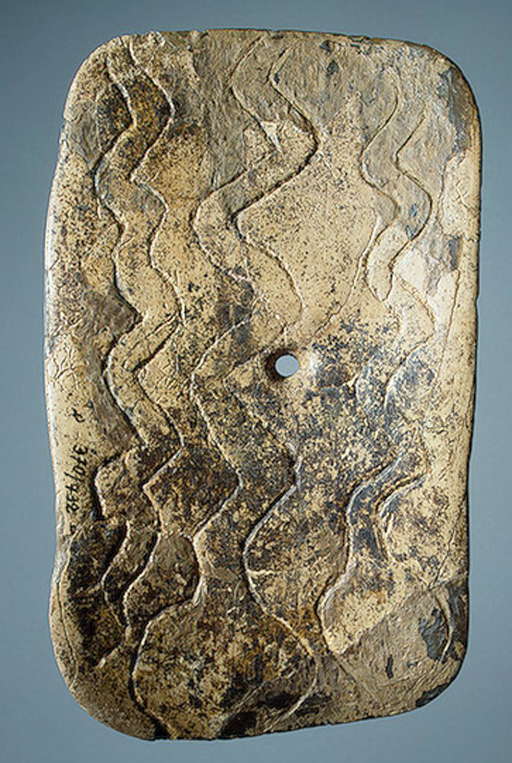
Compare words: stick/stake/(strength/string) snake/rake/peck/peg/pick/pike/spike/spigot/
dig/pig/pin/punji/punt/poke/push/pull/plug/pluck/plow (bullocks pulling plows originated from pegs driven into soil and sharpened sticks used to pull up tubers, related to pig cloven/claw hoof), and paralleling pig was hog/hock/hoof/hook/crook/hoe/hole/hoick/hoist, related to peg insertion & removal.
Pharoah of Egypt: translated as "great house" or "Dominion of the tent stake" Awtad
"‘Awtad’ comes from the Arabic Root: 'WAW-TA-DAL' [note phonetic similarity to awl, idol & doll] which does indeed mean: Stakes, Pegs, Tent Poles or to drive in a stake (into ground or wall) as a literal understanding."
http://quransmessage.com/articles/pharaoh%20-%20lord%20of%20the%20stakes%20or%20pyramids%20FM3.htm
http://donsmaps.com/images11/malta0203.jpg notice photo of people next to "totem pole?" at Mal'ta site.
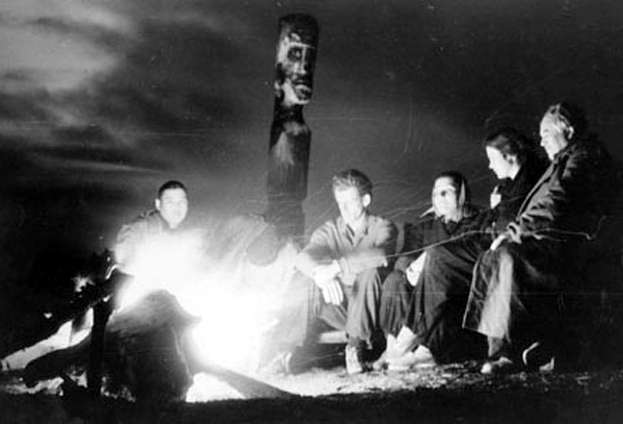
OBeLisK (OBa [Lith=stone] (am)?), SHiVa LingG(am), Totem pole (OD ooD(em)), Abrams' father Terah's ((O? al?)TeRaPH(im)), similar sounds (doll, idol to "-adal"), all derived from the ancestral humble tent peg (awtad, wAWTaDaL). Note too the similarity in sound in English of mother goddess, mothers' address and home post (-box) & host & guest. Compare Micmac 'aoutem' (kin) to both Eskimo dogsled (komatik) & Cree dog (atim) as that used to pull family's property.
English maypole from maeg bole (kin beam) paralleling Dutch/German mais baum. Bole/bone (rib)/boom/beam used in tents, huts, sleds & boats.
Between Arab awtad and Micmac autim we find English taut/tie/tether (bind) and knot/naut, and in Tamil katu (bind, as in katumaram-catamaran: bound logs) and nao/prahu (boat), and Malay tali (rope) and perau (boat).
Cupola (inverted 'cup-bowl' above roof, chimney cover) relates to BaMbuti mongolu and Sanskrit bungalo dome huts, derived via qupholu/kebhala or so (Persian qupha = bowlboat, Greek hoplon = round shield), where initially the 'cup-bowl' was a portable open round basket & later hidebound roundshield/bullboat.
In Japan, the red Shinto shrine gates are torii, in India, Buddhist temple gates are toran, and in the Jewish torah (see previous post), all represent the (communal) entry (door way/portal), just as the ritually carved symbolic house post/tent peg represented the front door entrance.
Anubis amulets (Amu(rru)/Anu?) of Egypt, probably via Syria/Slovenia:
http://www.flickriver.com/photos/25396001@N04/4248506587/
((D)Anubians: from Blue Danube of Slovenia (Swabia-Slavia) & Anu (Lake Tana & Tana delta) of Blue Nile of Nubia, J(Y)ordan, Sud(d)an, Aldan/Jana rivers of east Siberia, Danes of Denmark, Swedes of Sweden), Ma'dan, Mandan, Dhannu/Denu (OE & Sanskrit) river shore floodplains/terraces/traders.
Compare Anubis 3ka to Lion Man of Hohlenstein (possibly brought from Africa?) cave 32ka:
http://en.wikipedia.org/wiki/File:Anubis_standing.svg

http://www.showcaves.com/english/explain/Archaeology/Loewenfrau.html
Anubis: Associated with funeral/grave/mummification
(Note right hand holds was tent peg remover? Jackal form from older cave lion form (sphynx)?
http://en.wikipedia.org/wiki/Anubis
http://en.wikipedia.org/wiki/Lion_man_of_the_Hohlenstein_Stadel
In N America, the Plains Cree people called the travois-pulling dog atim, [note pole/pull/pulka 1/2sledge-1/2boat of Volga/Bulghar/Saami], the horse misatim "big dog", while the James Bay Cree called the lion misatim. So the Egyptian jackal form of Anubis may have transformed from the ancient cave lion in mythology.
http://moniyawlinguist.wordpress.com/2010/12/27/atimw-animal-that-pulls-your-stuff/
Note bowl/dome basket/hut/boat on travois. Early form of Eskimo sled komatic or Lapp pulka sledge-boat?
http://www.sila.nu/data?atom_id=dogsled_entry&l=en
Komatic: eskimo dog sled ("kam-u-tic")
Kom: (old Dutch) bowl cf kofa/qufa roundboat, koppe/cup
-atic? related to atim?
Northern Plains Cree people called the travois-pulling dog atim ("u-tim")
Choctaw of lower Mississippi: itti homma = boundary marker pole/tree painted red
Muskogee of Florida: yat kitischee = red people (ochre?)
Hebrew, 'staff of life/bread' = matteh lechem http://concordances.org/hebrew/4294.htm
Oldest wheel & axle found in Slovene Ljubjanska/Lyubyana swamp/lake 5.3ka (same neolithic period as Otzi the ice man mummy found 150 miles away), note similarity to travois, but employed "pegs/pins" to hold square axle onto frame allowing rotation of both wheel and axle:
http://www.slovenia.info/pictures%5CTB_attractions%5C1%5C2011%5Ckolo_19.7.2011_351550.jpg

Teraph, Teraphim: Abram's father Terah, before written language, carved figurines represented home dominion & land ownership, later household "idol" or even 'gods', originally from tent pegs.
http://www.biblepicturegallery.com/pictures/pagang/Statuettes%20of%20pagan%20deities%20excavated%20in%20Palestin%20pa.htm
http://www.bible-history.com/ibh/Egyptian+Gods/Teraphims/Teraphim+Figures
(note the was tent peg remover in hand, resemblance to a nail-pulling hammer-claw)
http://jandyongenesis.blogspot.com/2008/12/teraphim-of-genesis-31.html
http://www.google.com/imgres?imgurl=http://www.biblepicturegallery.com/thumbs/la/world/worship/pagan/p_gods/Palestinian%2520Teraphim%2520or%2520household%2520gods.jpg&imgrefurl=http://www.biblepicturegallery.com/pictures/pagang.htm&usg=__u8Adz0orFHKY_J_BhD8Yy4gTstc=&h=120&w=160&sz=4&hl=en&start=3&sig2=4Ph241K-jQfYszCLrj_mCA&zoom=1&tbnid=TvF9HpGyZZ3GwM:&tbnh=74&tbnw=98&ei=TxY8T5HZNo_AtgeCponoCg&prev=/search%3Fq%3Dteraphim%26um%3D1%26hl%3Den%26sa%3DN%26rls%3Dcom.microsoft:en-us%26tbm%3Disch&um=1&itbs=1

(Terah/Terai valley of Nepal terraced taro fields (1st agriculture in Papua) gradually became over run by weedy rice which became the staple, Nepali totems (lingam)
Shivalingam: (note phonetic similarity to 'shaft')
http://en.wikipedia.org/wiki/File:Nepalese_stone_linga_SF_Asian_Art_Museum.JPG

Oba (Yoruba, 'God' cf Russian 'Bog', God)
YHWH/YaHWeH/JeHoVaH (JaH ObaH?)/YesHuWaHa/YesHiVa/Shiva in the same dialectical pattern as we see in LeViTiCus/VaTiCan/VeDiC-MeDiCal/MuSiCal/MyThiCal/MaGiCal; when associated with VeNeTian/VoYaGer/ViKinGer/DaNuBian/PhoeNiCian/PuNiC/FinNiC/AiNu produces a (textile or hide-skinned) summer-tent-based nomadic herd hunting salmon/tuna fishing diaspora with female built sites, peg/post addresses, and a proto-law/medicine system. Veni, Vidi, Vicci!
The letter WaW in Hebrew is a picture of a tent stake, my name in Arab/Hebrew is Daud ~ Dawood which uses WaW after the Da-. In Chinese, Da-wei. In English, David.
Egyptian symbols from nomadic tent past: djed/tet symbol from beduin tent stake, was symbol from tent stake remover, ankh as knot of rope around stake (originally tendon?).
http://www.crystalinks.com/djed.html
Tents derived from hides draped over wigwam/mongolu dome huts where fat & meat was scraped off, then hide was inverted & dried, giving warmth to dwellers in areas outside the tropical rainforests. Tendons/vines held the skins over the wicker frame (first bull/bowl boats), later portable stakes were used/carried in more open tree-less plains country, where the woven wicker frame was replaced by straight poles, pulled behind with the leather cover.
Ancient Hebrew table was a round leather hide on the ground which people sat around.
Is there a link between Komi-Zyrian people of arctic Russia and bowl-boat-using Syrians of Tigris?
http://en.wikipedia.org/wiki/Komi-Zyrian_language
http://llmap.org/languages/kpv.html
related to Finnic & samoyed, name intriguing, related to Hurrian/Assyrian/Syrian?
Syr-yan (cf jor-dan) related to Yana/Jana/Aldana in Siberia etc.?
Did "Sumerian" derive from Su-mer-yana (south mer delta?) or Samoyen/Saamyan? Sumerians are said to have come earlier from the north, they were not Semites.
saami (Lapps of Finland), komi related? three of them are Uralic: Hungarian, Permic Zyrian Komi and Samoyedic Nenets
Beehive dome house of Caddo:
http://caddolegacy.com/grassthatchedhouses.aspx
Investigating whether "Maypole" is a cognate to totem pole/shivalingam/obelisk/tent peg:
apparently so, but the definition changed when Christianity became dominant in Europe. Probably derived from maeg-bole? (cf proto germanic mais baum) "kin tree/beam". The English word tree bole may have been from earlier woven wicker & hide bowl boats (parical/coracle/cup/qufa) being replaced by streamlined shallow dugout canoes cut from tree trunks (compare Dutch kom (bowl) to Dutch boom (tree, pole, beam)
boom (n.)
"long pole," 1540s, from Scottish boun, borrowed from Du. boom "tree, pole, beam," from a M.Du. word analogous to O.E. beam (see beam).
bowsprit
"spar extending from the bow of a ship," late 13c., probably from M.L.G. bochspret, from boch "bow of a ship" (see bow (n.2)) + spret "pole" (cf. O.E. spreot "pole," Du. spriet "spear;" see sprit).
Baton Rouge
city in Louisiana, U.S., a French translation of Choctaw itti homma "red pole," perhaps in reference to a painted boundary marker. [compare to Red Wing & Mississippi river Indians painting red on trees]
yard (2)
"measure of length," O.E. gerd (Mercian), gierd (W.Saxon) "rod, stick, measure of length," from W.Gmc. *gazdijo, from P.Gmc. *gazdaz "stick, rod" (cf. O.S. gerda, O.Fris. ierde, Du. gard "rod;" O.H.G. garta, Ger. gerte "switch, twig," O.N. gaddr "spike, sting, nail"), from PIE *gherdh- "staff, pole" (cf. L. hasta "shaft, staff").
windlass
device for raising weights by winding a rope round a cylinder, c.1400, alteration of wyndase (late 13c.), from Anglo-Fr. windas, and directly from a Scandinavian source such as O.N. vindass, from vinda "to wind" (see wind (v.)) + ass "pole, beam."
totem
animal or natural object considered as the emblem of a family or clan, 1760, from Algonquian (probably Ojibwa) odoodeman "his sibling kin, his group or family," hence, "his family mark;" also attested in French c.1600 in form aoutem among the Micmacs or other Indians of Nova Scotia. Totem pole is 1808, in reference to west coast Canadian Indians.
palanquin
"a covered litter," 1580s, from Port. palanquim (early 16c.), from Malay and Javanese palangki, ultimately from Skt. palyanka-s "couch, bed, litter," from pari "around" + ancati "it bends, curves," related to anka-s "a bend, hook, angle," and meaning, perhaps, "that which bends around the body." Some have noted the "curious coincidence" of Sp. palanca, from L. phalanga "pole to carry a burden."
stake (n)
"pointed stick or post," O.E. staca, from P.Gmc. *stakon (cf. O.N. stiaki, Du. staak, Ger. stake), from PIE root *steg- "pole, stick."
pig
probably from O.E. *picg, found in compounds, ultimate origin unknown. Originally "young pig" (the word for adults was swine). Another O.E. word for "pig" was fearh, related to furh "furrow," from PIE *perk- "dig, furrow" (cf. L. porc-us "pig," see pork).
spigot
late 14c., "plug used to stop the hole of a cask," probably from O.Fr. *espigot (cf. Gascony dialect espigot "core of a fruit, small ear of grain"), dim. of O.Prov. espiga "ear of grain," from L. spica "ear of grain" (see spike (n.2)).
taut
early 14c., tohte, possibly from tog- [compare to 'dog'], pp. stem of O.E. teon "to pull, drag," from P.Gmc. *tugn, from [IMO unlikely] PIE *deuk- "to lead" (see duke).
tone
mid-14c., from O.Fr. ton (13c.), from L. tonus "a sound, tone, accent," lit. "stretching" (in M.L., a term peculiar to music), from Gk. tonos "vocal pitch, raising of voice, accent, key in music," originally "a stretching, taut string," related to teinein "to stretch" (see tenet).
string (n.)
O.E. streng "line, cord, thread," from P.Gmc. *strangiz (cf. O.N. strengr, Dan. streng, M.Du. strenge, Du. streng, O.H.G. strang, Ger. Strang "rope, cord"), from *strang- "taut, stiff," from PIE root *strenk- "tight, narrow; pull tight, twist" (see strain). Gradually restricted by early M.E. to lines that are smaller than a rope. Old English meaning "ligaments, tendons" is preserved in hamstring, heartstrings.
Eskimo skin boat being transported over ice on sleds, childrens, adults:
http://tycoontalk.freelancer.com/photography-forum/148118-children-chasing-a-bowhead-whale.html
St. Laurence island eskimo angyapik umiak boat: http://indigenousboats.blogspot.com/2010_12_01_archive.html
Amur river trading Ainu with 'itaomachip' sewn plank boat and shallow dugout canoe:
http://indigenousboats.blogspot.com/search/label/Ainu
Kanak/Kanaka: Austronesian/Melanesian/Polynesian/Malaysian/Indonesian
http://en.wikipedia.org/wiki/Kanak_people
Kanak Totem poles in New Caledonia, as Great House door posts and roof poles:
http://en.wikipedia.org/wiki/File:Kanak_doorpost_Inv.MH31-50-2.jpg

http://en.wikipedia.org/wiki/File:Kanak_house-2.jpg

Compare the Kanak wood carvings to the Giant Easter Island Moai stone statues:
http://www.easterislandtourism.com/what-to-visit/easter-island-statues/
These Moai had been originally 1 meter tall ("Tiki" in Marquesas isles.), sitting in ahu altars, then enlarged in the same way that US west coast Indians enlarged their totem poles upon establishing sedentary villages and halting nomadism and regulating warfare.
The Maori of New Zealand carved wooden totem poles:
Symbol of 10th month: Pou-tu-te-rangi (pole raise sky, similar to Malay kutub angkat langit)
http://www.astronomynz.org.nz/index.php?option=content&task=view&id=39
Turkish Crescent/jingle/Chinese hat - a long post/walking stick with bells, originally from Central Asian shaman/santa clause
http://en.wikipedia.org/wiki/Turkish_crescent
Manasota canoe in Florida: http://indigenousboats.blogspot.com/search/label/Manasota
http://www.dailymail.co.uk/sciencetech/article-1362138/The-1-000-year-old-canoe-excavated-10-years-discovery-amateur-archaeologist.html
"The Manasota people provided the indigenous culture on the west cost of Florida.
They were a race of hunter-gatherers who lived there from around 550BC until around 900AD.
Weedon Island, where the canoe was discovered, was a key religious ground for the culture, and many people and objects were laid to rest there in sand burial mounds. http://www.dailymail.co.uk/sciencetech/article-1362138/The-1-000-year-old-canoe-excavated-10-years-discovery-amateur-archaeologist.html#ixzz1nhLiniiv
link of manasota to minnesota?
Australian marsh canoes from bark, hand paddled: http://indigenousboats.blogspot.com/2010/05/ten-canoes.html
Yurt & skin boats:
http://skinboatjournal.blogspot.com/2012/02/yurt-or-skin-on-frame-portable-dwelling.html
DDeden
Tuesday, January 10, 2012
Bowl boats & Bull boats
Vietnamese bamboo bowl boat
http://www.extrasleepy.com/photo/pages/photo-bowl-boat.html
Mandan willow-frame buffalo skin boat
http://www.minnehahacounty.org/museums/exhibits/l_c_gifts_mandan/teachers/artifact_pages/32_buffalo_bull_boat.htm
http://en.wikipedia.org/wiki/File:Catlin_mandan_village.jpg
Tibetan willow-frame yak skin boat (kudru) w/ yak butter grease (ghee) waterproofing
http://upload.wikimedia.org/wikipedia/commons/thumb/0/0e/Kudru.jpg/220px-Kudru.jpg
http://www.theoi.com/Gallery/T17.5.html
-
Large baskets from Yosemite valley Paiute/Miwok (Pen-uti-an) woman:
http://content.cdlib.org/ark:/13030/kt9199q6g6/?layout=metadata&brand=calisphere
http://content.cdlib.org/ark:/13030/kt809nd0gr/ (baskets)
http://content.cdlib.org/ark:/13030/kt15801729/ (Yosemite valley flooded)
http://www.aboutnevadacounty.com/history/maidu/
Words in Penutian, Maidun (water: momim ~ omi -danubian/Yoruba; miwok - kiku/liwa)
http://www.native-languages.org/fampen_words.htm
Penutian from pen (2) and uti (2), not an original tribal name.
http://www.jstor.org/pss/1265869
British Celtic mai-dun, meaning a "great hill." (maidun hill fort, British south coast)
Situla: 7th c BC bronze age bucket/pail (Etruscan, Slovene, Egypt (mammaeform bottom cf Polynesian kavakava coconut bowl), probably derived from pitch-lined basket bowl cf shield)
http://en.wikipedia.org/wiki/Situla_(vessel)
Slovene: adjacent to Venice, 'origin' of Venetian/Veneti/Finnic/Uenn/Phoenician/Punic/Punt/Pun (red sea Ochre trade), linked via Danube to Nile Anu/danubia, always bordering empires (Rome, Austria, Ottoman), had Uralic languages.
http://en.wikipedia.org/wiki/Slovenia
http://en.wikipedia.org/wiki/Slovenia
mapiloa(N)=point/show with finger
Malays point with thumb, not finger (rude)
Maples have hand-like leaves (pentadactyle)
thumbs/fools/uei mapipiltin(N)who shone at small tlacuicuiliztli(N)=sculpture,=taquiyya(Arab)=
sweeping [no tree bark in desert, so cairns/stone markings/sweeping (also Peru)]
similar to shaving/sco(lpt)ring/scrap(pt)ing/stripping bark(beaver/bear/moose/mammoth), possibly related to first scripting/writing/runes/cuneiforms not stamped, cf alif/alpha/elf/eleve/vette|i(spade)
(tre/a/uck-travel/ois-trade-drag-troika) trunk/kudru(tibet coracle)/thung chai(Viet coracle)/thumb; first tropical coracle/hut-tent from plants, first ex-tropical coracle/hut-tent) may have been mammoth/elephant pelt, only much later defurred waxed/yak-buttered sewn leathers.
-
Giant art gallery yacht, Seafair, stops in Miami: http://www.expoships.com/
http://www.extrasleepy.com/photo/pages/photo-bowl-boat.html
Mandan willow-frame buffalo skin boat
http://www.minnehahacounty.org/museums/exhibits/l_c_gifts_mandan/teachers/artifact_pages/32_buffalo_bull_boat.htm
http://en.wikipedia.org/wiki/File:Catlin_mandan_village.jpg

Tibetan willow-frame yak skin boat (kudru) w/ yak butter grease (ghee) waterproofing
http://upload.wikimedia.org/wikipedia/commons/thumb/0/0e/Kudru.jpg/220px-Kudru.jpg
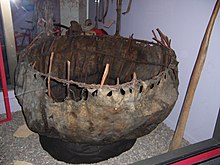
http://www.theoi.com/Gallery/T17.5.html
-
Large baskets from Yosemite valley Paiute/Miwok (Pen-uti-an) woman:
http://content.cdlib.org/ark:/13030/kt9199q6g6/?layout=metadata&brand=calisphere
http://content.cdlib.org/ark:/13030/kt809nd0gr/ (baskets)
http://content.cdlib.org/ark:/13030/kt15801729/ (Yosemite valley flooded)
http://www.aboutnevadacounty.com/history/maidu/
Words in Penutian, Maidun (water: momim ~ omi -danubian/Yoruba; miwok - kiku/liwa)
http://www.native-languages.org/fampen_words.htm
Penutian from pen (2) and uti (2), not an original tribal name.
http://www.jstor.org/pss/1265869
British Celtic mai-dun, meaning a "great hill." (maidun hill fort, British south coast)
Situla: 7th c BC bronze age bucket/pail (Etruscan, Slovene, Egypt (mammaeform bottom cf Polynesian kavakava coconut bowl), probably derived from pitch-lined basket bowl cf shield)
http://en.wikipedia.org/wiki/Situla_(vessel)
Slovene: adjacent to Venice, 'origin' of Venetian/Veneti/Finnic/Uenn/Phoenician/Punic/Punt/Pun (red sea Ochre trade), linked via Danube to Nile Anu/danubia, always bordering empires (Rome, Austria, Ottoman), had Uralic languages.
http://en.wikipedia.org/wiki/Slovenia
http://en.wikipedia.org/wiki/Slovenia
mapiloa(N)=point/show with finger
Malays point with thumb, not finger (rude)
Maples have hand-like leaves (pentadactyle)
thumbs/fools/uei mapipiltin(N)who shone at small tlacuicuiliztli(N)=sculpture,=taquiyya(Arab)=
sweeping [no tree bark in desert, so cairns/stone markings/sweeping (also Peru)]
similar to shaving/sco(lpt)ring/scrap(pt)ing/stripping bark(beaver/bear/moose/mammoth), possibly related to first scripting/writing/runes/cuneiforms not stamped, cf alif/alpha/elf/eleve/vette|i(spade)
(tre/a/uck-travel/ois-trade-drag-troika) trunk/kudru(tibet coracle)/thung chai(Viet coracle)/thumb; first tropical coracle/hut-tent from plants, first ex-tropical coracle/hut-tent) may have been mammoth/elephant pelt, only much later defurred waxed/yak-buttered sewn leathers.
-
Giant art gallery yacht, Seafair, stops in Miami: http://www.expoships.com/
Wednesday, November 30, 2011
Humans & Huts, Apes & Nests, Monkeys & Masses
'Conch-shell' dome hut of bamboo and rice straw:
http://dornob.com/deformed-dome-bamboo-hut-builds-on-a-modeling-mistake/
77ka bedding with insecticide:
http://www.sciencemag.org/content/334/6061/1388.abstract
-
56ma- Opposable big toe/thumb allows clinging to twigs, (no claws for
trunk climbing, no lemur leaping)
52ma- Noct to diurnal, increased sociality (group noct. sleep, less insectivory, more leaves & fruit)
35ma- OWM/apes got color vision (canopy sleep - snakes-raptor detection,
more frugivory)
23ma- TRP2 pheromone signal disabled (olf. neural switch to RAM?),
increased visual sexual signaling in hominoids
20ma- Morotopith vertebrae - orthogrady, twig weaving bowl nests (all
extant great apes) anti-raptor mimicry
16ma- family coherance/bonding - increased altriciality & neural complexity?
-
50ma: nocturnal slow-climbing insecti-folio-frugi-omni-vorous, scent-dominant (slow-loris -like)primates become diurnal/social binocular-color-sight-sound dominant, night-sleeping in plucked-leaf-cushioned tree-forks or enmassed-bunch ("snoozing-bear" mimic) defence against predators.
Opposable thumb allows clinging to twigs, sharp nails grasps trunks:
A 56 MILLION-YEAR-OLD skeleton found in Wyoming shows that one of the
earliest primate ancestors had an opposable big toe, allowing it to creep
to the outermost branches of trees to hunt nuts and fruit.
Because Carpolestes combines features of the earlier plesiadapiforms with
primate-like features, it begins to answer the question of what order these
traits evolved, and for what purpose. The study is published in the November
22 issue of the journal Science. ...
The Carpolestes, which weighed about 4 ounces (100 grams), had a long tail,
and a body about 14 inches (35 centimeters) long, shared some, but not all of
the characteristics of modern primates, and thus can be viewed as a
transitional animal. It had very primate like teeth that were highly
specialized for eating flowers, seeds, and fruit. The opposable big toe gave
it a grasping ability that indicates it spent most of its time climbing trees.
Carpolestes also had a nail on its big toe, but its eyes were not forward
facing, and it did not have the bone structure that would allow for
specialized leaping, like some of the earliest primates.
http://www.bbc.co.uk/news/science-environment-15600357
The team pinpointed the shift from non-social to social living to about 52 million years ago; a switch that appears to have happened in one step, and coincided with a move into daylight.
An analysis of over 200 primate species by a University of Oxford team suggests that our ancestors gave up their solitary existence when they shifted from being nocturnal creatures to those that are active during the day. It is likely communal living was adopted to protect against day time predators, the researchers say.
"If you are a small animal active at night then your best strategy to avoid predation is to be difficult to detect," explained Oxford's Suzanne Shultz, who led the study.
"Once you switch to being active during the day, that strategy isn't very effective, so an alternative strategy to reduce the risk of being eaten is to live in social groups," she told BBC News.
Dr Shultz thinks that the move to day-time living in ancient primates allowed animals to find food more quickly, communicate better, and travel faster through the forest.
female bonding emerged much later at about 16 million years ago.
http://www.ns.umich.edu/Releases/2003/Jun03/r061603.html
35ma- OWM got color vision but lost pheromone detection (replaced by RAM?)
Even our humble mammal cousin, the mouse, was found to have 140 genes just for pheromone receptors when its genome was completely sequenced earlier this year.
But humans are clueless when it comes to pheromone signals, according to University of Michigan evolutionary biologist Jianzhi “George” Zhang. He believes color vision put our pheromones out of business.
Zhang said. In fact, though humans and these apes still carry genes that should create pheromone receptors in our noses "Some pheromone detection genes don't function. There is considerable evidence that there are nasal receptors for pheromones in humans which affect behaviour, though their signals are not registered consciously." This may be origin of RAM memory in humans, via olfaction neural network.
A pheromone attaches to a water molecule, drifts about in the air currents and finally lands on the proper receptor in someone else’s nose. The receiver can’t immediately be sure who sent it, where it came from or when. But with sexual swelling, everyone in the troop can see precisely when and where the signal is, even at a significant distance.
Sexual swelling occurs in about 10 percent of all primate species, but only in the Old World species of Africa and Asia, which is where humans probably originated, as well.
To test their idea, Zhang’s team zeroed in on a human gene called TRP2, which makes an ion channel that is unique to the pheromone signaling pathway. They found that in humans and Old World primates, this gene suffered a mutation just over 23 million years ago that rendered it dysfunctional. But because we could use color vision for mating, it didn’t hurt us. In turn, the pheromone receptor genes that rely on this ion channel fell into disuse, and in a random fashion, mutated to a dysfunctional state because they haven’t experienced any pressure from natural selection.
34ma: New World monkeys transit Atlantic Ocean on floating vegetative raft, Red Sea opens, Antarctica freezes, equatoreal-Tethys currents changing affects forest seasonality.
20ma: Hominoids become sub-canopy open-bowl-nesting (eagle-nest mimic, outreached hooked hand = raptors' hooked beak, red scalp hair = danger sign to predator in flight, infant coo-ing = eagle chick cheeps), orthograde upright branch-hanging/standing/hand-plucking apes eg. morotopithecus, ardipithecus; development of deeper larynx and laryngeal air sac improved both upright vocalization in rainforest canopy and face-up upper-body buoyancy while wade-foraging (cf finger-raking surface-growing hydrocharis seaweed by Ndoki gorilla) in shallow forest wetlands and coastal mangroves, some slow open-ground upright bipedalism (cf siamang) with only little (above-branch) pronograde quadrupedalism.
5ma: Chromosome 2 inversion/fusion [Photic sneeze reflex activated, Iodine & Iron metabolism changes] in human ancestors, humans invert (dimple) the standard woven great ape sub-canopy open-bowl nest (leaf-lined interior) into small fully-enclosed-dome-hut with mosquito-proof/waterproof leaf-shingled exterior (reduced natural selection for fur coat), entire dome was lifted for access. Photic sneeze was advantageous against predation, eg. a leopard (or human enemy) at daybreak lifting the dome shell would flood it with sunlight, causing an explosive solar-powered sneeze (accompanied by a sharp stick) in the snout.
3.3ma: Gorilla louse transferred to humans and became human pubic louse, (possibly indicating that African Australopiths (eg. Lucy) starting at that period were HG hybrids?), Africa tropical rainforest reduced, humans more waterside and ground based. Apes (chimps, gorillas) independently develop knuckle-walking quadrupedalism to transit more open woodlands, while bipedal humans develop kneecrawling to enter/exit dome huts (no doorways yet, just lightweight dome shell).
2.6ma: First Oldawan sharp stone tools used to cut sedges/wicker/nuts/meat, reducing need for large sharp teeth, but molars enlarged for more chewing. Air sacs gradually lost, with increased submerged-face foraging (wading/swimming) in shallows for benthic rhyzomes and soft shelled seafoods along with shrub berries, herbs, eggs, larvae, etc.
1.8ma: Humans forage more often in coastal areas, develop denser bones and paranasal sinuses as result of deeper benthic gathering of shellfish, crustaceans. Females made slightly larger domes to contain small infants while foraging nearby so as to keep both hands free, males made smaller portable domes as hunting blinds/roundshields which females valued for use as baskets, these roundshields may have covered open hatchways at night to signal female's domes companionship. Likely seafoods, mangrove honey and mangrove salt-crystal leaf exudates were collected, consumed and brought inland seasonally, perhaps exchanging with inland groups. Bifacial hand axes were improved for cutting, used as bait traps when inserted into fish or animal organs to bait crocs, bears, big cats & wolves near shore.
120ka?: Humans invent portable roundshield-door-roundboat, modify hut (cone & drum), add doorway hatch.
25ka?: Humans invent orthogonal linear buildings, villages evolve from seasonal camps
DDeden
-
Article from New Scientist: http://www.newscientist.com/article/dn21258-earliest-human-bedding-didnt-let-the-bedbugs-bite.html
After a hard day hunting and gathering, humans 77,000 years ago could count on a good night's mosquito-free sleep on a comfy bed of grass and leaves. Archaeologists have discovered the oldest evidence of humans using plant bedding, 50,000 years before it appears anywhere else.
Many animals make beds for themselves, says lead author Lyn Wadley of the University of the Witwatersrand in Johannesburg, South Africa, but what's interesting in the new find is the way the owners managed their bedding. To keep it clean and pest-free, they burned it.
Wadley's team has spent the past decade excavating a rock shelter called Sibudu, situated high in a cliff surrounded by forest and near the Uthongathi river in South Africa. People lived there on and off between 80,000 and 38,000 years ago, in a complex society that used stone tools and even made glue and simple ornaments.
Wadley found layers of plant material on the cave floor that date from 77,000 years ago onwards – mostly grasses, sedges and rushes. These could not have grown in the dry shelter, so people probably collected them near the river.
Burning the beds
Wadley thinks the bedding was used to make a clean area for sitting, working, eating and sleeping. Tools and other artefacts were found buried within it.
Intriguingly, all the layers of bedding that are 73,000 years old or younger show signs of burning, which Wadley suggests may have been the result of routine cleaning. Burning the plants would have killed pests and diseases. That the cave's occupants needed to do this, he says, may suggest they spent extended periods of time in the shelter, so had to keep it clean.
It seems the bed-makers were selective about the plants they would sleep on. A range of trees grow in the region, but only the Cape laurel (Cryptocarya woodii) was used.
Cape laurel leaves give off insecticidal chemicals, so they would have repelled insects and their larvae – including malarial mosquitoes. That would make the cave bedding the earliest evidence of humans using medicinal plants, although other animals have similar tricks: common starlings often use insecticidal plants in their nests to repel blood-sucking insects.
Old knowledge
The behaviours may have started sooner than this site shows. "I would guess that right back until the earliest anatomically modern humans, people would have known which plant to choose," says Wadley.
Chimpanzees also build nests, and there is some evidence that they too include insecticidal plants. Fiona Stewart of the University of Cambridge, UK, spent several nights sleeping in chimp nests, and found that insects bit her less than when she slept on the ground.
"Perhaps this purpose of bedding has been continuous throughout human evolution," Stewart suggests.
Journal reference: Science, DOI: 10.1126/science.1213317
Note: I have written in an earlier post about medicinal and insecticidal plants used by archaic humans.
http://www.plantzafrica.com/plantcd/crytocarwood.htm
A bedding dated from the Lower Paleolithic, 130 000 years ago, was discovered by
Henry de Lumley. It was the home of the Lazaret Man near Nice in southern
France. The site was a construction, eleven feet long and twelve feet wide,
consisting of a frame of vertical posts resting against the wall of the cave, on
which were arranged skins falling to the ground. A partition separated the
interior activity areas and one area was containing the remains of a bedding.
The men of the Lazaretto rest and sleep on thick litter of dried kelp.
http://independent.academia.edu/pfpuech/Papers/212001/Enamel_Pits_of_the_Lazaret_Man
1) 52ma from noct to diur primates -> social group (little/no aquatic
foraging, surface swim)
2) 20ma from branch to open nest, prono to orthograde locom./forag.
(wade, face-up float, surface forage)
3) 5ma phot. sneeze reflex - from open nest to dome, (subsurface
forage)
4) 100ka-50ka roundboats (super-surface forage)
5) 20ka? longboats dugout/tied raft
My time chart:
0) pre-52ma small primate size, individual/infant tree hollow sleeping
(bushbaby, tupaia), little surface swimming
1) 52ma from noct to diur primates -> social group (little/no aquatic
foraging, surface swimming) (group sleeping on branches?(proconsul))
2) 20ma from branch to large open nest, (morotopith, raptor-mimic
nest) from prono to orthograde locom./forag.
(wade, face-up float, surface forage)
3) 5ma phot. sneeze reflex - from open nest to dome, (subsurface
forage, HP split, #2 chrom. fusion)
4) 100ka-50ka roundboats (super-surface forage) qufa
5) 20ka? longboats dugout/tied raft
-
Chufa = suph = sedge
Chum: Chinook - dog salmon, Siberian - cone tent (proto-tipi) for summer fishing?
Ket/a: Russian - dog salmon, Ket people of Yenisei R,
Kot/a: Saami/Lapp conic tent, Kot people of Yenisei R.
http://dornob.com/deformed-dome-bamboo-hut-builds-on-a-modeling-mistake/
77ka bedding with insecticide:
http://www.sciencemag.org/content/334/6061/1388.abstract
-
56ma- Opposable big toe/thumb allows clinging to twigs, (no claws for
trunk climbing, no lemur leaping)
52ma- Noct to diurnal, increased sociality (group noct. sleep, less insectivory, more leaves & fruit)
35ma- OWM/apes got color vision (canopy sleep - snakes-raptor detection,
more frugivory)
23ma- TRP2 pheromone signal disabled (olf. neural switch to RAM?),
increased visual sexual signaling in hominoids
20ma- Morotopith vertebrae - orthogrady, twig weaving bowl nests (all
extant great apes) anti-raptor mimicry
16ma- family coherance/bonding - increased altriciality & neural complexity?
-
50ma: nocturnal slow-climbing insecti-folio-frugi-omni-vorous, scent-dominant (slow-loris -like)primates become diurnal/social binocular-color-sight-sound dominant, night-sleeping in plucked-leaf-cushioned tree-forks or enmassed-bunch ("snoozing-bear" mimic) defence against predators.
Opposable thumb allows clinging to twigs, sharp nails grasps trunks:
A 56 MILLION-YEAR-OLD skeleton found in Wyoming shows that one of the
earliest primate ancestors had an opposable big toe, allowing it to creep
to the outermost branches of trees to hunt nuts and fruit.
Because Carpolestes combines features of the earlier plesiadapiforms with
primate-like features, it begins to answer the question of what order these
traits evolved, and for what purpose. The study is published in the November
22 issue of the journal Science. ...
The Carpolestes, which weighed about 4 ounces (100 grams), had a long tail,
and a body about 14 inches (35 centimeters) long, shared some, but not all of
the characteristics of modern primates, and thus can be viewed as a
transitional animal. It had very primate like teeth that were highly
specialized for eating flowers, seeds, and fruit. The opposable big toe gave
it a grasping ability that indicates it spent most of its time climbing trees.
Carpolestes also had a nail on its big toe, but its eyes were not forward
facing, and it did not have the bone structure that would allow for
specialized leaping, like some of the earliest primates.
http://www.bbc.co.uk/news/science-environment-15600357
The team pinpointed the shift from non-social to social living to about 52 million years ago; a switch that appears to have happened in one step, and coincided with a move into daylight.
An analysis of over 200 primate species by a University of Oxford team suggests that our ancestors gave up their solitary existence when they shifted from being nocturnal creatures to those that are active during the day. It is likely communal living was adopted to protect against day time predators, the researchers say.
"If you are a small animal active at night then your best strategy to avoid predation is to be difficult to detect," explained Oxford's Suzanne Shultz, who led the study.
"Once you switch to being active during the day, that strategy isn't very effective, so an alternative strategy to reduce the risk of being eaten is to live in social groups," she told BBC News.
Dr Shultz thinks that the move to day-time living in ancient primates allowed animals to find food more quickly, communicate better, and travel faster through the forest.
female bonding emerged much later at about 16 million years ago.
http://www.ns.umich.edu/Releases/2003/Jun03/r061603.html
35ma- OWM got color vision but lost pheromone detection (replaced by RAM?)
Even our humble mammal cousin, the mouse, was found to have 140 genes just for pheromone receptors when its genome was completely sequenced earlier this year.
But humans are clueless when it comes to pheromone signals, according to University of Michigan evolutionary biologist Jianzhi “George” Zhang. He believes color vision put our pheromones out of business.
Zhang said. In fact, though humans and these apes still carry genes that should create pheromone receptors in our noses "Some pheromone detection genes don't function. There is considerable evidence that there are nasal receptors for pheromones in humans which affect behaviour, though their signals are not registered consciously." This may be origin of RAM memory in humans, via olfaction neural network.
A pheromone attaches to a water molecule, drifts about in the air currents and finally lands on the proper receptor in someone else’s nose. The receiver can’t immediately be sure who sent it, where it came from or when. But with sexual swelling, everyone in the troop can see precisely when and where the signal is, even at a significant distance.
Sexual swelling occurs in about 10 percent of all primate species, but only in the Old World species of Africa and Asia, which is where humans probably originated, as well.
To test their idea, Zhang’s team zeroed in on a human gene called TRP2, which makes an ion channel that is unique to the pheromone signaling pathway. They found that in humans and Old World primates, this gene suffered a mutation just over 23 million years ago that rendered it dysfunctional. But because we could use color vision for mating, it didn’t hurt us. In turn, the pheromone receptor genes that rely on this ion channel fell into disuse, and in a random fashion, mutated to a dysfunctional state because they haven’t experienced any pressure from natural selection.
34ma: New World monkeys transit Atlantic Ocean on floating vegetative raft, Red Sea opens, Antarctica freezes, equatoreal-Tethys currents changing affects forest seasonality.
20ma: Hominoids become sub-canopy open-bowl-nesting (eagle-nest mimic, outreached hooked hand = raptors' hooked beak, red scalp hair = danger sign to predator in flight, infant coo-ing = eagle chick cheeps), orthograde upright branch-hanging/standing/hand-plucking apes eg. morotopithecus, ardipithecus; development of deeper larynx and laryngeal air sac improved both upright vocalization in rainforest canopy and face-up upper-body buoyancy while wade-foraging (cf finger-raking surface-growing hydrocharis seaweed by Ndoki gorilla) in shallow forest wetlands and coastal mangroves, some slow open-ground upright bipedalism (cf siamang) with only little (above-branch) pronograde quadrupedalism.
5ma: Chromosome 2 inversion/fusion [Photic sneeze reflex activated, Iodine & Iron metabolism changes] in human ancestors, humans invert (dimple) the standard woven great ape sub-canopy open-bowl nest (leaf-lined interior) into small fully-enclosed-dome-hut with mosquito-proof/waterproof leaf-shingled exterior (reduced natural selection for fur coat), entire dome was lifted for access. Photic sneeze was advantageous against predation, eg. a leopard (or human enemy) at daybreak lifting the dome shell would flood it with sunlight, causing an explosive solar-powered sneeze (accompanied by a sharp stick) in the snout.
3.3ma: Gorilla louse transferred to humans and became human pubic louse, (possibly indicating that African Australopiths (eg. Lucy) starting at that period were HG hybrids?), Africa tropical rainforest reduced, humans more waterside and ground based. Apes (chimps, gorillas) independently develop knuckle-walking quadrupedalism to transit more open woodlands, while bipedal humans develop kneecrawling to enter/exit dome huts (no doorways yet, just lightweight dome shell).
2.6ma: First Oldawan sharp stone tools used to cut sedges/wicker/nuts/meat, reducing need for large sharp teeth, but molars enlarged for more chewing. Air sacs gradually lost, with increased submerged-face foraging (wading/swimming) in shallows for benthic rhyzomes and soft shelled seafoods along with shrub berries, herbs, eggs, larvae, etc.
1.8ma: Humans forage more often in coastal areas, develop denser bones and paranasal sinuses as result of deeper benthic gathering of shellfish, crustaceans. Females made slightly larger domes to contain small infants while foraging nearby so as to keep both hands free, males made smaller portable domes as hunting blinds/roundshields which females valued for use as baskets, these roundshields may have covered open hatchways at night to signal female's domes companionship. Likely seafoods, mangrove honey and mangrove salt-crystal leaf exudates were collected, consumed and brought inland seasonally, perhaps exchanging with inland groups. Bifacial hand axes were improved for cutting, used as bait traps when inserted into fish or animal organs to bait crocs, bears, big cats & wolves near shore.
120ka?: Humans invent portable roundshield-door-roundboat, modify hut (cone & drum), add doorway hatch.
25ka?: Humans invent orthogonal linear buildings, villages evolve from seasonal camps
DDeden
-
Article from New Scientist: http://www.newscientist.com/article/dn21258-earliest-human-bedding-didnt-let-the-bedbugs-bite.html
After a hard day hunting and gathering, humans 77,000 years ago could count on a good night's mosquito-free sleep on a comfy bed of grass and leaves. Archaeologists have discovered the oldest evidence of humans using plant bedding, 50,000 years before it appears anywhere else.
Many animals make beds for themselves, says lead author Lyn Wadley of the University of the Witwatersrand in Johannesburg, South Africa, but what's interesting in the new find is the way the owners managed their bedding. To keep it clean and pest-free, they burned it.
Wadley's team has spent the past decade excavating a rock shelter called Sibudu, situated high in a cliff surrounded by forest and near the Uthongathi river in South Africa. People lived there on and off between 80,000 and 38,000 years ago, in a complex society that used stone tools and even made glue and simple ornaments.
Wadley found layers of plant material on the cave floor that date from 77,000 years ago onwards – mostly grasses, sedges and rushes. These could not have grown in the dry shelter, so people probably collected them near the river.
Burning the beds
Wadley thinks the bedding was used to make a clean area for sitting, working, eating and sleeping. Tools and other artefacts were found buried within it.
Intriguingly, all the layers of bedding that are 73,000 years old or younger show signs of burning, which Wadley suggests may have been the result of routine cleaning. Burning the plants would have killed pests and diseases. That the cave's occupants needed to do this, he says, may suggest they spent extended periods of time in the shelter, so had to keep it clean.
It seems the bed-makers were selective about the plants they would sleep on. A range of trees grow in the region, but only the Cape laurel (Cryptocarya woodii) was used.
Cape laurel leaves give off insecticidal chemicals, so they would have repelled insects and their larvae – including malarial mosquitoes. That would make the cave bedding the earliest evidence of humans using medicinal plants, although other animals have similar tricks: common starlings often use insecticidal plants in their nests to repel blood-sucking insects.
Old knowledge
The behaviours may have started sooner than this site shows. "I would guess that right back until the earliest anatomically modern humans, people would have known which plant to choose," says Wadley.
Chimpanzees also build nests, and there is some evidence that they too include insecticidal plants. Fiona Stewart of the University of Cambridge, UK, spent several nights sleeping in chimp nests, and found that insects bit her less than when she slept on the ground.
"Perhaps this purpose of bedding has been continuous throughout human evolution," Stewart suggests.
Journal reference: Science, DOI: 10.1126/science.1213317
Note: I have written in an earlier post about medicinal and insecticidal plants used by archaic humans.
http://www.plantzafrica.com/plantcd/crytocarwood.htm
A bedding dated from the Lower Paleolithic, 130 000 years ago, was discovered by
Henry de Lumley. It was the home of the Lazaret Man near Nice in southern
France. The site was a construction, eleven feet long and twelve feet wide,
consisting of a frame of vertical posts resting against the wall of the cave, on
which were arranged skins falling to the ground. A partition separated the
interior activity areas and one area was containing the remains of a bedding.
The men of the Lazaretto rest and sleep on thick litter of dried kelp.
http://independent.academia.edu/pfpuech/Papers/212001/Enamel_Pits_of_the_Lazaret_Man
1) 52ma from noct to diur primates -> social group (little/no aquatic
foraging, surface swim)
2) 20ma from branch to open nest, prono to orthograde locom./forag.
(wade, face-up float, surface forage)
3) 5ma phot. sneeze reflex - from open nest to dome, (subsurface
forage)
4) 100ka-50ka roundboats (super-surface forage)
5) 20ka? longboats dugout/tied raft
My time chart:
0) pre-52ma small primate size, individual/infant tree hollow sleeping
(bushbaby, tupaia), little surface swimming
1) 52ma from noct to diur primates -> social group (little/no aquatic
foraging, surface swimming) (group sleeping on branches?(proconsul))
2) 20ma from branch to large open nest, (morotopith, raptor-mimic
nest) from prono to orthograde locom./forag.
(wade, face-up float, surface forage)
3) 5ma phot. sneeze reflex - from open nest to dome, (subsurface
forage, HP split, #2 chrom. fusion)
4) 100ka-50ka roundboats (super-surface forage) qufa
5) 20ka? longboats dugout/tied raft
-
Chufa = suph = sedge
Chum: Chinook - dog salmon, Siberian - cone tent (proto-tipi) for summer fishing?
Ket/a: Russian - dog salmon, Ket people of Yenisei R,
Kot/a: Saami/Lapp conic tent, Kot people of Yenisei R.
Saturday, October 15, 2011
Videos
Incredible videos: mussel hunting under ice during low tide, others
http://www.youtube.com/watch_popup?v=Z0qGvC3vqaA
Amazing pendulum waves of Mach:
http://sciencedemonstrations.fas.harvard.edu/icb/icb.do?keyword=k16940&pageid=icb.page80863&pageContentId=icb.pagecontent341734&state=maximize&view=view.do&viewParam_name=indepth.html#a_icb_pagecontent341734
http://www.youtube.com/watch_popup?v=Z0qGvC3vqaA
Amazing pendulum waves of Mach:
http://sciencedemonstrations.fas.harvard.edu/icb/icb.do?keyword=k16940&pageid=icb.page80863&pageContentId=icb.pagecontent341734&state=maximize&view=view.do&viewParam_name=indepth.html#a_icb_pagecontent341734
Tuesday, September 6, 2011
Ancient predator traps
Update of this post: http://the-arc-ddeden.blogspot.com/2007/12/aechulian-hand-axe-or-bifacial-bait.html
http://news.yahoo.com/giant-crocodile-captured-alive-philippines-134625838.html
http://lawnchairanthropology.blogspot.com/2011/08/how-old-is-acheulian-tool-industry-and.html
What exactly were Acheulian "hand-axes" (with their very specific forms) for?--marc
DDeden: multi-functional knives, including use as predator bait traps, inserted into flesh of prey and set at waterside to kill crocs, sharks, wolves, lions, etc. They are most commonly found near former waterside areas, (per Mikey Brass at Paleoanthro) they were made with sharp edges all around (so inconvenient for handling unless partly covered), swallowed by predators that had a habit of 'wolfing' down chunks of flesh quickly.
http://news.sciencemag.org/sciencenow/2011/08/why-did-early-humans-leave-afric.html?ref=hp
Why Did Early Humans Leave Africa Without the Latest Gadgets?Brian Switek 31.8.11In ancient sediments near Kenya's Lake Turkana, archaeologists have foundstone hand axes dating to 1.76 Ma - the oldest examples yet found of theAcheulian stone-tool technology.People love to get their hands on the latest & greatest technology, andscientists had long believed that early humans were no exception.Paleontologists theorized that our ancestors didn't start leaving Africauntil they had developed advanced hand axes.But a new study finds that early humans began to migrate out of thecontinent with more primitive tools, even though better technology hadbeen invented. Over time, various groups of ancient humans have made various types ofstone tools. The oldest & most rudimentary instruments (sharp-edged stones created bybanging rounded rocks against larger stone "anvils") belong to the Oldowanculture ~2.6-1.7 Mao.From the Oldowan, a more complex tool culture developed called theAcheulian ~1.6 Ma. These are more complicated tools, such as teardrop-shaped hand axes,created by striking carefully selected stones with other rocks calledhammer-stones. These tools were useful for a wider range of tasks than the Oldowan ones.It was the Acheulian culture that first spread farthest around the globe,and it persisted until ~100 ka.
http://news.yahoo.com/giant-crocodile-captured-alive-philippines-134625838.html
http://lawnchairanthropology.blogspot.com/2011/08/how-old-is-acheulian-tool-industry-and.html
What exactly were Acheulian "hand-axes" (with their very specific forms) for?--marc
DDeden: multi-functional knives, including use as predator bait traps, inserted into flesh of prey and set at waterside to kill crocs, sharks, wolves, lions, etc. They are most commonly found near former waterside areas, (per Mikey Brass at Paleoanthro) they were made with sharp edges all around (so inconvenient for handling unless partly covered), swallowed by predators that had a habit of 'wolfing' down chunks of flesh quickly.
http://news.sciencemag.org/sciencenow/2011/08/why-did-early-humans-leave-afric.html?ref=hp
Why Did Early Humans Leave Africa Without the Latest Gadgets?Brian Switek 31.8.11In ancient sediments near Kenya's Lake Turkana, archaeologists have foundstone hand axes dating to 1.76 Ma - the oldest examples yet found of theAcheulian stone-tool technology.People love to get their hands on the latest & greatest technology, andscientists had long believed that early humans were no exception.Paleontologists theorized that our ancestors didn't start leaving Africauntil they had developed advanced hand axes.But a new study finds that early humans began to migrate out of thecontinent with more primitive tools, even though better technology hadbeen invented. Over time, various groups of ancient humans have made various types ofstone tools. The oldest & most rudimentary instruments (sharp-edged stones created bybanging rounded rocks against larger stone "anvils") belong to the Oldowanculture ~2.6-1.7 Mao.From the Oldowan, a more complex tool culture developed called theAcheulian ~1.6 Ma. These are more complicated tools, such as teardrop-shaped hand axes,created by striking carefully selected stones with other rocks calledhammer-stones. These tools were useful for a wider range of tasks than the Oldowan ones.It was the Acheulian culture that first spread farthest around the globe,and it persisted until ~100 ka.
Tuesday, June 7, 2011
Friday, June 3, 2011
steps
http://ngm.nationalgeographic.com/2011/06/gobekli-tepe/musi-photography
http://www.uprightape.net/Image_Pages/UA_Fig3-2_DjedDrawing.html
Note similarity of the T pillar at Gobleki Tepe 9ka and the Djed column in Ancient Egypt (fig. B), both have hands extended forward, both have bench (or ladder rungs) below and T (or multiple Ts) above.
Note similarity of vertebrae, mastaba (mammae + stepped pyramid), stupa/pagoda, stair, stele/tel/tepe...
cf Greek 'step' = "be'ma" (speakers stand or judgement seat at trial)
The first dwelling of humanity was the triangularly woven geodesic dome of branches with a waterproof external coil of inserted leaf shingles (cf modern BaMbuti mongolu dome hut constructed by Pygmy women from intertwined branches.), an inversion of the great ape nest (which had been naturally selected due to its effective mimicry of the raptors large canopy open nest, with internal leaves inserted for lining). The dome hut occurred after the #2 chromosome inversion/fusion in humans, when human ancestors (46 chromosomes) permanently separated from apes (48 chromosomes) and exchanged open-nest-tree-canopy dwelling for enclosed-dome-ground dwelling. From this, humans expanded from their forest origins outwards omnidirectionally, modifying their dome huts. This included changing from a coil of large leaves to a coil of grass or reed bundles (more insulating), clumps of clay-roots (first Jericho huts) or slate-slabs or rocks (more permanent, eg. Natufian) or even mammoth skulls & bones covered by animal furs or tree bark or grass bundles, depending on availability of leaves etc. and amount of rain and temperature changes. The partly buried sod dome (at first hand-pulled root-soil clumps, then serrated-blade-obsidian-knife-cut square clods and later sawn snowblocks for dome igloos (eg. Alaskan Eskimo Inuit) and sundried clay-straw bricks (eg. Sudan Nile huts, India Harappa) were derived gradually. (By this time the original all-branch geodesic frame was replaced by tied-stick frame, knots/lashings and glues more recent than weaving.) Nomads following herd seasonal migrations developed the cone (stick-hide Saami kota, Dakota tipi) in areas with few trees, and the stilted coned column (stick-lathe-felt yurt, stick-lather-manure-clay roundhouse hut) followed in seasonally semi-permanent villages. Then square base huts and longhouses formed due to population pressure, round huts became "squished" and straightened by permanent fences/walls/roads and more concentration, height became functional for growth, usable for open canopy-covered patios (stick stepladders), areas not flood-prone would allow subground cool storeroom cellars (stone stairs), houses above floodprone areas had shaded patios and animal pens below.
See post on round basket craft, dome huts & round basket boats:
http://the-arc-ddeden.blogspot.com/2008/12/crescent.html
Le Tuc d'Audoubert cave, rotunda contains 2 clay sculted bison, outer chamber contains dripping stalactites (a poet referred to them as 'milky tits'), which links stalactite to galact to melt, molassis & Moses (drawn from water in a papyrus ark/teba coated in bitumen tar, as was the earlier Egyptian Horus) later getting water from stone in the land of milk (PIE melug, galact) & honey (mahdu, mead).
http://cd0901-2.blogspot.com/2009/01/birth-of-art-paleolithic-art.html
The holy sacred texts of ancient cultures speak of village squares, temples and 2 story buildings in towns & cities and fabricated tents of nomads, this dates them to long after the early human habitat of woven-branch dome shelters in small forest camps, rings of small huts (Saami kota, Malay mahakota = crown) around the central cooking/drying campfire (Mbuti apa = fire = camp, Malay api = fire, kampong = camp).
http://anthropology.net/2010/02/22/gobekli-tepe-temple-in-turkey-predates-the-pyramids-of-giza/#comment-25079
See beehive houses of Sanlurfia nearby:
http://images.travelpod.com/users/sallycousens/1.1244889872.bee-hive-houses.jpg
Compare to neolithic huts of Ban P'o site in 7ka China:
http://hilbertspaces.com/photos/china/xian/banpo/dscn1346.jpg
"Majority of them were semi subterranean, 3-5m (10-16ft) in diameter, and with floors almost a meter beneath the ground surface. Every house had timber beams that placed on stone bases, whereby they gave support to precipitously pitched roof. Moreover, the interior walls and floors were plastered with straw and clay". http://www.articlelisted.com/Art/41928/185/Neolithic-Village-Ban-po-ts-un.html
Basically a tied tipi top above ground and supported columnar bottom in or at ground level, typical for pre-brick neolithic small village settlements throughout Eurasia & Africa amongst transitional hunter-gatherer - permanent agriculturalists.
The igloo instead combined the coiled shingle unit (mongongo/pandanus leaf -> clay-straw clump (later brick) -> sod clod block -> snow block) and semi-subterranean depth with raised bed, but discarded the (scarce) wood branch geodesic framework, relying on the melt-freeze cycling of snow for rigid blocks similar to sun dried clay-straw bricks.
"Iglu is the Inuit word for a house or home built out of any material,[1] and is not restricted exclusively to snowhouses, but includes traditional tents, sod houses, homes constructed of driftwood and modern buildings.[2][3] The hole left in the snow where the blocks are cut from is usually used as the lower half of the shelter" (Similar to the semi-subterranean dome & cone structures elsewhere, inside was lower except in flood-prone areas where stilts were used.)Animal skins were used as door flaps to keep warm air in. Igloos used as winter shelters had beds made of snow, covered with twigs and caribou furs. (Furs were never used to cover the dome, only the doorway and bed.) Architecturally, the igloo is unique in that it is a dome that can be raised out of independent blocks leaning on each other and polished to fit without an additional supporting structure during construction. (Thus the wood frame was lost. In areas where snow was unreliable for blocks, huts of whale ribs and hides were built, surrounded by compacted snow for insulation.)
http://en.wikipedia.org/wiki/File:Igloo_spirale.svg (similar to leaf coiling of BaMbuti dome)
http://upload.wikimedia.org/wikipedia/commons/b/b3/EskimoIglooDrawing.jpeg
Earlier, I had speculated that the igloo had been derived from Lake Baikal seal air holes which are snow pile domes. In inuit these snowpiles are called aglu. But there is no coiled block construction, so I think the term aglu is derived from the igloo, which is surely derived from coiled sod clod domes derived from geodesic branch & coiled leaf domes (mongolu)
Where trees grew or driftwood was available, a pole & sod house was built:
http://pubs.aina.ucalgary.ca/arctic/Arctic45-2-199.pdf
Note that the ceiling was held up by either inverted forked roots or branch forks. [The T pillars of G. Tepe may have served a similar function, holding up a canopy, ceiling or dome above the central pair of Tees.] Some Siberian people had a tipi-like structure, but the smokehole was also the access hole, while a ladder was used for entry. In colder climates, the access hole was dug underground and covered. [Catal Hoyuk and other neolithic settlements also often used ceiling ladders rather than floor-level doorways or subterranean tunnels.]
Siberian yaranga (arctic yurt): http://en.wikipedia.org/wiki/Yaranga
Saami goahti*/kota/lavu: http://en.wikipedia.org/wiki/Goahti (peat & birch bark cover)
Siberian summer chum tipi tent: http://en.wikipedia.org/wiki/Chum_(tent)
Siberian winter pyramidal golomo uten**: http://www.grida.no/prog/polar/siberia2003/people/evenk/evenk.htm
nenet huts http://www.culturecenternorthernasia.org/housetypes.jpg
Siberian Koryak winter step hut: http://www.koryaks.net/history.html
* goahti (wide tipi) similar to: kota/cote/cottage/coat/hut/court
** golomo uten (wooden pyramid roof cabin) similar to: mongolu/igloo/harigolu/ma-gulu, uten similar to hut/wooden/hutan/(endu = interior of hut)/endura = forest interior)
DDeden
http://www.uprightape.net/Image_Pages/UA_Fig3-2_DjedDrawing.html
Note similarity of the T pillar at Gobleki Tepe 9ka and the Djed column in Ancient Egypt (fig. B), both have hands extended forward, both have bench (or ladder rungs) below and T (or multiple Ts) above.
Note similarity of vertebrae, mastaba (mammae + stepped pyramid), stupa/pagoda, stair, stele/tel/tepe...
cf Greek 'step' = "be'ma" (speakers stand or judgement seat at trial)
The first dwelling of humanity was the triangularly woven geodesic dome of branches with a waterproof external coil of inserted leaf shingles (cf modern BaMbuti mongolu dome hut constructed by Pygmy women from intertwined branches.), an inversion of the great ape nest (which had been naturally selected due to its effective mimicry of the raptors large canopy open nest, with internal leaves inserted for lining). The dome hut occurred after the #2 chromosome inversion/fusion in humans, when human ancestors (46 chromosomes) permanently separated from apes (48 chromosomes) and exchanged open-nest-tree-canopy dwelling for enclosed-dome-ground dwelling. From this, humans expanded from their forest origins outwards omnidirectionally, modifying their dome huts. This included changing from a coil of large leaves to a coil of grass or reed bundles (more insulating), clumps of clay-roots (first Jericho huts) or slate-slabs or rocks (more permanent, eg. Natufian) or even mammoth skulls & bones covered by animal furs or tree bark or grass bundles, depending on availability of leaves etc. and amount of rain and temperature changes. The partly buried sod dome (at first hand-pulled root-soil clumps, then serrated-blade-obsidian-knife-cut square clods and later sawn snowblocks for dome igloos (eg. Alaskan Eskimo Inuit) and sundried clay-straw bricks (eg. Sudan Nile huts, India Harappa) were derived gradually. (By this time the original all-branch geodesic frame was replaced by tied-stick frame, knots/lashings and glues more recent than weaving.) Nomads following herd seasonal migrations developed the cone (stick-hide Saami kota, Dakota tipi) in areas with few trees, and the stilted coned column (stick-lathe-felt yurt, stick-lather-manure-clay roundhouse hut) followed in seasonally semi-permanent villages. Then square base huts and longhouses formed due to population pressure, round huts became "squished" and straightened by permanent fences/walls/roads and more concentration, height became functional for growth, usable for open canopy-covered patios (stick stepladders), areas not flood-prone would allow subground cool storeroom cellars (stone stairs), houses above floodprone areas had shaded patios and animal pens below.
See post on round basket craft, dome huts & round basket boats:
http://the-arc-ddeden.blogspot.com/2008/12/crescent.html
Le Tuc d'Audoubert cave, rotunda contains 2 clay sculted bison, outer chamber contains dripping stalactites (a poet referred to them as 'milky tits'), which links stalactite to galact to melt, molassis & Moses (drawn from water in a papyrus ark/teba coated in bitumen tar, as was the earlier Egyptian Horus) later getting water from stone in the land of milk (PIE melug, galact) & honey (mahdu, mead).
http://cd0901-2.blogspot.com/2009/01/birth-of-art-paleolithic-art.html
The holy sacred texts of ancient cultures speak of village squares, temples and 2 story buildings in towns & cities and fabricated tents of nomads, this dates them to long after the early human habitat of woven-branch dome shelters in small forest camps, rings of small huts (Saami kota, Malay mahakota = crown) around the central cooking/drying campfire (Mbuti apa = fire = camp, Malay api = fire, kampong = camp).
http://anthropology.net/2010/02/22/gobekli-tepe-temple-in-turkey-predates-the-pyramids-of-giza/#comment-25079
See beehive houses of Sanlurfia nearby:
http://images.travelpod.com/users/sallycousens/1.1244889872.bee-hive-houses.jpg

Compare to neolithic huts of Ban P'o site in 7ka China:
http://hilbertspaces.com/photos/china/xian/banpo/dscn1346.jpg

"Majority of them were semi subterranean, 3-5m (10-16ft) in diameter, and with floors almost a meter beneath the ground surface. Every house had timber beams that placed on stone bases, whereby they gave support to precipitously pitched roof. Moreover, the interior walls and floors were plastered with straw and clay". http://www.articlelisted.com/Art/41928/185/Neolithic-Village-Ban-po-ts-un.html
Basically a tied tipi top above ground and supported columnar bottom in or at ground level, typical for pre-brick neolithic small village settlements throughout Eurasia & Africa amongst transitional hunter-gatherer - permanent agriculturalists.
The igloo instead combined the coiled shingle unit (mongongo/pandanus leaf -> clay-straw clump (later brick) -> sod clod block -> snow block) and semi-subterranean depth with raised bed, but discarded the (scarce) wood branch geodesic framework, relying on the melt-freeze cycling of snow for rigid blocks similar to sun dried clay-straw bricks.
"Iglu is the Inuit word for a house or home built out of any material,[1] and is not restricted exclusively to snowhouses, but includes traditional tents, sod houses, homes constructed of driftwood and modern buildings.[2][3] The hole left in the snow where the blocks are cut from is usually used as the lower half of the shelter" (Similar to the semi-subterranean dome & cone structures elsewhere, inside was lower except in flood-prone areas where stilts were used.)Animal skins were used as door flaps to keep warm air in. Igloos used as winter shelters had beds made of snow, covered with twigs and caribou furs. (Furs were never used to cover the dome, only the doorway and bed.) Architecturally, the igloo is unique in that it is a dome that can be raised out of independent blocks leaning on each other and polished to fit without an additional supporting structure during construction. (Thus the wood frame was lost. In areas where snow was unreliable for blocks, huts of whale ribs and hides were built, surrounded by compacted snow for insulation.)
http://en.wikipedia.org/wiki/File:Igloo_spirale.svg (similar to leaf coiling of BaMbuti dome)

http://upload.wikimedia.org/wikipedia/commons/b/b3/EskimoIglooDrawing.jpeg

Earlier, I had speculated that the igloo had been derived from Lake Baikal seal air holes which are snow pile domes. In inuit these snowpiles are called aglu. But there is no coiled block construction, so I think the term aglu is derived from the igloo, which is surely derived from coiled sod clod domes derived from geodesic branch & coiled leaf domes (mongolu)
Where trees grew or driftwood was available, a pole & sod house was built:
http://pubs.aina.ucalgary.ca/arctic/Arctic45-2-199.pdf
Note that the ceiling was held up by either inverted forked roots or branch forks. [The T pillars of G. Tepe may have served a similar function, holding up a canopy, ceiling or dome above the central pair of Tees.] Some Siberian people had a tipi-like structure, but the smokehole was also the access hole, while a ladder was used for entry. In colder climates, the access hole was dug underground and covered. [Catal Hoyuk and other neolithic settlements also often used ceiling ladders rather than floor-level doorways or subterranean tunnels.]
Siberian yaranga (arctic yurt): http://en.wikipedia.org/wiki/Yaranga
Saami goahti*/kota/lavu: http://en.wikipedia.org/wiki/Goahti (peat & birch bark cover)
Siberian summer chum tipi tent: http://en.wikipedia.org/wiki/Chum_(tent)
Siberian winter pyramidal golomo uten**: http://www.grida.no/prog/polar/siberia2003/people/evenk/evenk.htm
nenet huts http://www.culturecenternorthernasia.org/housetypes.jpg

Siberian Koryak winter step hut: http://www.koryaks.net/history.html
* goahti (wide tipi) similar to: kota/cote/cottage/coat/hut/court
** golomo uten (wooden pyramid roof cabin) similar to: mongolu/igloo/harigolu/ma-gulu, uten similar to hut/wooden/hutan/(endu = interior of hut)/endura = forest interior)
DDeden
Wednesday, April 21, 2010
"Archae-tecture"
Some thoughts on how housing developed:
I had puzzled over what happened many many thousands of years ago when some humans switched from semi-nomadic hunting and gathering housed in round tensional hut village dwellings to sedentary semi-agricultural square/rectilinear town housing. Although caves and rockshelters have always provided some forms of shelter, they were not often conveniently located, and probably used more for special activities (meeting place, food stores, art studios, temples, quarries) than regular domestic housing. I think simple dome piles, originally like beaver lodges, of stacked circular sedges & interwoven branches/saplings, may have been long employed for housing, and gradually they became more vertical and with thinner walls, transforming into the typical round hut, which then differentiated depending on the seasonal climate and migratory patterns of the people and various associated flora and fauna, and the increasing level of resource control and sedentary community development.
from (^) ( ^ ) (^)
to (^^) and {^ X ^} and [^^]
to [^^x^^]
to-- ^
- / _X_ \
/_____\
_____
to
====================
____________________
____________________
____________________
I 'knew' it was due to population concentration around a wellspring, a semi-controllable "domesticated" resource, where freshwater was always available and semi-domesticated animals were kept safe from predators by a wall or thorn fence.
But I didn't know how the dome huts converted to pyramid-roofed cube/rectilinear housing. Domes are stronger, stabler, roomier, better airflow control. Why change to a "worse" arrangement?
I think as populations grew, instead of enlarging the outer perimeter fence, they tightened their domes to fit more in, making them from hemisphere dome to round house to square house, then added a patio on top, then added a roof on top, which then became a second story house, which then became a 3 story apartment building.
It was hard to understand why didn't they just expand the perimeter fence, and keep making more domes outwardly. I think partly this was due to generations spent enclosed in the "permanent" compound, the children were told not to mess with the fences to prevent breaking it which would allow night-time predators to sneak in, and when the children grew they subconsciously continued to maintain that rule, repairing when necessary but not altering it. Only when subgroups moved in or out would the fence perimeter become a bit flexible, as part of a change in social order.
Also, to avoid polluting the well, all the food scraps & waste would be deposited outside the fence, resulting in a ring around, with only paths radiating from the center well, so people wouldn't want to build a house just outside the fence in the fertile wasteland, (better to move beyond to a "suburban" colony).
So the result was a concentric but discontinous ring of dome huts that evolved over generations to a series of rectangular huts in interconnected arcs (but split by paths/roads) radiating out from the center. Over time, 2nd and 3rd floors were added, which depended on both the house below and the neighboring house structural strength, while domes changed from houses to central social buildings like temples, later they also became more rectilinear due to population concentrations, canals and road congestion.
So, I'm glad to finally make sense of this prehistorical transition from dome structure housing to multiple unit subdivision blocks/longhouses. Interestingly, I figured it out by thinking about bubbles! A single bubble on a pond surface is a dome, but two combined bubbles form an adjoining vertical plane, and a ring of pond-floating bubbles produce rectilinear radiating vertical inner walls and horizontal floors (lacking only entrance/exit paths). I recall some Chinese traditional ring housing, 3 stories, vertical walls, around a central well. The residents said it was to protect them from predatory bandits, it may be a stage of social structural development which some cultures already passed through (like huge modern hyperpopulated rectilinear-imposed-grid cities) while others went through a parallel but distinctly different route (like feudal castles). DDeden
-
Brief add: post-hole artifacts probably derived from a period after dome huts were 'tightened' into roundhouses by tensional fence/wall effect on population density as function of social-physical concentration/compression; self-stabilized domes replaced by roundhouses with ground soil friction supporting post foundation (indicating shovels/drills used in well digging in soil).
-
Interesting information on theoretical structural architecture archaeology:
theoretical structural archaeology
-
Brief on housing in nature, in reference to Bucky Fuller (geodesic domes, isotropic vector matrix IVM):
Also, in a general sense, in nature, many animals tend to distribute their burrows/nests in an IVM pattern, not perfectly since the terrain contains many different local features (hills, ponds, dry spots) but in a generalized ecosystematic way. This depends on a lot of other factors, but holds true for many very different species, excluding highly social types (honeybees pack em in tight in hexagonal packing). I was thinking about how beaver families in small streams stay apart from other families (topographically descending knotted rope), but in large swampy lakes they tend to be horizontally equidistanced, that is, vectorially equilibrium distributed in a horizontal space-conserving fashion, (topographically planar crystal).
-
Etymology: commercial, merchant, marchand, mercantile, market, marine, mire/moor/mer
mer - sumer/meru/meroe/samar...,
cent/kent/zehn/ten/centum-satum
Malay: satu, Uzbek(?): sato
Why did Greek use thalassa for sea? thalassa sounds like Arab Selasa/thelatha (wednesday/3), did "thalassa = sea" come from salt-aqua/sal-akwa/thal-acca?
Malacca/malaga/malaya from mal-aqua?
-
update:
"Oddly, all tent-based cultures that evolved to locational permanency and more sophisticated materials use, seem to have rather naturally adopted the vertical-walls method." JB
Not so likely, since tents were specialized implements and derivative of dog domestication, long after generalized dome huts had been in use. Until then, skins and hides were food wraps and scraps, the whole furry carcass burned, just as in nature after wildfires.
Post-holes are found only after dome huts got (fence-tensionally) squeezed into ("vertical") roundhouses and longhouses with triangular roofs (from which nomads derived tipis, yurts, tents), and are associated with improved well-digging and early irrigation, which then encouraged vertical wall construction. DD
article on 10,000ka lakeside roundhouse:
http://www.sciencedaily.com/releases/2010/08/100810101724.htm
Pygmies & bushmen: dome hut = mongolu (igloo, bungalo/buffalo, ger, geodesic, judaic, masjid?)
http://music000001.blogspot.com/2009/10/222-deconstructing-postmodern-condition.html
Slovenian marsh: veneti, oldest (square circle/merkaba) axle & wheel, wood canoe
http://www.angelfire.com/country/veneti/AmerDomoOldestWheel.html
I had puzzled over what happened many many thousands of years ago when some humans switched from semi-nomadic hunting and gathering housed in round tensional hut village dwellings to sedentary semi-agricultural square/rectilinear town housing. Although caves and rockshelters have always provided some forms of shelter, they were not often conveniently located, and probably used more for special activities (meeting place, food stores, art studios, temples, quarries) than regular domestic housing. I think simple dome piles, originally like beaver lodges, of stacked circular sedges & interwoven branches/saplings, may have been long employed for housing, and gradually they became more vertical and with thinner walls, transforming into the typical round hut, which then differentiated depending on the seasonal climate and migratory patterns of the people and various associated flora and fauna, and the increasing level of resource control and sedentary community development.
from (^) ( ^ ) (^)
to (^^) and {^ X ^} and [^^]
to [^^x^^]
to-- ^
- / _X_ \
/_____\
_____
to
====================
____________________
____________________
____________________
I 'knew' it was due to population concentration around a wellspring, a semi-controllable "domesticated" resource, where freshwater was always available and semi-domesticated animals were kept safe from predators by a wall or thorn fence.
But I didn't know how the dome huts converted to pyramid-roofed cube/rectilinear housing. Domes are stronger, stabler, roomier, better airflow control. Why change to a "worse" arrangement?
I think as populations grew, instead of enlarging the outer perimeter fence, they tightened their domes to fit more in, making them from hemisphere dome to round house to square house, then added a patio on top, then added a roof on top, which then became a second story house, which then became a 3 story apartment building.
It was hard to understand why didn't they just expand the perimeter fence, and keep making more domes outwardly. I think partly this was due to generations spent enclosed in the "permanent" compound, the children were told not to mess with the fences to prevent breaking it which would allow night-time predators to sneak in, and when the children grew they subconsciously continued to maintain that rule, repairing when necessary but not altering it. Only when subgroups moved in or out would the fence perimeter become a bit flexible, as part of a change in social order.
Also, to avoid polluting the well, all the food scraps & waste would be deposited outside the fence, resulting in a ring around, with only paths radiating from the center well, so people wouldn't want to build a house just outside the fence in the fertile wasteland, (better to move beyond to a "suburban" colony).
So the result was a concentric but discontinous ring of dome huts that evolved over generations to a series of rectangular huts in interconnected arcs (but split by paths/roads) radiating out from the center. Over time, 2nd and 3rd floors were added, which depended on both the house below and the neighboring house structural strength, while domes changed from houses to central social buildings like temples, later they also became more rectilinear due to population concentrations, canals and road congestion.
So, I'm glad to finally make sense of this prehistorical transition from dome structure housing to multiple unit subdivision blocks/longhouses. Interestingly, I figured it out by thinking about bubbles! A single bubble on a pond surface is a dome, but two combined bubbles form an adjoining vertical plane, and a ring of pond-floating bubbles produce rectilinear radiating vertical inner walls and horizontal floors (lacking only entrance/exit paths). I recall some Chinese traditional ring housing, 3 stories, vertical walls, around a central well. The residents said it was to protect them from predatory bandits, it may be a stage of social structural development which some cultures already passed through (like huge modern hyperpopulated rectilinear-imposed-grid cities) while others went through a parallel but distinctly different route (like feudal castles). DDeden
-
Brief add: post-hole artifacts probably derived from a period after dome huts were 'tightened' into roundhouses by tensional fence/wall effect on population density as function of social-physical concentration/compression; self-stabilized domes replaced by roundhouses with ground soil friction supporting post foundation (indicating shovels/drills used in well digging in soil).
-
Interesting information on theoretical structural architecture archaeology:
theoretical structural archaeology
-
Brief on housing in nature, in reference to Bucky Fuller (geodesic domes, isotropic vector matrix IVM):
Also, in a general sense, in nature, many animals tend to distribute their burrows/nests in an IVM pattern, not perfectly since the terrain contains many different local features (hills, ponds, dry spots) but in a generalized ecosystematic way. This depends on a lot of other factors, but holds true for many very different species, excluding highly social types (honeybees pack em in tight in hexagonal packing). I was thinking about how beaver families in small streams stay apart from other families (topographically descending knotted rope), but in large swampy lakes they tend to be horizontally equidistanced, that is, vectorially equilibrium distributed in a horizontal space-conserving fashion, (topographically planar crystal).
-
Etymology: commercial, merchant, marchand, mercantile, market, marine, mire/moor/mer
mer - sumer/meru/meroe/samar...,
cent/kent/zehn/ten/centum-satum
Malay: satu, Uzbek(?): sato
Why did Greek use thalassa for sea? thalassa sounds like Arab Selasa/thelatha (wednesday/3), did "thalassa = sea" come from salt-aqua/sal-akwa/thal-acca?
Malacca/malaga/malaya from mal-aqua?
-
update:
"Oddly, all tent-based cultures that evolved to locational permanency and more sophisticated materials use, seem to have rather naturally adopted the vertical-walls method." JB
Not so likely, since tents were specialized implements and derivative of dog domestication, long after generalized dome huts had been in use. Until then, skins and hides were food wraps and scraps, the whole furry carcass burned, just as in nature after wildfires.
Post-holes are found only after dome huts got (fence-tensionally) squeezed into ("vertical") roundhouses and longhouses with triangular roofs (from which nomads derived tipis, yurts, tents), and are associated with improved well-digging and early irrigation, which then encouraged vertical wall construction. DD
article on 10,000ka lakeside roundhouse:
http://www.sciencedaily.com/releases/2010/08/100810101724.htm
Pygmies & bushmen: dome hut = mongolu (igloo, bungalo/buffalo, ger, geodesic, judaic, masjid?)
http://music000001.blogspot.com/2009/10/222-deconstructing-postmodern-condition.html
Slovenian marsh: veneti, oldest (square circle/merkaba) axle & wheel, wood canoe
http://www.angelfire.com/country/veneti/AmerDomoOldestWheel.html
Tuesday, February 23, 2010
Ancient calendars?
Is there more than just a chance resemblance shared by Göbekli Tepe, the Anykthera mechanism, and stonehenge, regarding earth solunar cycles? Check it out for yourself:
Göbekli Tepe, Anatolia

Gobekli Tepe
Antikythera Mechanism, Greek island

Antikythera mechanism
http://en.wikipedia.org/wiki/Antikythera_mechanism
Stonehenge from birds eye view: (rotated)

stonehenge
Stonehenge (rotated) overlapped on the Antikthera mechanism:

Tepe showing supposed calender:

Aside from some similar angles I don't see too much overlap, but interesting to compare 10,000 & 5,000 year old large earthworks to a small astronomic 'computer' from the Archimedes Greek period of 2,100 years ago.
BTW, words from very different languages overlap via common descent:
top/tip/up/alp - above
tipi/teepee - Dakota cone tent
topi - Malay, Hindu - dome skullcap
tepe - Turkish (hill)
tepec - Aztec (hill)
tila - Assamese (hillock)
o'por - Assamese (upper/over/above/upon)
http://www.chinahistoryforum.com/index.php?/topic/29041-tepec-nahuatl-tepe-turkish-hill/
tip top vs pit pot (sound & position inversion) bottom, boat, bottle, butt, tub
tip chip vs top chop (small vs large)
-
The Ends of the Earth
Field notes by Barry Evans, describing the difference between direction and position
polarity

(Earth has no end, only cycles)
xkcd pieces
Göbekli Tepe, Anatolia

Gobekli Tepe
Antikythera Mechanism, Greek island

Antikythera mechanism
http://en.wikipedia.org/wiki/Antikythera_mechanism
Stonehenge from birds eye view: (rotated)

stonehenge

Stonehenge (rotated) overlapped on the Antikthera mechanism:

Tepe showing supposed calender:

Aside from some similar angles I don't see too much overlap, but interesting to compare 10,000 & 5,000 year old large earthworks to a small astronomic 'computer' from the Archimedes Greek period of 2,100 years ago.
BTW, words from very different languages overlap via common descent:
top/tip/up/alp - above
tipi/teepee - Dakota cone tent
topi - Malay, Hindu - dome skullcap
tepe - Turkish (hill)
tepec - Aztec (hill)
tila - Assamese (hillock)
o'por - Assamese (upper/over/above/upon)
http://www.chinahistoryforum.com/index.php?/topic/29041-tepec-nahuatl-tepe-turkish-hill/
tip top vs pit pot (sound & position inversion) bottom, boat, bottle, butt, tub
tip chip vs top chop (small vs large)
-
The Ends of the Earth
Field notes by Barry Evans, describing the difference between direction and position
polarity

(Earth has no end, only cycles)
xkcd pieces
Sunday, January 3, 2010
Shellfish saved humans but not AAT!!??
Humans: Mammals of the Seashores
Video
Shellfish fed human ancestors
map & photo of Buia & Djibouti bays
(Note similarity and nearness to Djibouti harbor just south along coast, with islands offshore rich in coral reefs and mangroves. During a slightly wetter period, paradise, but now desert isles.)
1ma beef at Buia, Eritrea: Surf & Turf at tropical lagoons
Surf & Turf @ coast
Dahlak archipelago settled 2ka, speak Dahalik dialect of Tigrinya, pastoral/fishing/pearl diving
-
Epic of Gilgamesh/Noah's ark was round
http://www.guardian.co.uk/uk/2010/jan/01/noahs-ark-was-circular
similar to the marsh Arab barns or coracles?
Finkel's research throws light on the familiar Mesopotamian story, which became the account in Genesis, in the Old Testament, of Noah and the ark that saved his menagerie from the waters which drowned every other living thing on earth.
In his translation, the god who has decided to spare one just man speaks to Atram-Hasis, a Sumerian king who lived before the flood and who is the Noah figure in earlier versions of the ark story. "Wall, wall! Reed wall, reed wall! Atram-Hasis, pay heed to my advice, that you may live forever! Destroy your house, build a boat; despise possessions And save life! Draw out the boat that you will built with a circular design; Let its length and breadth be the same."
The tablet goes on to command the use of plaited palm fibre, waterproofed with bitumen, before the construction of cabins for the people and wild animals.
-
50,000 year old pigments in shells for body paint
paint or mosquito repellant?
Scientists unearthed the shells at two archaeological sites in the Murcia province of southern Spain. Professor Joao Zilhao, the archaeologist from Bristol University in the UK, who led the study, said that he and his team had examined shells that were used as containers to mix and store pigments. Black sticks of the pigment manganese, which may have been used as body paint by Neanderthals, have previously been discovered in Africa. "[But] this is the first secure evidence for their use of cosmetics," he told BBC News. "The use of these complex recipes is new. It's more than body painting." The scientists found lumps of a yellow pigment, that they say was possibly used as a foundation. They also found red powder mixed up with flecks of a reflective brilliant black mineral. The shells were coated with residues of mixed pigments
Some of the sculpted, brightly coloured shells may also have been worn by Neanderthals as jewellery. [I think this was H sapiens, not neandertals.]
-
My dear sir, in this world it is not so easy to settle these plain things. I have ever found your plain things the knottiest of all.
- Moby-Dick by Herman Melville
________
'We are coming now rather into the region of guesswork', said Dr Mortimer.
'Say, rather, into the region where we balance probabilities and choose the most likely. It is the scientific use of the imagination, but we have always some material basis on which to start our speculation', [replied Holmes].
- The Hound of the Baskervilles by Arthur Conan Doyle
-----------
"The whole aim of practical politics is to keep the populace alarmed -- and
thus clamorous to be led to safety -- by menacing it with an endless series
of hobglobins, all of them imaginary." -- H.L. Mencken
-
Some years ago — it was February, 1955, late in the southern summer — I was introduced by Professor Raymond A. Dart to a room filled with fossil bones in the basement of Johannesburg's Medical School. In that room I met more than bones, for I encountered a variety of things that I had never heard of. I had never heard of man's origin on the continent of Africa. I had never heard of our probable ancestors, the australopithecines, a zoological group of small-brained erect-running creatures, hesitating between the roles of ape and man, who haunted the high African savannahs a million or two years ago.
Authors, being shameless, tend to rush into print. So fathomless was my ignorance, however, and so oceanic were the dimensions of scientific accomplishment while my back had been turned, that the rush consumed six years of my life, and even then I learned only to float. For it was not just a matter of Australopithecus and the predatory transition; there were alpha fish and pecking orders, gene pools and displacement activities, exploratory behavior and ritualized aggression, and all had bearing on the human condition. Above all, there was territory.
Robert Ardrey - The Territoreal Imperative
-
Babble from Bab-El, syllabic phonetic language roots in Hebrew/Arabic/Phoenician/Venetian
http://www.edenics.org/
-
SS Earth http://en.wikipedia.org/wiki/Operating_Manual_for_Spaceship_Earth
Spaceship earth: The idea that the earth is a spaceship, with the sun as our energy supplier.
General systems theory: The idea of the earth is as a mechanical vehicle that requires maintenance, and that if you do not keep it in good order it will cease to function.
Synergy: Likens humanity to a chick that has just broken out of its shell and is now ready to enter the next phase of its existence. Suggests "How big can we think?"
Integral functions: Where the whole of a system is greater than the sum of its parts. "Ergo, only complete world desovereignization can permit the realization of an all humanity high standard support."
Regenerative landscape: Wealth is expanded by the development of tools which go beyond what was integral to man. States that the highest priority need of world society is a realistic accounting system, instead of one where a top toolmaker in India gets paid in a month what he would make in a day in Detroit. Defines tools as either craft tools that can be invented by one man such as bows and arrows and industrial tools that can not be produced by one man such as the S.S. Queen Mary. Finds language to be the first industrial tool. States that craft tools were used to create industrial tools. States that to take advantage of potential wealth we must give life fellowships to each person who is or becomes unemployed, and states that for every 100,000 fellowships given out one person will come up with something so valuable that it will pay for the remaining 99,999 fellowships. Predicts that soon the great office buildings will be turned into residences and that all the work that had been done in them will be done in the basements of a few buildings. States that we "must operate exclusively on our vast daily energy income from the powers of wind, tide, water, and the direct Sun radiation energy".
This quotation, referring to fossil fuels, reflects his approach:
"...can make all of humanity successful through science's world-engulfing industrial evolution provided that we are not so foolish as to continue to exhaust in a split second of astronomical history the orderly energy savings of billions of years' energy conservation aboard our Spaceship Earth. These energy savings have been put into our Spaceship's life-regeneration-guaranteeing bank account for use only in self-starter functions."
"Spaceship earth" may have been derived from a passage in Henry George's best known work, Progress and Poverty[1] (1879). From book IV, chapter 2:
It is a well-provisioned ship, this on which we sail through space. If the bread and beef above decks seem to grow scarce, we but open a hatch and there is a new supply, of which before we never dreamed. And very great command over the services of others comes to those who as the hatches are opened are permitted to say, "This is mine!"
-
Darwin's Origin of Species, David Winters @ Atavism blog:
http://sciblogs.co.nz/the-atavism/2009/12/31/the-origin-of-species-and-the-origin-of-species/
Biological speciation vs Social specialization.
species: separate full-time from parent group type due to divergent geo/bio-niche
specialists: separate part-time from parent group type
"You can see where my number came from once you consider that only about 4% of the genome is functional DNA - 150 mutations in your genome will lead to about 6 mutations in functional regions."
Video
Shellfish fed human ancestors
map & photo of Buia & Djibouti bays
(Note similarity and nearness to Djibouti harbor just south along coast, with islands offshore rich in coral reefs and mangroves. During a slightly wetter period, paradise, but now desert isles.)
1ma beef at Buia, Eritrea: Surf & Turf at tropical lagoons
Surf & Turf @ coast
Dahlak archipelago settled 2ka, speak Dahalik dialect of Tigrinya, pastoral/fishing/pearl diving
-
Epic of Gilgamesh/Noah's ark was round
http://www.guardian.co.uk/uk/2010/jan/01/noahs-ark-was-circular
similar to the marsh Arab barns or coracles?
Finkel's research throws light on the familiar Mesopotamian story, which became the account in Genesis, in the Old Testament, of Noah and the ark that saved his menagerie from the waters which drowned every other living thing on earth.
In his translation, the god who has decided to spare one just man speaks to Atram-Hasis, a Sumerian king who lived before the flood and who is the Noah figure in earlier versions of the ark story. "Wall, wall! Reed wall, reed wall! Atram-Hasis, pay heed to my advice, that you may live forever! Destroy your house, build a boat; despise possessions And save life! Draw out the boat that you will built with a circular design; Let its length and breadth be the same."
The tablet goes on to command the use of plaited palm fibre, waterproofed with bitumen, before the construction of cabins for the people and wild animals.
-
50,000 year old pigments in shells for body paint
paint or mosquito repellant?
Scientists unearthed the shells at two archaeological sites in the Murcia province of southern Spain. Professor Joao Zilhao, the archaeologist from Bristol University in the UK, who led the study, said that he and his team had examined shells that were used as containers to mix and store pigments. Black sticks of the pigment manganese, which may have been used as body paint by Neanderthals, have previously been discovered in Africa. "[But] this is the first secure evidence for their use of cosmetics," he told BBC News. "The use of these complex recipes is new. It's more than body painting." The scientists found lumps of a yellow pigment, that they say was possibly used as a foundation. They also found red powder mixed up with flecks of a reflective brilliant black mineral. The shells were coated with residues of mixed pigments
Some of the sculpted, brightly coloured shells may also have been worn by Neanderthals as jewellery. [I think this was H sapiens, not neandertals.]
-
My dear sir, in this world it is not so easy to settle these plain things. I have ever found your plain things the knottiest of all.
- Moby-Dick by Herman Melville
________
'We are coming now rather into the region of guesswork', said Dr Mortimer.
'Say, rather, into the region where we balance probabilities and choose the most likely. It is the scientific use of the imagination, but we have always some material basis on which to start our speculation', [replied Holmes].
- The Hound of the Baskervilles by Arthur Conan Doyle
-----------
"The whole aim of practical politics is to keep the populace alarmed -- and
thus clamorous to be led to safety -- by menacing it with an endless series
of hobglobins, all of them imaginary." -- H.L. Mencken
-
Some years ago — it was February, 1955, late in the southern summer — I was introduced by Professor Raymond A. Dart to a room filled with fossil bones in the basement of Johannesburg's Medical School. In that room I met more than bones, for I encountered a variety of things that I had never heard of. I had never heard of man's origin on the continent of Africa. I had never heard of our probable ancestors, the australopithecines, a zoological group of small-brained erect-running creatures, hesitating between the roles of ape and man, who haunted the high African savannahs a million or two years ago.
Authors, being shameless, tend to rush into print. So fathomless was my ignorance, however, and so oceanic were the dimensions of scientific accomplishment while my back had been turned, that the rush consumed six years of my life, and even then I learned only to float. For it was not just a matter of Australopithecus and the predatory transition; there were alpha fish and pecking orders, gene pools and displacement activities, exploratory behavior and ritualized aggression, and all had bearing on the human condition. Above all, there was territory.
Robert Ardrey - The Territoreal Imperative
-
Babble from Bab-El, syllabic phonetic language roots in Hebrew/Arabic/Phoenician/Venetian
http://www.edenics.org/
-
SS Earth http://en.wikipedia.org/wiki/Operating_Manual_for_Spaceship_Earth
Spaceship earth: The idea that the earth is a spaceship, with the sun as our energy supplier.
General systems theory: The idea of the earth is as a mechanical vehicle that requires maintenance, and that if you do not keep it in good order it will cease to function.
Synergy: Likens humanity to a chick that has just broken out of its shell and is now ready to enter the next phase of its existence. Suggests "How big can we think?"
Integral functions: Where the whole of a system is greater than the sum of its parts. "Ergo, only complete world desovereignization can permit the realization of an all humanity high standard support."
Regenerative landscape: Wealth is expanded by the development of tools which go beyond what was integral to man. States that the highest priority need of world society is a realistic accounting system, instead of one where a top toolmaker in India gets paid in a month what he would make in a day in Detroit. Defines tools as either craft tools that can be invented by one man such as bows and arrows and industrial tools that can not be produced by one man such as the S.S. Queen Mary. Finds language to be the first industrial tool. States that craft tools were used to create industrial tools. States that to take advantage of potential wealth we must give life fellowships to each person who is or becomes unemployed, and states that for every 100,000 fellowships given out one person will come up with something so valuable that it will pay for the remaining 99,999 fellowships. Predicts that soon the great office buildings will be turned into residences and that all the work that had been done in them will be done in the basements of a few buildings. States that we "must operate exclusively on our vast daily energy income from the powers of wind, tide, water, and the direct Sun radiation energy".
This quotation, referring to fossil fuels, reflects his approach:
"...can make all of humanity successful through science's world-engulfing industrial evolution provided that we are not so foolish as to continue to exhaust in a split second of astronomical history the orderly energy savings of billions of years' energy conservation aboard our Spaceship Earth. These energy savings have been put into our Spaceship's life-regeneration-guaranteeing bank account for use only in self-starter functions."
"Spaceship earth" may have been derived from a passage in Henry George's best known work, Progress and Poverty[1] (1879). From book IV, chapter 2:
It is a well-provisioned ship, this on which we sail through space. If the bread and beef above decks seem to grow scarce, we but open a hatch and there is a new supply, of which before we never dreamed. And very great command over the services of others comes to those who as the hatches are opened are permitted to say, "This is mine!"
-
Darwin's Origin of Species, David Winters @ Atavism blog:
http://sciblogs.co.nz/the-atavism/2009/12/31/the-origin-of-species-and-the-origin-of-species/
Biological speciation vs Social specialization.
species: separate full-time from parent group type due to divergent geo/bio-niche
specialists: separate part-time from parent group type
"You can see where my number came from once you consider that only about 4% of the genome is functional DNA - 150 mutations in your genome will lead to about 6 mutations in functional regions."
Wednesday, December 16, 2009
Skull density in hominids
Gauld SC 1996 AJPA 100:411-426
Allometric patterns of cranial bone thickness in fossil hominids
Skull thickness in He is more than twice that of other primates of
comparable body size, Hn is intermediate, Hs is still above most other
primates, and A.africanus is somewhat above other equally-sized primates,
but I need more figures of other apiths, esp. robust ones.
Extraordinarily thick skull vaults are typically (AFAIK exclusively) seen in
shallow slow parttime diving animals. Slow divers in sea water (density c
1.024) are expected to have much thicker skulls than those in freshwater.
Alan Shabel found that in dentitions & enamel thickness apiths resembled
mungoes & other carnivores that fed (partly) on hard-shelled invertebrates.
Might africanus (& other apiths??) have parttime dived (or ducked) for
bottom shell+crayfish in the wetlands & swamp forests where they lived??
We need a lot more measurements of skull thicknesses esp. of fossil
hominids, but also of other animals.
I made a graph (somebody did it for me) with
- x-axis = the cubic root of the body weight of different primate spp,
- y-axis = their skull thickness.
It was almost a straight line, with small spp a bit below that line,
medium-sized a bit above (esp.orang & chimp), and very large ones (gorilla)
a bit lower.
But there were 3 obvious exceptions:
- He was far above that line (but it might have been heavier than the usual
estimation of c 50 kg),
- Hs was clearly above it,
- A.africanus was also clearly above it (depending on its body weight, which
might be a bit higher IMO than usu.estimated).
Other data suggest Hn was intermediate between He & Hn, but I still lack
enough comparable data on apiths, Ardipith etc.
Does anybody know where to find more data? MV @ AAT
-
This fits the pattern -
early hominoid, foraging on pond surface AHV aquatic herbs, congo lowland gorillas raking high-protein hydrocharis and yanking up sedges for their rhyzomes, not dunking their faces nor seeking benthic foods, with large inflatable laryngeal air sacs for partial flotation, with lightweight skulls. Apith afarensis similar, but in Rift valley, less fruit trees, more sedges.
Apith africanus ate more water lily rhyzomes, reaching below water so smaller air sacs and denser skull, more invertebrate foods crayfish/snails and small vertebrates, more high fruit trees. Rift - So. Africa shallow lakes?
Human ancestors similar, but more tidal saltwater, lost air sacs and gained dense skull, ate tidal mangrove oysters at lagoons, more shrub berries, less high fruit trees, Medit. zone?
-
Myrica gale is a flowering plant native to Europe, with sweet resinous scent, and is a traditional insect repellent, used by campers to keep biting insects out of tents. Sweet Gale can grow in a narrow band in the intertidal zone, especially if it has some logs, washed down into the estuary on which to establish itself. It is a favorite food of beavers and low beaver dams can be found in the intertidal zone if sufficient sweet gale is present. The ponds thus formed are often completely submerged at high tide but retain water at low tide and provide deep enough water to provide a refuge for fish, including juvenile salmon where the water is too deep for predation by wading birds. wiki
-
Ear wax & Scent: Difference of appocrine sweat glands in Europeans, Africans and Asians
scent, ear wax
rice, milk, alcohol in ancient Eurasians
-
Gorilla hybrids, Ardi party @ Lawnchair anthropology
-
Molars in hominoids
Gorilla and chimp molars evert earlier than orang and human due to more forest ground foraging (parallel with knucklewalking), orang probably has primitive hominoid condition, human also but even more so do to beaver lodge - hut/cave nesting & aquatic foraging & mainly food processing & cooking.
Speaking of dense bones and waterside herbivores, article on neolithic dugong & fishing rituals:
http://gulfnews.com/news/gulf/uae/general/excavation-uncovers-ritual-site-1.523925
Allometric patterns of cranial bone thickness in fossil hominids
Skull thickness in He is more than twice that of other primates of
comparable body size, Hn is intermediate, Hs is still above most other
primates, and A.africanus is somewhat above other equally-sized primates,
but I need more figures of other apiths, esp. robust ones.
Extraordinarily thick skull vaults are typically (AFAIK exclusively) seen in
shallow slow parttime diving animals. Slow divers in sea water (density c
1.024) are expected to have much thicker skulls than those in freshwater.
Alan Shabel found that in dentitions & enamel thickness apiths resembled
mungoes & other carnivores that fed (partly) on hard-shelled invertebrates.
Might africanus (& other apiths??) have parttime dived (or ducked) for
bottom shell+crayfish in the wetlands & swamp forests where they lived??
We need a lot more measurements of skull thicknesses esp. of fossil
hominids, but also of other animals.
I made a graph (somebody did it for me) with
- x-axis = the cubic root of the body weight of different primate spp,
- y-axis = their skull thickness.
It was almost a straight line, with small spp a bit below that line,
medium-sized a bit above (esp.orang & chimp), and very large ones (gorilla)
a bit lower.
But there were 3 obvious exceptions:
- He was far above that line (but it might have been heavier than the usual
estimation of c 50 kg),
- Hs was clearly above it,
- A.africanus was also clearly above it (depending on its body weight, which
might be a bit higher IMO than usu.estimated).
Other data suggest Hn was intermediate between He & Hn, but I still lack
enough comparable data on apiths, Ardipith etc.
Does anybody know where to find more data? MV @ AAT
-
This fits the pattern -
early hominoid, foraging on pond surface AHV aquatic herbs, congo lowland gorillas raking high-protein hydrocharis and yanking up sedges for their rhyzomes, not dunking their faces nor seeking benthic foods, with large inflatable laryngeal air sacs for partial flotation, with lightweight skulls. Apith afarensis similar, but in Rift valley, less fruit trees, more sedges.
Apith africanus ate more water lily rhyzomes, reaching below water so smaller air sacs and denser skull, more invertebrate foods crayfish/snails and small vertebrates, more high fruit trees. Rift - So. Africa shallow lakes?
Human ancestors similar, but more tidal saltwater, lost air sacs and gained dense skull, ate tidal mangrove oysters at lagoons, more shrub berries, less high fruit trees, Medit. zone?
-
Myrica gale is a flowering plant native to Europe, with sweet resinous scent, and is a traditional insect repellent, used by campers to keep biting insects out of tents. Sweet Gale can grow in a narrow band in the intertidal zone, especially if it has some logs, washed down into the estuary on which to establish itself. It is a favorite food of beavers and low beaver dams can be found in the intertidal zone if sufficient sweet gale is present. The ponds thus formed are often completely submerged at high tide but retain water at low tide and provide deep enough water to provide a refuge for fish, including juvenile salmon where the water is too deep for predation by wading birds. wiki
-
Ear wax & Scent: Difference of appocrine sweat glands in Europeans, Africans and Asians
scent, ear wax
rice, milk, alcohol in ancient Eurasians
-
Gorilla hybrids, Ardi party @ Lawnchair anthropology
-
Molars in hominoids
Gorilla and chimp molars evert earlier than orang and human due to more forest ground foraging (parallel with knucklewalking), orang probably has primitive hominoid condition, human also but even more so do to beaver lodge - hut/cave nesting & aquatic foraging & mainly food processing & cooking.
Speaking of dense bones and waterside herbivores, article on neolithic dugong & fishing rituals:
http://gulfnews.com/news/gulf/uae/general/excavation-uncovers-ritual-site-1.523925
Subscribe to:
Posts (Atom)