Novel structure incorporating 3 simplest structural polyhedral forms:
" the ARC in =4D= " the tail as a rotating/fused/swiveling structure
I found 6 correlations. [Update: a 7th found, the Proxigean extreme spring tide occurs every 31 years, see bottom of post.] The last one was hard, the ictet has 31 sides, but what was the 12? I knew there must be a twelve. Then I remembered Bucky's 12 radial spokes supporting a tensional wheel. Just as a rotating tail (but not a swiveling tail) such as a propeller or a clock must balance outwards to avoid offset erosion of the prop axle, the wheel must have 12 contacts in balance, as the sphere in a matrix must have 12 contact points. The result is extraordinary. (I did not originally see the link of 31 GC & vertebral nerve prs and 12 cranial nerves, Rybo at Synergeo group did, a copy of his graphic is at the bottom of the ARC blog. Ken at AAT group noted the 31 equal temperment of an octave.)
1 growth-31 vert neural pairs, 12 cranial nerve pairs, pentameric
2 form-31 great circles in icosa, 12 vertices, pentagonal
3 energy-31 equal temperment in octave, 12 tones, pentatonic
4 time-31~ day/night cycles in month, 12 month, heptapent
5 triax-31=sum of 1st 7 factors, of 12 factors of 60, hexapent
6 ictet-31 triangular sides, 12 deg. of freedom of tail pentabase
7 orbit-31 year cycle extreme proxigean spring tide, 12 pt ellipsis
Bio video of helical propelled bacteria: Rhodobacter sphaeroides
http://www.rowland. harvard.edu/ labs/bacteria/ showmovie. php?mov=rsphe_ f_swim_1
http://tinyurl. com/qzdb4r
Good graphical explanation of flagella, cilia, rod:
http://lecturer. ukdw.ac.id/ dhira/BacterialS tructure/ Flagella. html
Note: (Flower petals/leaves often split as 2, 3, 5, which are prime)
The number 60, a highly composite number, has twelve factors:
1, 2, 3, 4, 5, 6, 10, 12, 15, 20, 30, 60.
1 + 2 + 3 + 4 + 5 + 6 + 10 = 31 (sum of 1st 7 factors)
In spherically arranged tight-fit ball packing layers:
12, 42, 92, 162, 252, 362 (shell layer balls in VE, Icosa)
10, 40, 90, 160, 250, 360 (subtract 2)
1, 4, 9, 16, 25, 36 (divide by 10)
f = 1, 2, 3, 4, 5, 6 (sq root)
form: 1 tet = 4 sides (tetrahedron)
form: 1 octa = 8 sides (octahedron)
form: 1 octet = 11 sides (2 merge into 1 double pane = tube)
form: 1 icosa = 20 sides (icosahedron)
form: 1 ictet = 31 sides (icosa w/ pin-hinged octet "tail")
Ictet = icosa + tail, polar moment, mono-axis
So now we have a composite structure of all 3 structural elements, the overall shape is an icosa-spheroid with an octet tail which can rotate in any direction (or if reversely docked, swing-hinge in an arc), answering the question, from whence did the flagella and sperm arise. Also explains the persistence of the tail in all motile organisms. Also explains why humans have 31 vertebral neural pairs, 12 cranial neural pairs and no tail. At least it would seem so.
AFAIK no one has noted the significance of the combined 'Ictet' structure as a universal jointed spheric mobile entity, and its numerical parallel of 31 sides with the 31 equal temperment of the octave, the 31 vertebral neural pairs in humans, the 31 lunar days and 31 great circles of the icosahedron, the 31 sum of 1st 7 factors of 60.
http://www.tabletoptelephone.com/~hopspage/Fuller.html
http://en.wikipedia.org/wiki/Icosahedron
http://www.buckminster.info/Pics/Tetrahedra/Tet-Quark-Mite.gif
At the single open vertex of the tetrahedron (the far left blue point) of the octet is the universal 'pin joint' which is attached to one of the 12 pentagonal sutures (pore/window) of the (truncated/regular) icosahedron or hexapent buckyball, the octet tail allowed to swivel radially or horizontally on a favorable plane.
(The picture includes the internal electrostatic bonding forces referred to as a mite or quark, whose form is an irregular tetrahedron.)
Note that the icosa meets the octet at a pentagon window, the tet meets the octa with each of the tet base corners having 5 vectors. So there is a continuum of pentagonal adhesion/cohesion, aka pentabase. Synergetic.
DDeden, August 18, 2009
(ictet not abbreviation for interpenetrated icosa-tet, rather an abbreviation for attached icosa-octa-tet, in the manner of R.B. Fuller term octet to name attached octa-tet form in patent.)
(More information on ICTET 31-12 available at AAT & Synergeo Yahoo groups.)
-
background addendum:
The term harmony derives from the Greek (harmonía), meaning "joint", re. "to fit
together, to join". The harmonious major triad is composed of three tones in a
simple whole number ratio of 6:5:4. The major triad chord in music theory
consists of a root, a major third, and a perfect fifth.
In structural theory, the simplest closed structures, the Platonic triad, are
the tetrahedron, the octahedron and the icosahedron. It would seem to me that
these 2 triads or chords are the same relationship expressed in different form,
(sound) energy and physical matter. [Compare to diving/backfloating partners
with infant]
The relevance to the 'ictet' above is that the chordal form triad is
preserved, the icosa, tet and oct are securely joined, yet the pin joint allows
vibrational energy propulsion via propeller rotation equivalent to a wheel of 12 spokes tensionally held or 12 degrees of freedom. A dual pin hinge would produce lateral swiveling.
An alternative form, not considered here but perhaps relevant to echinoforms or
spongiforms, is a central icosa with an octet flagella (or spine) docked at each
of the 12 surface pentagons, resembling a stellated icosahedron.
Tetrahedron: triangular corner (3 lines converge)
Octahedron: square corner (4 lines converge)
Icosahedron: pentagon corner (5 lines converge)
Potentially supporting information as to the antiquity of the ictet tail structure, this time as a fused external structure: fused structural segments produce 'primary cilia' (flagella, filament) different from motile cilia and found in animal skin and brain cells. Not impossibly this 'primary cilia' became the source of the notochord & tail in pre/vertebrates.
-
http://www.eurekalert.org/pub_releases/2009-08/uoc--ssc082109.php
"Unlike the more familiar motile cilia, primary cilia do not move, and only one pokes out of each cell. They have recently been discovered to play an essential role in assuring normal embryological development. May protect against skin cancer"
http://www.eurekalert.org/pub_releases/2009-08/uoc--sbt082109.php
"UCSF scientists have discovered that a tiny filament extending from cells, until recently regarded as a remnant of evolution, may play a role in the most common malignant brain tumor in children. "In the last few years, primary cilia have been shown to be essential for the cell-signaling that drives both human development, including the differentiation of stem cells into neurons, and some diseases, including polycystic kidney disease. The fact that the two UCSF studies implicate primary cilia in two totally different tissues suggests the finding is likely to be very general."
Note: A skew icosahedron is inscribed within an octahedron in a 4 frequency tetrahedron.
http://groups.yahoo.com/group/synergeo/message/54332
"In other words, you can't make a regular icosahedron out of regular tetrahedrons. In
http://groups.yahoo.com/group/synergeo/message/10326
I once said that, "The dihedral angle between the faces of a regular tetrahedron is 1.230959418 radians or 70.52877938 degrees. This is also the angle between alternating faces of a regular octahedron. Notice that it is not quite 72 degrees, so you can't put exactly five
tetrahedra around a common edge or five octahedra around a common vertex, as was attempted in the gapball or octaball Photos." AM
http://home.usit.net/~rybo6/rybo/id2.html
-
The number 31 pops up again, this time in regard to tidal cycles.
"During the last 400 years, there have been 39 instances or 'Extreme Proxigean Spring Tides' There were, in fact cases of extreme tidal flooding recorded during these particular spring tides which occur once every 31 years."
1800 yr ocean tidal cycle
http://www.pubmedcentral.nih.gov/articlerender.fcgi?artid=18099
The gravitational force of the moon is one ten-millionth that of earth, but when you combine other forces such as the earth's centrifugal force created by its spin, you get tides.
When the moon is full or new, the gravitational pull of the moon and sun are combined. At these times, the high tides are very high and the low tides are very low. This is known as a spring tide. The net result of this is that the Earth gets deformed into a slightly squashed, ellipsoidal shape due to these tidal forces.
The tidal bulge of the Moon follows along the path on the earth's surface which intersects with the orbital plane of the Moon. This plane is tilted about 23 degrees with respect to the equatorial plane of the earth. The result is that near the equator, the difference between high tide and low tide is actually rather small, compared to other latitudes.
The Proxigean Spring Tide is a rare, unusually high tide. This very high tide occurs when the moon is both unusually close to the Earth (at its closest perigee, called the proxigee) and in the New Moon phase (when the Moon is between the Sun and the Earth). The proxigean spring tide occurs at most once every 1.5 years.
During the last 400 years, there have been 39 instances or 'Extreme Proxigean Spring Tides' where the tide-producing severity has been near the theoretical maximum. The last one of these was on March 7 1995 at 22:00 hours Greenwich Civil Time during a lunar Full Moon. There were, in fact cases of extreme tidal flooding recorded during these particular spring tides which occur once every 31 years."
If you see earths' orbit as a circle (slightly lopsided, ellipse) around the sun, imagine the sun as the center of a sunflower, and earth orbit as the edge of that center, then the moon could be seen as a set of 366 flower petals around it. In the last 400 years, the extreme proxigean spring tide occurred 39 times. Maybe at 366 it skipped the extreme tide.
Also note Rybo's picture at bottom of page showing the 31 spinal nerve pairs and 12 cranial nerve pairs.
Tuesday, August 18, 2009


Sunday, August 16, 2009
On Bagpipes and Blowguns: Respiration at waterside
On Bagpipes & Blowguns
[Updated as of Aug. 31, 09 with addition on mumps, omnivory & air sac transition to diving]
Respiration in surface float feeding vs deep benthic diving
Float/surface foragers have a bagpipe-like system of breathing & vocalizing
The lungs and/or the air sac are always aerated (buoyant), nostril-up or closed
Dive/benthic foragers have a blowgun-like system of breathing & vocalizing
The lungs and/or the blood/muscle are oxygenated, nostril-down or closed
This is parallel in: [surface vs benthic foraging]
lily pad sitting frogs vs deep sub aquatic frogs
surface foraging right whales vs benthic foraging sperm whales
nostril-up wading reindeer/caribou vs nostril-down moose/muntjac
nostril-up gorillas/chimps vs nostril-down humans
Nostril-up usually indicates laryngeal/throat air sac (frog/gorilla/chimp)
Nostril-down usually indicates lack of throat sac (human/sea otter/nasalis)
-
Allopatric speciation in humans and chimpanzees:
http://www.mailund.dk/index.php/2009/08/26/patterns-of-autosomal-divergence-between-the-human-and-chimpanzee-genomes-support-an-allopatric-model-of-speciation/
http://www.nature.com/news/2009/090828/full/news.2009.870.html?s=news_rss
Hominoid to human: From sit-float to backfloat to boat
http://the-arc-ddeden.blogspot.com/2009/04/re-from-sit-float-feeding-to-backfloat.html
The link from laryngeal air sac inflated sit-floating hominoids 20ma to forage diving - backfloating humans 1ma, connecting mumps, milk, weaning, hydrodynamics.
http://tech.groups.yahoo.com/group/AAT/message/53637
I think human laryngocoeles indicate at least a small throat air sac ancestrally (like dolphins). I doubt they had very large air sacs equal to large adult male gorilla. Human females in some areas low in Iodine can develop goiters, there may be a link, since the thyroid cartilage is adjacent. Goiters are usually mild, but can become very large. I've never heard of any non-human hominoid having a goiter. Both male and female apes have air sacs, only males may have huge ones.
We know that 3 year old Selam (dikik-1) of about 3ma had a hyoid bone (tongue base bone) indicating a laryngeal air sac, we don't know her exact species, though similar to Lucy the Apith afarensis. The hyoid is a small weak bone, usually it breaks down long before the skull does. The air sac itself doesn't last long at all. All Genus Homo hyoids found lack air sac indications, which fits with diving/submerged crouching but not much arboreal-terrestrial-swamp mix. Human ancestors after gorilla, chimps split didn't stay in wetlands, they were somewhere else, no more upright sit-floating. Most likely seashore beaches and no more thick forest canopy.
The correlation of fused tail bone and enlarged throat air sac is strong in non-quadruped tetrapods. Waterside foragers which don't dive tend to have shortened tails, whether they have air sacs or long prehensile nose-lip tools. I think our ancestors changed from sit-floating in lukewarm brackish water to backfloating in sunwarmed saltwater with face submerged, so air sacs became disadvantageous and the male beard became fuller, possibly females had slight goiters, possibly post-weaned kids had mild mumps swellings before puberty (post-milk, chewing-salivation immuno-reaction, triggered by contagious mumps
virus which might otherwise be present but non-infectious?).
http://tech.groups.yahoo.com/group/AAT/message/53638
More on mumps, milk, air sacs, goiter, saliva, defensins:
Gorillasw are herbivores, they get their protein from floating herbs. A mother gorilla and mother rabbit both feed their infants fecal pellets, I think deer also do this, to provide symbiotic gut bacteria and pre-digested plant material and probably some maternal hormone and immuno-defensins. Carnivores and omnivores don't do this. Instead they chew, partly swallow, then regurgitate the food for the infant (birds and wolves). Human mothers just chew and spit out some foods, Marc has noted that kissing may have begun this way ancestrally,
notably some tribes don't kiss but do alternatively rub noses, foreheads or cheeks.
Pre-birth, fetus gets food and defensins via blood.
Post-partum, newborn gets food and defensins via milk.
Human babies at weaning get food chewed by the mother, mixing her saliva containing defensins (anti-biotics & pro-biotics).
So I think that mumps and probably goiters only originated after the move from fresh-brackish wetland herbivory float-sit-foraging to increased upright submersed crouch-plucking lily seeds and invertebrates and early shallow diving.
So in Genus Homo (and maybe only partially in Genus Pan, see bushbaby spearing by female fertile chimps) there is a combined correlation of increased omnivorous nutrition, salivary defensin transmittance at weaning, improved submerged hydrodynamic form of throat area but male-only beards, reduced plant protein consumption but still Vit C dependence on fruits-plants so PTC gene still selected for, contagious but mild form of mumps after weaning but before puberty, mild form of goiter hypothyroidy in fertile females but not
pre-pubertal females or males, effect of osteoporosis in elder females(?), weaned children chewing more, activating salivary glands, but also suction feeding at puberty (raw oyster as aphrodisiac).
So, I think the early speculation that mumps correlates to the diving transition is further confirmed. The loss of the laryngeal air sac and AHV herbivory resulted in increased general diet including seafood high in Iodine and Omega 3 fatty acids, supplementing shore foods, with effects on jaw, dentition, tongue, larynx, facial hair, "childhood diseases". (Chicken pox may correlate to hair loss or sun UV or eccrine sweating protection in some way.)
(Marc V. had the idea about the goiter-hydrodynamic-diet-temperature link.)
-
Air sac & tidal lung breathing and buoyancy in dinosaurs, birds, crocs & snakes
http://scienceblogs.com/tetrapodzoology/2009/07/birds_cannot_be_dinosaurs.php#c2023608
"mauka to makai" Hawaiian for 'inland to oceanside' is a science/nature/marine blog
http://maukamakai.wordpress.com/
http://underwater-society.org/
http://www.usfreediving.org/freediving-gs-faq.htm
-
Laryngospasm & Shallow Water Blackout: When divers attempt long dives, they may run out of oxygen, which causes SWBO and associated laryngospasm (safety closure of larynx at glottis valve). The diving buddy needs to recover the unconscious diver, get them to the surface, and if the diver does not awaken within a few seconds, do the BTT: Blow (remove mask) across the eyelids, Tap the cheek, Talk to wake up the diver. The eyelids link to the trigeminal nerve, the cheeks to the facial nerve, the ears to the auditory nerve. The BTT informs the diver that oxygen conservation is completed and to breathe. Presumably in ancient human divers, sunlight in the eyes did the same thing.
[Updated as of Aug. 31, 09 with addition on mumps, omnivory & air sac transition to diving]
Respiration in surface float feeding vs deep benthic diving
Float/surface foragers have a bagpipe-like system of breathing & vocalizing
The lungs and/or the air sac are always aerated (buoyant), nostril-up or closed
Dive/benthic foragers have a blowgun-like system of breathing & vocalizing
The lungs and/or the blood/muscle are oxygenated, nostril-down or closed
This is parallel in: [surface vs benthic foraging]
lily pad sitting frogs vs deep sub aquatic frogs
surface foraging right whales vs benthic foraging sperm whales
nostril-up wading reindeer/caribou vs nostril-down moose/muntjac
nostril-up gorillas/chimps vs nostril-down humans
Nostril-up usually indicates laryngeal/throat air sac (frog/gorilla/chimp)
Nostril-down usually indicates lack of throat sac (human/sea otter/nasalis)
-
Allopatric speciation in humans and chimpanzees:
http://www.mailund.dk/index.php/2009/08/26/patterns-of-autosomal-divergence-between-the-human-and-chimpanzee-genomes-support-an-allopatric-model-of-speciation/
http://www.nature.com/news/2009/090828/full/news.2009.870.html?s=news_rss
Hominoid to human: From sit-float to backfloat to boat
http://the-arc-ddeden.blogspot.com/2009/04/re-from-sit-float-feeding-to-backfloat.html
The link from laryngeal air sac inflated sit-floating hominoids 20ma to forage diving - backfloating humans 1ma, connecting mumps, milk, weaning, hydrodynamics.
http://tech.groups.yahoo.com/group/AAT/message/53637
I think human laryngocoeles indicate at least a small throat air sac ancestrally (like dolphins). I doubt they had very large air sacs equal to large adult male gorilla. Human females in some areas low in Iodine can develop goiters, there may be a link, since the thyroid cartilage is adjacent. Goiters are usually mild, but can become very large. I've never heard of any non-human hominoid having a goiter. Both male and female apes have air sacs, only males may have huge ones.
We know that 3 year old Selam (dikik-1) of about 3ma had a hyoid bone (tongue base bone) indicating a laryngeal air sac, we don't know her exact species, though similar to Lucy the Apith afarensis. The hyoid is a small weak bone, usually it breaks down long before the skull does. The air sac itself doesn't last long at all. All Genus Homo hyoids found lack air sac indications, which fits with diving/submerged crouching but not much arboreal-terrestrial-swamp mix. Human ancestors after gorilla, chimps split didn't stay in wetlands, they were somewhere else, no more upright sit-floating. Most likely seashore beaches and no more thick forest canopy.
The correlation of fused tail bone and enlarged throat air sac is strong in non-quadruped tetrapods. Waterside foragers which don't dive tend to have shortened tails, whether they have air sacs or long prehensile nose-lip tools. I think our ancestors changed from sit-floating in lukewarm brackish water to backfloating in sunwarmed saltwater with face submerged, so air sacs became disadvantageous and the male beard became fuller, possibly females had slight goiters, possibly post-weaned kids had mild mumps swellings before puberty (post-milk, chewing-salivation immuno-reaction, triggered by contagious mumps
virus which might otherwise be present but non-infectious?).
http://tech.groups.yahoo.com/group/AAT/message/53638
More on mumps, milk, air sacs, goiter, saliva, defensins:
Gorillasw are herbivores, they get their protein from floating herbs. A mother gorilla and mother rabbit both feed their infants fecal pellets, I think deer also do this, to provide symbiotic gut bacteria and pre-digested plant material and probably some maternal hormone and immuno-defensins. Carnivores and omnivores don't do this. Instead they chew, partly swallow, then regurgitate the food for the infant (birds and wolves). Human mothers just chew and spit out some foods, Marc has noted that kissing may have begun this way ancestrally,
notably some tribes don't kiss but do alternatively rub noses, foreheads or cheeks.
Pre-birth, fetus gets food and defensins via blood.
Post-partum, newborn gets food and defensins via milk.
Human babies at weaning get food chewed by the mother, mixing her saliva containing defensins (anti-biotics & pro-biotics).
So I think that mumps and probably goiters only originated after the move from fresh-brackish wetland herbivory float-sit-foraging to increased upright submersed crouch-plucking lily seeds and invertebrates and early shallow diving.
So in Genus Homo (and maybe only partially in Genus Pan, see bushbaby spearing by female fertile chimps) there is a combined correlation of increased omnivorous nutrition, salivary defensin transmittance at weaning, improved submerged hydrodynamic form of throat area but male-only beards, reduced plant protein consumption but still Vit C dependence on fruits-plants so PTC gene still selected for, contagious but mild form of mumps after weaning but before puberty, mild form of goiter hypothyroidy in fertile females but not
pre-pubertal females or males, effect of osteoporosis in elder females(?), weaned children chewing more, activating salivary glands, but also suction feeding at puberty (raw oyster as aphrodisiac).
So, I think the early speculation that mumps correlates to the diving transition is further confirmed. The loss of the laryngeal air sac and AHV herbivory resulted in increased general diet including seafood high in Iodine and Omega 3 fatty acids, supplementing shore foods, with effects on jaw, dentition, tongue, larynx, facial hair, "childhood diseases". (Chicken pox may correlate to hair loss or sun UV or eccrine sweating protection in some way.)
(Marc V. had the idea about the goiter-hydrodynamic-diet-temperature link.)
-
Air sac & tidal lung breathing and buoyancy in dinosaurs, birds, crocs & snakes
http://scienceblogs.com/tetrapodzoology/2009/07/birds_cannot_be_dinosaurs.php#c2023608
"mauka to makai" Hawaiian for 'inland to oceanside' is a science/nature/marine blog
http://maukamakai.wordpress.com/
http://underwater-society.org/
http://www.usfreediving.org/freediving-gs-faq.htm
-
Laryngospasm & Shallow Water Blackout: When divers attempt long dives, they may run out of oxygen, which causes SWBO and associated laryngospasm (safety closure of larynx at glottis valve). The diving buddy needs to recover the unconscious diver, get them to the surface, and if the diver does not awaken within a few seconds, do the BTT: Blow (remove mask) across the eyelids, Tap the cheek, Talk to wake up the diver. The eyelids link to the trigeminal nerve, the cheeks to the facial nerve, the ears to the auditory nerve. The BTT informs the diver that oxygen conservation is completed and to breathe. Presumably in ancient human divers, sunlight in the eyes did the same thing.
Tuesday, July 14, 2009
Migration: lemurs & dragon's wings
Indian Ocean migrations: Madagascar lemurs, Maldive dragonflies
New theory on why male, female lemurs same size, matriarchal

Rice University link
Why are male and female lemurs the same size?
In most primate species, males have evolved to be much larger than females. Size is an advantage for males that guard females to keep other males from mating with them, and evolutionary biologists have long wondered why lemurs evolved differently. Some theories have suggested that environment played a role or that lemur social development was altered due to the extinction of predatory birds.
"Scientifically, this is quite a big question that researchers have debated for over 20 years," said Dunham, assistant professor of ecology and evolutionary biology. "I actually started doing research on lemurs as an undergraduate, working in Ranomafana (National Park in Madgascar), and the question about size monomorphism has bugged me since then."
In a paper featured on the cover of this month's Journal of Evolutionary Biology, Dunham offers one of the first new theories on lemur monomorphism in more than a decade. After an exhaustive review of the observational work done on lemurs, Dunham came to the conclusion that male lemurs do guard their mates, just like other primates. But unlike gorillas and other primates that fight for mating rights with females, male lemurs have evolved to passively guard their mates.
They do this by depositing a solid plug inside the female's reproductive tract just as they finish mating. The plug is deposited as a liquid protein but quickly hardens and stays in place for a day or two. Since many female lemurs are sexually responsive to males for only one day out of the entire year, the plug serves the purpose of preventing other males from mating with the female, while also freeing the male to mate with other females during the brief time they are available.
"If the female has a short receptivity period, as most lemurs do, then we hypothesize that this is likely to be an advantageous strategy," said Dunham, who co-authored the paper with Rice evolutionary biologist Volker Rudolf.
To test their hypothesis, Dunham and Rudolf examined 62 primate species and found that copulatory plugs were most likely to occur in species where female sexual receptivity was very brief and where males and females were the same size. This was true both for lemur species and for a few other species, like South American squirrel monkeys.
"Our idea needs further testing because it's new, but it's more parsimonious than some of the old theories, and we're very excited about looking into it further," Dunham said. "We've made some explicit predictions about the conditions where this strategy should be favored, so there are plenty of ways it can be tested." Dunham said she hopes to travel to Madagascar within the next year to begin gathering data for a new project that will examine the impacts of climate change on lemur populations.
Lemurs evolved on the African island in isolation from other primates for 65 million years, and they are well-known for having odd traits not found in other primates. For example, some lemurs hibernate, storing fat in their tails, and all have toothcombs -- teeth that are perfectly shaped for grooming. Lemurs also differ from other primates in another key respect that has also stymied primatologists for years: The females are usually the dominant sex.
Dunham's investigations into the long-standing mystery of female dominance among lemurs led her to put forward another important theory last year. Published in the journal Animal Behavior, the theory suggests that female lemurs tend to dominate males because the females do all of the work in rearing the young and therefore have more will to fight and win.
"Game theory predicts that when the fighting abilities of two contestants are comparable, the outcome will depend upon the value that each contestant places on the resources they are fighting over," she said. "In this case, the females clearly have more at stake, but the only reason the females are in a position to compete for dominance is because they're roughly the same size and strength as the males."
[A parallel to Bonobo chimps, where female-female relationships are tight. Both lemurs and bonobos are likely derived from an ancestral pregnant female isolated by water from the normal society producing a matriarchal society. This has happened in human populations as well.]
-------------------------------------------------------------------------------------------------
Dragons fly from Asia to Africa and back link
Matt Walker, Editor, Earth News

Globe skimmers (Pantala flavescens)
Globe skimmers rest up
Every year, millions of dragonflies fly thousands of kilometres across the sea from southern India to Africa. So says a biologist in the Maldives, who claims to have discovered the longest migration of any insect. If confirmed, the mass exodus would be the first known insect migration across open ocean water. It would also dwarf the famous trip taken each year by Monarch butterflies, which fly just half the distance across the Americas. Biologist Charles Anderson has published details of the mass migration in the Journal of Tropical Ecology. Each year, millions of dragonflies arrive on the Maldive Islands, an event which is well known to people living there.
"But no-one I have spoken to knew where they came from," says Anderson, an independent biologist who usually works with organisations such as the Maldivian Marine Research Centre to survey marine life around the islands.
Their appearance is especially peculiar because the 1200 islands that make up the Maldives lie 500 to 1000km from the mainland of southern India, and all are coral cays with almost no surface freshwater, which dragonflies need to complete their lifecycle. Anderson noticed the dragonflies after he first arrived in the Maldives in 1983. He started keeping detailed records each year from 1996 and now collates data collected by local observers at other localities in the Maldives, in India and on vessels at sea.
When Anderson compared these observations with those made of dragonflies appearing in southern India, he found a clear progression of arrival dates from north to south, with dragonflies arriving first in southern India, then in the Republic of Maldives' capital Male, and then on more southern atolls.
Each year, dragonflies first appear in Male between 4 and 23 October, with a mean arrival date of 21 October. Dragonfly numbers peak in November and December, before the insects then disappear once more. The insects arrive in waves, with each staying for no more than a few days.
Over 98% of the dragonflies recorded on the islands are Globe skimmers (Pantala flavescens), but Pale-spotted emperors (Anax guttatus), Vagrant emperors (A. ephippiger), Twisters (Tholymis tillarga) and Blue perchers (Diplacodes trivialis) also appear in some numbers. The dragonflies then reappear between April and June.
The dragonflies are clearly migrating from India across the open sea to the Maldives, says Anderson. That by itself is fairly amazing, as it involves a journey of 600 to 800km across the ocean," he says.
Quite how they do it was a bit of a mystery, as in October at least they appear to be flying against the prevailing winds. However, in October, and continuing into November and December, a weather system called the Inter-tropical Convergence Zone moves southwards over the Maldives. Ahead of the ITCZ the wind blows towards India, but above and behind it the winds blow from India. So it seems that the dragonflies are able to reach Maldives by flying on these winds at altitude above 1000m.
Globe skimmers are renowned for their ability to fly long-distances They can fly up to 6300m high, the highest of any dragonfly species With a tailwind of 10m per second, a dragonfly could cross from India to Male in 24 hours Maldivians consider the dragonflies' arrival to be a harbinger of the north-east monsoon But that is not the end of the animals' epic adventure. "As there is no freshwater in Maldives for dragonflies, what are they doing here?" asks Anderson.
"I have also deduced that they are flying all the way across the western Indian Ocean to East Africa." Anderson has gathered a wealth of circumstantial evidence to back his claim. Large numbers of dragonflies also start appearing in the northern Seychelles, some 2700km from India, in November, and then in Aldabra in the Seychelles, 3800km from India, in December. That matches the slow southerly movement of the Inter-tropical Convergence Zone weather system, behind which winds blow steadily from India to East Africa.
It is also known that Globe skimmers appear in large numbers through eastern and southern Africa. In Uganda, they appear twice each year in March or April and again in September, while further south in Tanzania and Mozambique they appear in December and January. That strongly suggest that the dragonflies take advantage of the moving weather systems and monsoon rains to complete an epic migration from southern India to east and southern Africa, and then likely back again, a round trip of 14,000 to 18,000km.
"The species involved breeds in temporary rainwater pools. So it is following the rains, taking sequential advantage of the monsoon rains of India, the short rains of East Africa, the summer rains of southern Africa, the long rains of East Africa, and then back to India for the next monsoon," says Anderson.
"It may seem remarkable that such a massive migration has gone unnoticed until now. But this just illustrates how little we still know about the natural world." The monarch butterfly is often cited as having the longest migration of any insect, covering around 7000km in an annual round trip from Mexico to southern Canada.
On average, it takes four generations of butterflies to complete the journey.
Anderson believes that the dragonflies survive the ocean flights by gliding on the winds, feeding on other small insects. They too, take four generations to make the full round trip each year. He says the migratory paths of a number of insect-eating bird species, including cuckoos, nightjars, falcons and bee-eaters, follow that of the dragonfly migration, from southern India to their wintering grounds in Africa. That suggests the birds feed on the dragonflies as they travel.
"They [fly] at the same time and altitudes as the dragonflies. And what has not been realised before is that all are medium-sized birds that eat insects, insects the size of dragonflies," he says. "There are earlier records of swarms of Globe skimmers flying out to sea, and at sea," Anderson continues. "But it was always assumed that those dragonflies were doomed. Which says rather more about our earth-bound lack of imagination than it does about the globe skimmers' extraordinary flying abilities."
New theory on why male, female lemurs same size, matriarchal

Rice University link
Why are male and female lemurs the same size?
In most primate species, males have evolved to be much larger than females. Size is an advantage for males that guard females to keep other males from mating with them, and evolutionary biologists have long wondered why lemurs evolved differently. Some theories have suggested that environment played a role or that lemur social development was altered due to the extinction of predatory birds.
"Scientifically, this is quite a big question that researchers have debated for over 20 years," said Dunham, assistant professor of ecology and evolutionary biology. "I actually started doing research on lemurs as an undergraduate, working in Ranomafana (National Park in Madgascar), and the question about size monomorphism has bugged me since then."
In a paper featured on the cover of this month's Journal of Evolutionary Biology, Dunham offers one of the first new theories on lemur monomorphism in more than a decade. After an exhaustive review of the observational work done on lemurs, Dunham came to the conclusion that male lemurs do guard their mates, just like other primates. But unlike gorillas and other primates that fight for mating rights with females, male lemurs have evolved to passively guard their mates.
They do this by depositing a solid plug inside the female's reproductive tract just as they finish mating. The plug is deposited as a liquid protein but quickly hardens and stays in place for a day or two. Since many female lemurs are sexually responsive to males for only one day out of the entire year, the plug serves the purpose of preventing other males from mating with the female, while also freeing the male to mate with other females during the brief time they are available.
"If the female has a short receptivity period, as most lemurs do, then we hypothesize that this is likely to be an advantageous strategy," said Dunham, who co-authored the paper with Rice evolutionary biologist Volker Rudolf.
To test their hypothesis, Dunham and Rudolf examined 62 primate species and found that copulatory plugs were most likely to occur in species where female sexual receptivity was very brief and where males and females were the same size. This was true both for lemur species and for a few other species, like South American squirrel monkeys.
"Our idea needs further testing because it's new, but it's more parsimonious than some of the old theories, and we're very excited about looking into it further," Dunham said. "We've made some explicit predictions about the conditions where this strategy should be favored, so there are plenty of ways it can be tested." Dunham said she hopes to travel to Madagascar within the next year to begin gathering data for a new project that will examine the impacts of climate change on lemur populations.
Lemurs evolved on the African island in isolation from other primates for 65 million years, and they are well-known for having odd traits not found in other primates. For example, some lemurs hibernate, storing fat in their tails, and all have toothcombs -- teeth that are perfectly shaped for grooming. Lemurs also differ from other primates in another key respect that has also stymied primatologists for years: The females are usually the dominant sex.
Dunham's investigations into the long-standing mystery of female dominance among lemurs led her to put forward another important theory last year. Published in the journal Animal Behavior, the theory suggests that female lemurs tend to dominate males because the females do all of the work in rearing the young and therefore have more will to fight and win.
"Game theory predicts that when the fighting abilities of two contestants are comparable, the outcome will depend upon the value that each contestant places on the resources they are fighting over," she said. "In this case, the females clearly have more at stake, but the only reason the females are in a position to compete for dominance is because they're roughly the same size and strength as the males."
[A parallel to Bonobo chimps, where female-female relationships are tight. Both lemurs and bonobos are likely derived from an ancestral pregnant female isolated by water from the normal society producing a matriarchal society. This has happened in human populations as well.]
-------------------------------------------------------------------------------------------------
Dragons fly from Asia to Africa and back link
Matt Walker, Editor, Earth News

Globe skimmers (Pantala flavescens)
Globe skimmers rest up
Every year, millions of dragonflies fly thousands of kilometres across the sea from southern India to Africa. So says a biologist in the Maldives, who claims to have discovered the longest migration of any insect. If confirmed, the mass exodus would be the first known insect migration across open ocean water. It would also dwarf the famous trip taken each year by Monarch butterflies, which fly just half the distance across the Americas. Biologist Charles Anderson has published details of the mass migration in the Journal of Tropical Ecology. Each year, millions of dragonflies arrive on the Maldive Islands, an event which is well known to people living there.
"But no-one I have spoken to knew where they came from," says Anderson, an independent biologist who usually works with organisations such as the Maldivian Marine Research Centre to survey marine life around the islands.
Their appearance is especially peculiar because the 1200 islands that make up the Maldives lie 500 to 1000km from the mainland of southern India, and all are coral cays with almost no surface freshwater, which dragonflies need to complete their lifecycle. Anderson noticed the dragonflies after he first arrived in the Maldives in 1983. He started keeping detailed records each year from 1996 and now collates data collected by local observers at other localities in the Maldives, in India and on vessels at sea.
When Anderson compared these observations with those made of dragonflies appearing in southern India, he found a clear progression of arrival dates from north to south, with dragonflies arriving first in southern India, then in the Republic of Maldives' capital Male, and then on more southern atolls.
Each year, dragonflies first appear in Male between 4 and 23 October, with a mean arrival date of 21 October. Dragonfly numbers peak in November and December, before the insects then disappear once more. The insects arrive in waves, with each staying for no more than a few days.
Over 98% of the dragonflies recorded on the islands are Globe skimmers (Pantala flavescens), but Pale-spotted emperors (Anax guttatus), Vagrant emperors (A. ephippiger), Twisters (Tholymis tillarga) and Blue perchers (Diplacodes trivialis) also appear in some numbers. The dragonflies then reappear between April and June.
The dragonflies are clearly migrating from India across the open sea to the Maldives, says Anderson. That by itself is fairly amazing, as it involves a journey of 600 to 800km across the ocean," he says.
Quite how they do it was a bit of a mystery, as in October at least they appear to be flying against the prevailing winds. However, in October, and continuing into November and December, a weather system called the Inter-tropical Convergence Zone moves southwards over the Maldives. Ahead of the ITCZ the wind blows towards India, but above and behind it the winds blow from India. So it seems that the dragonflies are able to reach Maldives by flying on these winds at altitude above 1000m.
Globe skimmers are renowned for their ability to fly long-distances They can fly up to 6300m high, the highest of any dragonfly species With a tailwind of 10m per second, a dragonfly could cross from India to Male in 24 hours Maldivians consider the dragonflies' arrival to be a harbinger of the north-east monsoon But that is not the end of the animals' epic adventure. "As there is no freshwater in Maldives for dragonflies, what are they doing here?" asks Anderson.
"I have also deduced that they are flying all the way across the western Indian Ocean to East Africa." Anderson has gathered a wealth of circumstantial evidence to back his claim. Large numbers of dragonflies also start appearing in the northern Seychelles, some 2700km from India, in November, and then in Aldabra in the Seychelles, 3800km from India, in December. That matches the slow southerly movement of the Inter-tropical Convergence Zone weather system, behind which winds blow steadily from India to East Africa.
It is also known that Globe skimmers appear in large numbers through eastern and southern Africa. In Uganda, they appear twice each year in March or April and again in September, while further south in Tanzania and Mozambique they appear in December and January. That strongly suggest that the dragonflies take advantage of the moving weather systems and monsoon rains to complete an epic migration from southern India to east and southern Africa, and then likely back again, a round trip of 14,000 to 18,000km.
"The species involved breeds in temporary rainwater pools. So it is following the rains, taking sequential advantage of the monsoon rains of India, the short rains of East Africa, the summer rains of southern Africa, the long rains of East Africa, and then back to India for the next monsoon," says Anderson.
"It may seem remarkable that such a massive migration has gone unnoticed until now. But this just illustrates how little we still know about the natural world." The monarch butterfly is often cited as having the longest migration of any insect, covering around 7000km in an annual round trip from Mexico to southern Canada.
On average, it takes four generations of butterflies to complete the journey.
Anderson believes that the dragonflies survive the ocean flights by gliding on the winds, feeding on other small insects. They too, take four generations to make the full round trip each year. He says the migratory paths of a number of insect-eating bird species, including cuckoos, nightjars, falcons and bee-eaters, follow that of the dragonfly migration, from southern India to their wintering grounds in Africa. That suggests the birds feed on the dragonflies as they travel.
"They [fly] at the same time and altitudes as the dragonflies. And what has not been realised before is that all are medium-sized birds that eat insects, insects the size of dragonflies," he says. "There are earlier records of swarms of Globe skimmers flying out to sea, and at sea," Anderson continues. "But it was always assumed that those dragonflies were doomed. Which says rather more about our earth-bound lack of imagination than it does about the globe skimmers' extraordinary flying abilities."
Friday, July 3, 2009
Aquatic frog of the Congo

The African dwarf frog, a member of the Pipidae, is an aquatic animal living its life entirely underwater, but needs to rise to the surface to breathe atmospheric air because they have lungs and not gills. They "breathe" water in through their skin. They are fairly small in size and don’t weigh more than a few ounces. (Wikipedia)
They produce vocal clicks and trills, rather than the more typical croaks of more terrestrial/arboreal frogs, due to a lack of long extensible tongue and throat sac.
Jamaican tree frog lacks vocal sac yet vocalizes
"Hyla marianae lacks a vocal sac" yet calls during mating season in arboreal wet bromeliads.
Treefrog without throat sac
So we see a precise parallel regarding water & foraging:
benthic foraging frogs & humans lack throat sac, lack tail
surface foraging frogs & large apes have throat sac, lack tail
arboreal foraging frogs & canopy gibbons lack throat sac, lack tail
benthic foraging salamanders & monkeys lack throat sac, have tail
arboreal foraging salamanders & *monkeys lack throat sac, have tail
*atellid howler monkey.
all wading/swimming/diving monkeys have medium or long tails.
---
Clicking for echolocation by dolphins and humans
http://www.wired.com/wiredscience/2009/06/echolocation/
Frog hydrodynamic streamlining:
Not linear in their resting position, no, but well streamlined and linear at
times when leaping and swimming.
http://www.funfacts.com.au/images/leaping-frog1.JPG

http://www.northrup.org/Photos/frog/low/frog-swimming-underwater.jpg

The frogs legs can spread wide, then clap together while pushing against the water.
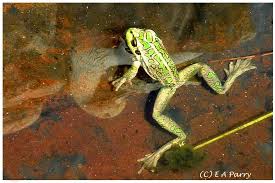
http://t3.gstatic.com/images?q=tbn:oTBfOGA5itQV5M:http://afrogpond.com/files/motorbike-frog-eaparry.jpg
Some frogs/toads walk or gallop briefly rather than hop. Many treefrogs mostly climb on 4 limbs, boreal toads tend to walk more than hop on the ground. The natterjack ground gallops briefly on all four, and burrows into drying salt-mires with forelimbs initially and then rear limbs.
http://scienceblogs.com/tetrapodzoology/2009/10/natterjack_life_and_times.php
This parallels primates/hominoids again, the change from ancestral long-tail locomotion (monkeys/salamanders) to non-tail hydrostatic foraging results in modified locomotion (leaping/swinging) which in some species returns to near-ancestral qpal locomotion in some species (natterjack/knucklewalking apes). The only missing parallel remaining is the possible frog which developed bipedal gait, so far not found in nature. Possibly long-tailed proto-archosaurs (ancestors of crocs, T rex, birds) developed from a coastal arboreal salamandrid, which in the avian line lost the long tail after branch vertical perching and reversed toe evolved.
Wednesday, June 17, 2009
Dahab
freediving through the arc
Water babies
Through the Arch (freediving in Dahab) from dahaba.net on Vimeo.
Water babies
Friday, June 12, 2009
Parallel convergence
Sit float feeding in warm water -> hominoid, absent tail, air sac
Sit grass feeding on dry ground -> gelada, long tail, no air sac
Sit float feeding in warm water -> LCA toad/frog, throat sac, croak, long
prehensile tongue, rear feet similar to other frogs
Dive & swim in water -> diving frog, no throat sac, no croak, trill, no more
long prehensile tongue, rear feet differs from other frogs
Diving frog
This most-aquatic frog has a unique immunity to the fungi that is killing
amphibians around the world. Breath control.
Dive & swim in water -> human, no throat sac, no croak, speech/click
no prehensile toes, rear feet differs from other hominoids
Diving hominoid
This most-aquatic hominoid has a unique condition (domestication) that is
killing hominoids around the world. Breath control.
Parallel convergence among tetrapods.
-
Orang-utans: Our Closest Relative?
Lluc
I find it odd that Lluca was pictured as a flat faced orangutan, considering
that it is the most distant of all hominoids from the current location of the
orangutan populations. Yet if it was merely the westernmost kin of a ring
species of base Pongid-Hominid apes which distributed along the Tethys shores
with localized dietary and predatory adaptations, and varying degrees of
bipedality, it is not so surprising.
IMO the question is not "are humans and orangs most closely related?" but
rather, "why do people insist on placing human ancestors geographically next to
chimps and gorillas, despite the gross differences in morphology?". Two closely
related species living in the same environment do not change drastically their
morphology, see gorillas and chimps.
Since lowland gorillas forage for floating AHV in brackish water, mountain
gorillas forage in highland fog forests for ground THV, savanna chimps forage in
open woodlands, forest chimps forage for small invertebrates in shallow water
and rainforest bonobos forage in the sub-canopy, we know that human ancestors
must have done something different (or in addition) to account for the extreme
morphological changes.
Crocs and hippos dominate the tropical waters of Africa except for small puddles
and highland waters, notably they lack both fur and SC fat, like manatees, they
rely on the sun's warmth in shallow water. Beavers and otters have thick fur and
live in sub-tropical and temperate waters, with the habit of cool water diving.
Humans, unlike all other great apes, fit in between these two groups, sun
basking (ashore and afloat in warm water) and cool-water deep-diving (deeper
than body length).
That this would have developed after the Orangutan had split eastwards and the
African apes split westwards, seems most parsimonious. The human ancestor seems
to have done neither, until they had well adapted to and dominated their new
African and Asian niches.
Rather, human ancestors seem to have paralleled the crab eating macaques (and
possibly Allen's swamp monkey), foraging both at the shoreline and beneath the
water surface, but still retaining the primate ability to climb. (also
paralleling the African clawed frog and marine otters, which can climb but not
as well as treefrogs or stoats.)
Why would human ancestors have generally stopped climbing and hanging from tree
branches and reeds while foraging? Because they brought their sticks with them
into the water to get food, just as chimps bring customized sticks to spear
bushbabies, to gather termites, to collect honey, to dig tubers in the wet
season. Orangutans don't customize sticks, though they use twigs to get neesia
seeds from spiny fruit, using their lips since one hand and both feet are used
to keep them in position in the high forest canopy.
Human ancestors didn't need their hands and feet to keep in position in the
canopy, because the canopy was low at shorelines, and because the food was as
much under the water surface as above, including later ambushed prey.
I can think of an interesting parallel here, whereby the young and old males
both compete individually and cooperate societally,
Gorilla: young lighter males climbing to canopy, older large males actively
ground foraging and in bais shallows
Orangutan: young lighter males climbing to canopy to forage, older larger males
lower (and if no cats) on ground foraging in swamps.
Aquarboreal ape: young males more mobile fruit foraging, older larger males at
tidal waterside peeling mangrove oysters and papyrus.
He: young males climbing coconut palms, older larger males more in water diving
for longer periods.
Hn: young males in waterside trees leaping onto and stabbing thirsty animals
into the water, older larger fatter males backfloating camouflaged with long
spears aimed at the prey's throats and chest as they dash into deeper water away
from the airborne ambush.
Hs: young trim males as paddlers/sailors/fishers, older larger males as ship
builders/captains/bankers.
A bit simplified but interesting. Not sure what happened to the "harem" and size
dimorphism, seems variable depending on climate, but otherwise a sort of
continuum. I'd think the shoreline would make for weaker harem/dimorphism
societies than the inlands where drought would be more drastic. The very deep
diving elephant seal harems seem to contradict this, but that may be due to
quite different constraints (simultaneous birthing, cyclical food supply) than
an aquatic ape (with hidden estrus and year around birth) which could forage
above, below and along the surface, and travel far inland during the muddy
coastal rainy season.
Sit grass feeding on dry ground -> gelada, long tail, no air sac
Sit float feeding in warm water -> LCA toad/frog, throat sac, croak, long
prehensile tongue, rear feet similar to other frogs
Dive & swim in water -> diving frog, no throat sac, no croak, trill, no more
long prehensile tongue, rear feet differs from other frogs
Diving frog
This most-aquatic frog has a unique immunity to the fungi that is killing
amphibians around the world. Breath control.
Dive & swim in water -> human, no throat sac, no croak, speech/click
no prehensile toes, rear feet differs from other hominoids
Diving hominoid
This most-aquatic hominoid has a unique condition (domestication) that is
killing hominoids around the world. Breath control.
Parallel convergence among tetrapods.
-
Orang-utans: Our Closest Relative?
Lluc
I find it odd that Lluca was pictured as a flat faced orangutan, considering
that it is the most distant of all hominoids from the current location of the
orangutan populations. Yet if it was merely the westernmost kin of a ring
species of base Pongid-Hominid apes which distributed along the Tethys shores
with localized dietary and predatory adaptations, and varying degrees of
bipedality, it is not so surprising.
IMO the question is not "are humans and orangs most closely related?" but
rather, "why do people insist on placing human ancestors geographically next to
chimps and gorillas, despite the gross differences in morphology?". Two closely
related species living in the same environment do not change drastically their
morphology, see gorillas and chimps.
Since lowland gorillas forage for floating AHV in brackish water, mountain
gorillas forage in highland fog forests for ground THV, savanna chimps forage in
open woodlands, forest chimps forage for small invertebrates in shallow water
and rainforest bonobos forage in the sub-canopy, we know that human ancestors
must have done something different (or in addition) to account for the extreme
morphological changes.
Crocs and hippos dominate the tropical waters of Africa except for small puddles
and highland waters, notably they lack both fur and SC fat, like manatees, they
rely on the sun's warmth in shallow water. Beavers and otters have thick fur and
live in sub-tropical and temperate waters, with the habit of cool water diving.
Humans, unlike all other great apes, fit in between these two groups, sun
basking (ashore and afloat in warm water) and cool-water deep-diving (deeper
than body length).
That this would have developed after the Orangutan had split eastwards and the
African apes split westwards, seems most parsimonious. The human ancestor seems
to have done neither, until they had well adapted to and dominated their new
African and Asian niches.
Rather, human ancestors seem to have paralleled the crab eating macaques (and
possibly Allen's swamp monkey), foraging both at the shoreline and beneath the
water surface, but still retaining the primate ability to climb. (also
paralleling the African clawed frog and marine otters, which can climb but not
as well as treefrogs or stoats.)
Why would human ancestors have generally stopped climbing and hanging from tree
branches and reeds while foraging? Because they brought their sticks with them
into the water to get food, just as chimps bring customized sticks to spear
bushbabies, to gather termites, to collect honey, to dig tubers in the wet
season. Orangutans don't customize sticks, though they use twigs to get neesia
seeds from spiny fruit, using their lips since one hand and both feet are used
to keep them in position in the high forest canopy.
Human ancestors didn't need their hands and feet to keep in position in the
canopy, because the canopy was low at shorelines, and because the food was as
much under the water surface as above, including later ambushed prey.
I can think of an interesting parallel here, whereby the young and old males
both compete individually and cooperate societally,
Gorilla: young lighter males climbing to canopy, older large males actively
ground foraging and in bais shallows
Orangutan: young lighter males climbing to canopy to forage, older larger males
lower (and if no cats) on ground foraging in swamps.
Aquarboreal ape: young males more mobile fruit foraging, older larger males at
tidal waterside peeling mangrove oysters and papyrus.
He: young males climbing coconut palms, older larger males more in water diving
for longer periods.
Hn: young males in waterside trees leaping onto and stabbing thirsty animals
into the water, older larger fatter males backfloating camouflaged with long
spears aimed at the prey's throats and chest as they dash into deeper water away
from the airborne ambush.
Hs: young trim males as paddlers/sailors/fishers, older larger males as ship
builders/captains/bankers.
A bit simplified but interesting. Not sure what happened to the "harem" and size
dimorphism, seems variable depending on climate, but otherwise a sort of
continuum. I'd think the shoreline would make for weaker harem/dimorphism
societies than the inlands where drought would be more drastic. The very deep
diving elephant seal harems seem to contradict this, but that may be due to
quite different constraints (simultaneous birthing, cyclical food supply) than
an aquatic ape (with hidden estrus and year around birth) which could forage
above, below and along the surface, and travel far inland during the muddy
coastal rainy season.
Friday, June 5, 2009
Spiral garden

My interpretation: A screened geodesic bubble frame with wind-spinning spiral ramp garden, fish & seafood pond below, ballasted with coral-crete and anchored offshore.
From here: plantagon
Wednesday, April 22, 2009
From sit-float-feeding to backfloat-dive-feeding to boat-net-feeding
AAT ~20ma initiation, 5ma immersion, 2ma dive/backfloating
I've no argument with Hardy's 20ma and Filler's date of ~20ma as initial aquatic
era, in an evolutionary sense. Upright posture, proconsul/morotopith wetland
sit-float-feeding as a change from its predecessor of upright dry sitting
(geladas) indicates daily aquatic foraging (surface feeding with gradually
enlarging air sacs and shrinking tail, maintained even in today's lowland
gorillas).
Homo Genus 5ma developing estuarine submersion foraging (crouch plucking), 3ma
seashore diving, 1.5ma diving/backfloating ARC cycle around the Levant and
former peri/tethys and upper Rift, gradual increase in waterside group ambush
improved tool technologies, which eventually took them to cooler rougher
predator-filled waters where rafts and boats were advantageous.
-
This from PZ's blog:
http://scienceblogs.com/pharyngula/2009/07/the_evolution_of_hedgehog.php#more
"As usual, it starts on a sound foundation of confirmed, known evidence, makes a reasonably hypothesis on the basis of the facts, and then proposes a series of research avenues with predicted results that would confirm the idea."
Re: From sit-float-feeding to backfloat-dive-feeding to boat-net-feeding
PAs can argue forever about details when evidence is scattered and lacking, and
topography and climate changes at varying rates.
I've produced a simple explanation, of how hominoids differentiated from other
primates (tail loss, air sacs), how Homo differentiated from other hominids (ARC
diving, low UV saltwater backfloating), and how Homo sapiens differentiated from
other Homo (mass harvesting -> trade -> transport).
Of the question 'What happened?' the missing pieces of the puzzle have been
found and placed, they fit.
Other explanations for the unique characteristics of humans compared to our genetic kin fall short by not taking into account various behaviors and vestigial traits common to humans but not to other primates. That doesn't mean they are insignificant or incorrect, just incomplete.
The story is a bit more complete now.
Prose of human speciation
Hominoids vs other primates (sit/float/eat, tail loss, air sacs),
Homo vs other hominids (ARC diving, low UV saltwater backfloating),
Homo sapiens vs other Homo (mass harvesting/transport).
---
Hominoids sit/floating on flooded ground,
hands to pluck/peel/pull/pinch,
calls/splashes/thumps to warn,
sleep in tree hollows, forks (damp), beaver dens
eat meat without bones (eggs, pith, larvae, seeded fruit)
Homo going deeper into water/caves, while apes went higher,
Homo crafted long/sharp fangs/claws of sticks/stones/shells.
Using pebbles to crack, flakes to cut, bifacials to bait, branches to bash,
spears to probe/pry/poke, lords of the ring/pond/pool
eat meat/nuts with shells/bones to be removed and reused.
Hs brought sunlight into cold night (fire),
and dark into hot day (shelter), and wet into dry.
Bags/baskets/boats processed (cut, woven) to transport, harpoons/atlatls to
launch spears/darts.
Meats/grains to guide/process (planting/herding), grinding masses, soaking,
heating, storing, exchanging, comparing.
Rings concentrically ordered, become overly congested and condense into
rectilinear patterns and vertical double-storied dwellings and overlapped social
groupings and finally oral-named individuals become anonymously writ-numbered
cells in the spherical body of humankind and beyond.
Compare these two shelters: entry routes, protection from bears/cold
link
link
Mammoth bone lodge of Central Russian floodplain 15ka, summer doorway
link
22ka camp huts & bedding at upper Rift waterside link
seal ancestors link
DDeden
I've no argument with Hardy's 20ma and Filler's date of ~20ma as initial aquatic
era, in an evolutionary sense. Upright posture, proconsul/morotopith wetland
sit-float-feeding as a change from its predecessor of upright dry sitting
(geladas) indicates daily aquatic foraging (surface feeding with gradually
enlarging air sacs and shrinking tail, maintained even in today's lowland
gorillas).
Homo Genus 5ma developing estuarine submersion foraging (crouch plucking), 3ma
seashore diving, 1.5ma diving/backfloating ARC cycle around the Levant and
former peri/tethys and upper Rift, gradual increase in waterside group ambush
improved tool technologies, which eventually took them to cooler rougher
predator-filled waters where rafts and boats were advantageous.
-
This from PZ's blog:
http://scienceblogs.com/pharyngula/2009/07/the_evolution_of_hedgehog.php#more
"As usual, it starts on a sound foundation of confirmed, known evidence, makes a reasonably hypothesis on the basis of the facts, and then proposes a series of research avenues with predicted results that would confirm the idea."
Non-scientists take note: this is a category of paper that is usually titled "hypothesis" or "insight," as opposed to a peer-reviewed research paper or a literature review, although it is more similar to the latter. PLoS Biology uses the term "unsolved mystery:"
Unsolved Mysteries discuss a topic of biological importance that is poorly understood and in need of research attention.-
Re: From sit-float-feeding to backfloat-dive-feeding to boat-net-feeding
PAs can argue forever about details when evidence is scattered and lacking, and
topography and climate changes at varying rates.
I've produced a simple explanation, of how hominoids differentiated from other
primates (tail loss, air sacs), how Homo differentiated from other hominids (ARC
diving, low UV saltwater backfloating), and how Homo sapiens differentiated from
other Homo (mass harvesting -> trade -> transport).
Of the question 'What happened?' the missing pieces of the puzzle have been
found and placed, they fit.
Other explanations for the unique characteristics of humans compared to our genetic kin fall short by not taking into account various behaviors and vestigial traits common to humans but not to other primates. That doesn't mean they are insignificant or incorrect, just incomplete.
The story is a bit more complete now.
Prose of human speciation
Hominoids vs other primates (sit/float/eat, tail loss, air sacs),
Homo vs other hominids (ARC diving, low UV saltwater backfloating),
Homo sapiens vs other Homo (mass harvesting/transport).
---
Hominoids sit/floating on flooded ground,
hands to pluck/peel/pull/pinch,
calls/splashes/thumps to warn,
sleep in tree hollows, forks (damp), beaver dens
eat meat without bones (eggs, pith, larvae, seeded fruit)
Homo going deeper into water/caves, while apes went higher,
Homo crafted long/sharp fangs/claws of sticks/stones/shells.
Using pebbles to crack, flakes to cut, bifacials to bait, branches to bash,
spears to probe/pry/poke, lords of the ring/pond/pool
eat meat/nuts with shells/bones to be removed and reused.
Hs brought sunlight into cold night (fire),
and dark into hot day (shelter), and wet into dry.
Bags/baskets/boats processed (cut, woven) to transport, harpoons/atlatls to
launch spears/darts.
Meats/grains to guide/process (planting/herding), grinding masses, soaking,
heating, storing, exchanging, comparing.
Rings concentrically ordered, become overly congested and condense into
rectilinear patterns and vertical double-storied dwellings and overlapped social
groupings and finally oral-named individuals become anonymously writ-numbered
cells in the spherical body of humankind and beyond.
Compare these two shelters: entry routes, protection from bears/cold
link
link
Mammoth bone lodge of Central Russian floodplain 15ka, summer doorway
link
22ka camp huts & bedding at upper Rift waterside link
seal ancestors link
DDeden
Thursday, April 16, 2009
Tuesday, April 7, 2009
Bio-convergent parallel: Anuroid & Hominoid
Arkive Video: Gorillas vertical wading and wet-sit-eating
left: dryland gelada, long-tailed, vertical-trunk, dry-sit-eat grasses, no air sac
right: lowland gorilla, tail-less, vertical-trunk, wet-sit-eat sedges, air sac


Another Video: Lowland Gorillas eating sedge rhyzomes and high-protein AHV (Aquatic Herbaceous Vegetation) while sitting-floating in forest open wetland Arkive video link
DD: The question is not "do air sacs always cause loss of tail?", but "is the complete loss of tail in hominoids due (in part) to laryngeal air sac?" The answer is clear, yes, float-sit-feeding with inflatable air sac selects for tail loss.
MV: Not so clear IMO: may depend on body size, size of airsacs, terrestrial vs aquatic milieu, salt vs fresh water milieu, time spent in trees & water, arm-hanging vs hopping vs above-branch, etc.
DD: parallel convergence at forest-waterside (swamp, wetland, shore):
left: Axlotl, long-tailed 'tadpole' with external gills and legs, swims but doesn't sit
right: Macaque, long-tailed, with lungs and legs, swims but doesn't feed sit-floating


Tadpoles with long tail swim, they don't sit partially feeding in water, they don't have prehensile tongue; frogs with no tail sit partially in water, and use long prehensile tongue to eat. Some frogs then evolved more arboreal traits (better climbing skills, less swimming), others spend much time on lake bottoms and developed more aquatic traits (skin 'gill' breathing)
left: tree frogs have since further specialized to arborealty, more 'spidery' and colorful
right: aquatic frog with hydrodynamic red external gills re-adapted to full submersion


Monkeys with long tails swim (Nasalis, Long-tailed macaque); while Ndoki swamp gorillas
(~LCA H-oid) with no tail sit partially in water while feeding.
left: tree apes have since further specialized to arborealty, more 'spidery' and colorful
right: aquatic apes (humans) with hydrodynamic hair re-adapted to submersion diving


AFAIK, neither spidery tree frogs nor deep-submersion frogs inflate their throat air sacs as much as forest-waterside frogs.
AFAIK, neither spidery tree apes (gibbon) nor deep submersion apes (humans) inflate their throat air sacs as much as forest-waterside apes.
Parallel pattern. Partial sit-float eating -> air sac -> tail lost; eventually species body size may enlarge at forest-waterside, OR become full-time spidery at arboreal canopy OR adapt deep submersion with active skin glands* or skin gills* as per photos.
DD: Complete loss of tail = vertical-trunk float-sitting while plucking-foraging. Laryngeal air sacs. Compare to long tailed gelada sitting while plucking-foraging grass on dry ground. No air sacs there, of course.
MV: Some baboons have short tails IIRC?
DD: None lost their tail, many highland monkeys (cold nights select for short tails) with non-prehensile tails have short tails. Tail covers peri-anal region, in water, muscle valves and tissue close peri-anal region.
Dry-sit-eating (no air sac, long-tailed) savanna gelada vs wet/float-sit-eating (air sac, tail-less) Ndoki swamp gorilla
http://tech.groups.yahoo.com/group/AAT/message/49817
* frogs and salamanders may respire via gills, lungs or skin. I conjecture that the eccrine skin glands of humans (inactive in African apes except volar eccrines) function in very limited respiration. link
Evolution Canyon European-African micro-climates in Jordan Rift Valley
Flowering plants & veination 140ma:
http://www.eurekalert.org/pub_releases/2009-12/w-hdf120109.php
The study, by Dr Tim Brodribb and Dr Taylor Field of the University of Tasmania and University of Tennessee, used plant physiology to reveal how flowering plants, including crops, were able to dominate land by evolving more efficient hydraulics, or 'leaf plumbing', to increase rates of photosynthesis.
"Flowering plants are the most abundant and ecologically successful group of plants on earth," said Brodribb. "One reason for this dominance is the relatively high photosynthetic capacity of their leaves, but when and how this increased photosynthetic capacity evolved has been a mystery."
Using measurements of leaf vein density and a linked hydraulic-photosynthesis model, Brodribb and Field reconstructed the evolution of leaf hydraulic capacity in seed plants. Their results revealed that an evolutionary transformation in the plumbing of angiosperm leaves pushed photosynthetic capacity to new heights.
The reason for the success of this evolutionary step is that under relatively low atmospheric C02 conditions, like those existing at present, water transport efficiency and photosynthetic performance are tightly linked. Therefore adaptations that increase water transport will enhance maximum photosynthesis, exerting substantial evolutionary leverage over competing species.
left: dryland gelada, long-tailed, vertical-trunk, dry-sit-eat grasses, no air sac
right: lowland gorilla, tail-less, vertical-trunk, wet-sit-eat sedges, air sac


Another Video: Lowland Gorillas eating sedge rhyzomes and high-protein AHV (Aquatic Herbaceous Vegetation) while sitting-floating in forest open wetland Arkive video link
DD: The question is not "do air sacs always cause loss of tail?", but "is the complete loss of tail in hominoids due (in part) to laryngeal air sac?" The answer is clear, yes, float-sit-feeding with inflatable air sac selects for tail loss.
MV: Not so clear IMO: may depend on body size, size of airsacs, terrestrial vs aquatic milieu, salt vs fresh water milieu, time spent in trees & water, arm-hanging vs hopping vs above-branch, etc.
DD: parallel convergence at forest-waterside (swamp, wetland, shore):
left: Axlotl, long-tailed 'tadpole' with external gills and legs, swims but doesn't sit
right: Macaque, long-tailed, with lungs and legs, swims but doesn't feed sit-floating


Tadpoles with long tail swim, they don't sit partially feeding in water, they don't have prehensile tongue; frogs with no tail sit partially in water, and use long prehensile tongue to eat. Some frogs then evolved more arboreal traits (better climbing skills, less swimming), others spend much time on lake bottoms and developed more aquatic traits (skin 'gill' breathing)
left: tree frogs have since further specialized to arborealty, more 'spidery' and colorful
right: aquatic frog with hydrodynamic red external gills re-adapted to full submersion


Monkeys with long tails swim (Nasalis, Long-tailed macaque); while Ndoki swamp gorillas
(~LCA H-oid) with no tail sit partially in water while feeding.
left: tree apes have since further specialized to arborealty, more 'spidery' and colorful
right: aquatic apes (humans) with hydrodynamic hair re-adapted to submersion diving


AFAIK, neither spidery tree frogs nor deep-submersion frogs inflate their throat air sacs as much as forest-waterside frogs.
AFAIK, neither spidery tree apes (gibbon) nor deep submersion apes (humans) inflate their throat air sacs as much as forest-waterside apes.
Parallel pattern. Partial sit-float eating -> air sac -> tail lost; eventually species body size may enlarge at forest-waterside, OR become full-time spidery at arboreal canopy OR adapt deep submersion with active skin glands* or skin gills* as per photos.
DD: Complete loss of tail = vertical-trunk float-sitting while plucking-foraging. Laryngeal air sacs. Compare to long tailed gelada sitting while plucking-foraging grass on dry ground. No air sacs there, of course.
MV: Some baboons have short tails IIRC?
DD: None lost their tail, many highland monkeys (cold nights select for short tails) with non-prehensile tails have short tails. Tail covers peri-anal region, in water, muscle valves and tissue close peri-anal region.
Dry-sit-eating (no air sac, long-tailed) savanna gelada vs wet/float-sit-eating (air sac, tail-less) Ndoki swamp gorilla
http://tech.groups.yahoo.com/group/AAT/message/49817
* frogs and salamanders may respire via gills, lungs or skin. I conjecture that the eccrine skin glands of humans (inactive in African apes except volar eccrines) function in very limited respiration. link
Evolution Canyon European-African micro-climates in Jordan Rift Valley
Flowering plants & veination 140ma:
http://www.eurekalert.org/pub_releases/2009-12/w-hdf120109.php
The study, by Dr Tim Brodribb and Dr Taylor Field of the University of Tasmania and University of Tennessee, used plant physiology to reveal how flowering plants, including crops, were able to dominate land by evolving more efficient hydraulics, or 'leaf plumbing', to increase rates of photosynthesis.
"Flowering plants are the most abundant and ecologically successful group of plants on earth," said Brodribb. "One reason for this dominance is the relatively high photosynthetic capacity of their leaves, but when and how this increased photosynthetic capacity evolved has been a mystery."
Using measurements of leaf vein density and a linked hydraulic-photosynthesis model, Brodribb and Field reconstructed the evolution of leaf hydraulic capacity in seed plants. Their results revealed that an evolutionary transformation in the plumbing of angiosperm leaves pushed photosynthetic capacity to new heights.
The reason for the success of this evolutionary step is that under relatively low atmospheric C02 conditions, like those existing at present, water transport efficiency and photosynthetic performance are tightly linked. Therefore adaptations that increase water transport will enhance maximum photosynthesis, exerting substantial evolutionary leverage over competing species.
Saturday, April 4, 2009
Aquanautical microbiota: Green Algae

Spirogyra reproduction, reminds one of double helix DNA, chromosome replication
Dancing spheres: volvox rotates, oscillates
Volvox reproduction, note the triangulation of cytoplasm threads, geodesic structure

volvox A large sphere colony with daughter sphere colonies containing small granddaughter colonies. Both male and female colonies form inside the equator of the parent colony. Volvoxes are hollow spheres of independent cells that each have an eye spot, the colony develops a light-polarity, where half of the colony has larger eye spots, making a supercell eyeball of sorts. Click the link to find out more. volvox wikipedia
nuther volvox tale

Pediastrum algae, a flat disk star

These outstanding photos are from this site: The Micropolitan Museum
Hydrodictyon reticulatum, Hexa-penta Water net algae, from: Hydrodictyon, Wikipedia

Protists: dinoflagellate plant/animal (planimal?) in toxic red tide, endosymbiont coral bleaching, some photosynthesizers and some with eyes (retina), have minicircles of 12 genes.
http://madlabrat.blogspot.com/2009/10/protists-and-their-plastids.html
Marimo Moss balls (Chladophora)
from cell to super-cell organism to super-organism society: colonial ants
-
Nutrition: Seaweed gardens
Naturally growing seaweeds are an important source of food, especially in Asia. They provide many vitamins including: A, B1, B2, B6, niacin and C, and are rich in iodine, potassium, iron, magnesium and calcium.[50] In addition commercially cultivated microalgae, including both Algae and Cyanobacteria, are marketed as nutritional supplements, such as Spirulina,[51] Chlorella and the Vitamin-C supplement, Dunaliella, high in beta-carotene.
Algae are national foods of many nations: China consumes more than 70 species, including fat choy, a cyanobacterium considered a vegetable; Japan, over 20 species;[52] Ireland, dulse; Chile, cochayuyo.[53] Laver is used to make "laver bread" in Wales where it is known as bara lawr; in Korea, gim; in Japan, nori and aonori. It is also used along the west coast of North America from California to British Columbia, in Hawaii and by the Māori of New Zealand. Sea lettuce and badderlocks are a salad ingredient in Scotland, Ireland, Greenland and Iceland.
Dulse, a food.
The oils from some Algae have high levels of unsaturated fatty acids. For example, Parietochloris incisa is very high in arachidonic acid, where it reaches up to 47% of the triglyceride pool.[54] Some varieties of Algae favored by vegetarianism and veganism contain the long-chain, essential omega-3 fatty acids, Docosahexaenoic acid (DHA) and Eicosapentaenoic acid (EPA), in addition to vitamin B12. The vitamin B12 in algae is not biologically active. Fish oil contains the omega-3 fatty acids, but the original source is algae, which are eaten by marine life such as copepods and are passed up the food chain.[55] wikipedia: algae nutrition
Friday, March 27, 2009
Asian small clawed otter pups
teh cuteness
LOL-otterz at San Diego Zoo
Coastal Forest Giants: leave some for the future
Northern California Redwood trees
Tasmania Eucalyptus trees

LOL-otterz at San Diego Zoo
Coastal Forest Giants: leave some for the future
Northern California Redwood trees
Tasmania Eucalyptus trees
Monday, March 16, 2009
water

Come gather 'round people
Wherever you roam
And admit that the waters
Around you have grown
And accept it that soon
You'll be drenched to the bone.
If your time to you
Is worth savin'
Then you better start swimmin'
Or you'll sink like a stone
For the times they are a-changin'.
Bob Dylan
deep time
World Water Day @ 'All my faults are stress related'
The Water Management Cluster is concerned about inland water supplies and their continued availability and quality. Existing water management activities through the NASA-funded WaterNet and the EPA-funded Midwest Spatial Decision Support Systems Partnership will be central to the work of this cluster.
The Water Management Cluster has focused its initial activities on inland basin water pollution and on drought and its impacts. Of special interest to the cluster is the NOAA National Integrated Drought Information System (NIDIS) portal being developed.

Oil companies buy water supplies big oil and little water
Sunday, March 1, 2009
Bay side base site

Boat house harbor (my boat in my father's boathouse) at Bay point park, Mississippi river, between the bluffs & tracks & bikes & trucks & traix archipelago (riparian).
boathouse village between MN & WI


Marine science program at College of the Redwoods CR link
Sunday, February 22, 2009
Aquabase


http://technology.timesonline.co.uk/tol/news/tech_and_web/microtrends/article5693274.ece
A house by the sea is a common dream. But in it? Surely that's only for James Bond baddies. Not so... an article by Murad Ahmed
Once the preserve of Bond villains, “semi-submerged environments”, or aquabases, to give them a more memorable name, are the latest projects being addressed by architects.
– These are homes that float on water, but with a submerged basement that can give you a great view of the ocean floor.
– One example is the Trilobis 65, designed by Giancarlo Zema. This amphibious home has four levels, half of which are a few metres underwater, and it can house a family of six. In fact, it’s a form of boat and can move at seven knots, although criminal masterminds may find it is not suited to making a quick getaway.
[DD: The dock reminds me a a floating dome I designed earlier. Don't take the trilobis near coral or rocky reefs in heavy surf!]
– Even more ambitious are the designs of Vincent Callebaut. His Lilypad is a floating eco-town that can accommodate 50,000 people. Self-sufficient, it runs on renewable energy and has a central freshwater lagoon that collects and purifies rain water. Huge shopping malls come built in as standard.
Comment: There's much more info available on this topic. Look up for instance "The Seasteading Book," a detailed online text about how to move beyond far-out utopian projects into something practical. Seasteading presents a new possibility for building a free society while socialism eats the West. Comment by Kris, Lancaster, Pennsylvania, USA
home offshore? Not for me, thanks, I like trees and sandy beaches. Maybe an island anchored to a seamount, with sliding dome cover for typhoons, with beach and coconut palms and lagoon and freshwater waterfall?
Water & Human Evolution
SOUTH AFRICA'S FAMOUS fossil apeman sites - Taung near Kimberley,
Sterkfontein, Swartkrans and Kromdraai near Krugersdorp, and Makapansgat
near Pietersburg - are situated in what is today the dry hinterland of the
subcontinent. So is the Olduvai Gorge on the Serengeti Plain of Tanzania,
Koobi Fora in the north and north-east of Kenya, and Bahr-el-Ghazal in the
Chad Republic in the Sahara Desert.
Yet, wherever the early members of the human family were evolving, they
needed water to drink and to keep cool. Proximity to water was the most
important factor in the location of an evolving group like the early
hominids. They must have lived near springs, rivers, lakes and freshwater
estuaries. Denied water in warm, tropical or sub-tropical climates, humans
quickly become dehydrated and death may follow in days. Water is necessary
for survival and an essential ingredient for evolutionary change.
Water and human dispersal
Water helped distribute humans across the planet, along seashores, lakes and
river banks. This would have accounted for the prehistoric peopling of most
of the Old World, from Africa to Europe and mainland Asia. Strolling or
swimming along the beach would have been sufficient to carry mankind from
the Horn of Africa to the Peloponnesos of Greece, from the Levant to the
Korean Peninsula, from Singapore to Siberia. When much water was bound up on
land as glaciers in the Ice Ages, sea levels were lower than they are today,
and previously submerged land-bridges appeared, helping spread humans to new
parts of the earth. At such times, it would have been possible to walk
dryshod from Tripoli and Tunisia to Malta and Sicily, from South Korea to
South Japan and from the Sakhalin Peninsula to Hokkaido, North Japan, from
Malaysia to Sumatra, Java and Bali and from Siberia to Alaska over the
500km-wide land connection called Beringia.
At some stages and in some places, humans learned to cross the water, even
without a land-bridge. Java and Bali were periodically connected to the
Asian mainland, so that animals, including humans, could easily cross to
them. However, the Indonesian island of Flores could be reached only by sea
crossings even when the sea level was lowest. Yet stone tools and fossil
bones on Flores show that humans (probably Homo erectus) and archaic
elephants (Stegodon) must have crossed this 19km-wide, deep oceanic channel
900 000 to 800 000 years ago. There is no evidence that they knew how to
make boats so early. Either they floated across using tree trunks and logs
as rafts, or they swam.
Another deep oceanic channel - the Strait of Gibraltar - lies between Ceuta
and Morocco in North Africa and Gibraltar and Spain. The strait today is
about 13 km at its narrowest point but when the sea-levels of the Atlantic
and Mediterranean were lower, the distance across was smaller and a few
islands (presently under water) would have appeared. The greatest sea
crossing then would have been only five kilometres. Stone tools and probable
fossil hominid remains between 1.5 and one million years old have been found
in south-eastern Spain near the village of Orce and the city of Murcia. For
a long time, the question has been: how did these earliest Europeans get to
the Iberian Peninsula from North Africa? There are two fairly obvious
overland routes one through the Middle East across Suez and the Levant,
and one from Tripoli, via Malta, Sicily, the Strait of Messina to Calabria,
the toe of Italy. To get to the south of Spain from either of these two
passages would have involved taking the long way round, including the
crossing of the Pyrenees in a southerly direction. Several of us have been
pursuing the option of the short cut the water traverse from Ceuta to
Spain. If people and elephants could get across a wider channel to get to
Flores just under a million years ago, I believe it is very likely that the
smaller water crossing of the Strait of Gibraltar would have been within
human capacity just over a million years ago. Again, floating, rafting on
flotsam and possibly even swimming seem to have been early acquisitions in
human cultural and behavioural evolution. Boats are technologically advanced
inventions which probably came much later.
These are details. The principle remains that water must have played a
crucial role in the distribution of humanity across the planet.
Semi-aquatic human ancestors?
The third way in which water is thought by some to have affected human
evolution is a nearly 40-year-old proposal, the Aquatic Ape Theory (AAT),
which holds that mankind evolved some of its distinctive features in an
aquatic environment and that ancient human ancestors spent more time in the
water than present-day descendants. As Graeme Addison explained in Out There
(January 1998), Sir Alister Hardy put forward the idea that man was more
aquatic in the past, following Max Westenhöfer's 1923 proposal that some
modern human anatomical features indicate an aquatic form of adaptation.
The idea was largely ignored by Hardy's contemporaries. There are two ways
in which a new idea in science is rejected: one is by direct confrontation
and attempts to refute it; the other is by turning a blind eye to it and
hoping that it will simply go away.
Among those who opposed the AAT, some pointed out that there were no fossils
to support it. One is tempted to ask what sort of fossils did they expect?
Those fossils already discovered in South and East Africa, four to three
million years old, show signs that they belonged to erect bipedal hominids.
One of the things the AAT proposed was that the early hominids developed
uprightness to hold the head above water while wading. Claiming that
water-adapted fossils had not been found, amounts to a circular argument
when the theory of water-adaptedness purported to explain the very erectness
of those fossil skeletons that had been found!
When a new idea is rejected, it is frequently because it flies in the face
of an accepted prevailing paradigm, in this case the Savannah Hypothesis
(SH).
The Savannah Hypothesis
From 1925 to 1995 almost everyone grew up on the "received wisdom" that the
Hominidae (the family of mankind) was born on the savannah, believed to have
been the ideal crucible in which the strange form of locomotion known as
bipedalism came into being. The idea is an old one. Robert Broom, in his
1933 book The Coming of Man: was it Accident or Design? stated: "Before
Australopithecus was discovered some of us believed that the ancestor of man
would be found in an anthropoid ape which had left the forest and taken to
living on the plains and among the rocks; and here (in Australopithecus, the
Taung child) we have just such a form."
Raymond Dart's 1925 paper, that announced the features of the little fossil
child from Taung, included this passage: "For the production of man a
different apprenticeship was needed to sharpen the wits and quicken the
higher manifestations of intellect a more open veldt country where
competition was keener between swiftness and stealth, and where adroitness
of thinking and movement played a preponderating role in the preservation of
the species... in my opinion, Southern Africa, by providing a vast open
country with occasional wooded belts and a relative scarcity of water,
together with a fierce and bitter mammalian competition, furnished a
laboratory such as was essential to this penultimate phase of human
evolution." (Emphasis mine)
From the animal remains found with the Australopithecus child, Broom (1933)
wrote, "... we can safely infer that the rainfall was then, as now, scanty,
and that there were no forests in that region, only grassy and bushy plains
from which the hills and krantzes arose."
My generation grew up steeped in what more recently has been called the
Savannah Hypothesis. As Elaine Morgan has chronicled in her book, The
Aquatic Ape Hypothesis (1997), this view was supported, directly or
indirectly, by numerous scholars, including Sherwood Washburn, Kenneth
Oakley, Richard Leakey, Peter Wheeler, Alan Walker. It was a paradigm that
lasted for about 70 years of this century.
In 1980, the Africanist archaeologist J. Desmond Clark put forward a
modified version of SH which favoured a mixed ecology. He said "there is
little doubt that proto-hominids (ancestors of hominids) were widely
distributed throughout the tropical savannahs. It seems certain that it was
within habitats consisting of mosaics of grassland, woodland, and forest
that the hominid line first became differentiated from that of the pongids
(the apes)." Clark singled out not only the great richness and diversity of
plant and animal resources in the savannahs compared with the forest, and
the fragmentation of the forest cover during the later Miocene-early
Pliocene, which isolated some hominid populations, but also the progressive
expansion of grasslands from that time onward, which made available "empty
niches" into which hominids could expand. These factors, he believed, "can
be expected to have led to a number of adaptations".
In 1985, Elisabeth Vrba suggested that the family of man was probably a
"founder member" of the African savannah fauna! That year, I published a
chapter called "The conquest of the savannah and the attaining of erect
bipedalism" in which I expressed the old idea: "The living apes of Africa
are to be found exclusively in the wet forest of the middle reaches of the
continent. It is likely that ancestral apes, too, were forest-dwelling
creatures...The spread of lighter woodland and savannah and the retreat of
the margins of the primaeval forests could well have created conditions in
which the tendency to uprightness and bipedalism was favoured. The ability
to run across the high grass cover of the savannah, perhaps from one
woodland-girt stream to another, might have held advantages for those apes
which could 'walk tall'. Uprightness gave its possessors a chance to see
over the tall grass and to watch out for predatory enemies like the lions
and sabre-toothed big cats. Seemingly it was under just such a set of
conditions that the Hominidae made their appearance upon the face of the
earth."
That statement may well be the quintessence of the SH - and I believe it was
my last statement in support of it. By 1995, when I gave the Daryll Forde
Memorial Lecture at University College, London, I stated of the SH, "We were
all profoundly and unutterably wrong!"
Repudiation of the Savannah Hypothesis
My disavowal of SH was based in the first place on evidence which had been
coming forth from excavations in South and East Africa. From Sterkfontein,
suggestions of greater woodland cover at the time when Australopithecus was
deposited in Member 4, had emerged from studies on fossil pollen, but these
were not compelling. Then Wits team member Marian Bamford identified fossil
vines or lianas of Dichapetalum in the same Member 4: such vines hang from
forest trees and would not be expected in open savannah. The team at
Makapansgat found floral and faunal evidence that the layers containing
Australopithecus reflected forest or forest margin conditions. From Hadar,
in Ethiopia, where "Lucy" was found, and from Aramis in Ethiopia, where Tim
White's team found Ardipithecus ramidus, possibly the oldest hominid ever
discovered, well-wooded and even forested conditions were inferred from the
fauna accompanying the hominid fossils.
All the fossil evidence adds up to the small-brained, bipedal hominids of
four to 2.5 million years ago having lived in a woodland or forest niche,
not savannah. The evidence for the presence of big forest trees supports the
idea we had gleaned from the bones of "Little Foot" that tree-climbing had
been a part of the lifeways of these early African hominids. At least, one
could conclude, there had been trees big enough to bear the weight of the
Australopithecines (for which stunted acacias of the savannah would have
been unsuitable).
To a large London audience in 1995 I said: "All the former savannah
supporters (including myself) must now swallow our earlier words in the
light of the new results from the early hominid deposits... Of course, if
savannah is eliminated as a primary cause, or selective advantage of
bipedalism, then we are back to square one."
Humans are not savannah-adapted animals
In rejecting the SH, I was moved primarily by the evidence unearthed in
South Africa and East Africa. Meanwhile, Elaine Morgan had been piecing
together a number of other arguments against the SH, based on some
anatomical, biochemical and physiological data of modern humans, much of
which was collected by Belgium's Dr Marc Verhaegen, which contrast sharply
with the traits in present-day animals that are truly adapted to savannah
life.
As examples, modern humans lack sun-reflecting fur and are virtually
hairless. The cooling system in our skin is quite unfit for hot, dry,
exposed environments: we have numerous sweat glands and we waste water and
sodium - not very suitable for life on the savannah. Our ability to
concentrate our urine is poor and too low and if ever our earliest ancestors
were savannah dwellers, we must have been the worst, the most profligate
urinators there.
Adapted savannah-dwellers need to drink more water at a time, but most
humans are not able to drink much at a time. The quantity of our
subcutaneous fat, which would insulate us against heat loss, is never found
in truly savannah-adapted animals.
In our bodily functions, chemistry and microscopical anatomy, we should be
hopeless as savannah-dwellers. So Marc Verhaegen and Elaine Morgan, in her
remarkable book, The Scars of Evolution, came to the same conclusion that we
had reached from quite different lines of evidence: the old Savannah
Hypothesis was not tenable. All former savannah supporters must recant and
this I did in London. It was an exciting moment - living through a change of
paradigm.
Max Planck, the German physicist and Nobel laureate, once wrote these words
on the replacement of an outworn paradigm: "A new scientific truth does not
triumph by convincing its opponents and making them see the light, but
rather because its opponents eventually die, and a new generation grows that
is familiar with it."
That must be one of the masterpieces of cynicism on the scientific process.
Paradigm changes, I like to think, flow overwhelmingly from new evidence
and, where the evidence is sound and even irresistible, they should be
embraced just as lief by the old as by the young. It was three weeks after
my 17th birthday and I went on to declare, "A change of paradigm shakes us
up; it rejuvenates us; and, this above all, it prevents mental
fossilisation - and that is good for all of us."
What the demise of the SH means for the AAT
My formal slaying of the SH removed a key objection to the AAT. Supporters
of the Hardy-Morgan concept hailed this event as my espousal of the aquatic
ape hypothesis. This was not strictly correct for there were other theories
on the “primary causes” of bipedalism, though, to my knowledge, there was
none to explain those physiological and biochemical aspects which seemed to
ally us to marine mammals. Now, at least, anthropologists should be able to
examine this with a more open mind than previously when the thinking of so
many was clouded by the SH.
It seems, however, that the name Aquatic Ape Theory has become a handicap.
For nearly 40 years since Hardy first put the idea forward, AAT has been a
bit of a joke to many scientists, conjuring up visions of a creature that
spent all - or almost all - of its time in the water. Yet Hardy's original
1960 article was modestly entitled, "Was man more aquatic in the past?" In
scientific writing a name can send very misleading messages and the term
"Aquatic Ape" does just that. Replace it with something else, I urged Elaine
Morgan. Then, I think the implications of those apparently water-adapted
features like humans' loss of hair will receive less cynical attention from
those who have hitherto smirked at the mere mention of "The Aquatic Ape"!
At the Dual Congress at Sun City in 1998, Marc Verhaegen and Pierre-François
Puech of France summed the evidence that hominid evolution did not begin in
warm and dry, but in warm and wet conditions. This included new thinking on
what one can infer from the micro-wear on the teeth as to the food of early
hominids: they found signs of marshland plants, molluscs, aquatic herbs.
Dr Michael Crawford of the Institute of Brain Chemistry and Human Nutrition,
London, Dr L Broadhurst of the USA., and other collaborators presented an
unexpected and fascinating study. In his book The Driving Force: Food,
Evolution and the Future (1989), Crawford explores many issues around "the
land-water interface". To develop the large brain characteristic of the
hominids, a chemical known as DHA was necessary. The lack of DHA in savannah
food may explain the "degenerative evolution" of the brains of savannah
species and the reason why Homo sapiens could not have evolved on the
savannahs. The marine food chain, on the other hand, has an abundant supply
of DHA. Early hominids had to make use of the marine food chain to enable
the evolution of brain and brain size to keep pace with body size. Their
claim that the human brain depended on the marine food chain suggests
independent evidence in support of the importance of water in human
evolution.
In the face of all this evidence, old and new, it is time for human
evolutionists to open their minds and give fair and objective thought to the
role of water in the evolution of mankind. We need a new holistic emphasis
on water: first for drinking, secondly as a source of food from aquatic
plants and animals and, thirdly, as waterways facilitating - or impeding -
the spread of humanity across the globe. Fourthly, we may no longer shy away
from the questions posed by those especial features of the human skin,
sweat-glands, chemistry of sweat, body temperature control and fluctuations,
heat and radiation tolerance and water consumption, which in modern humans
appear so different from those of savannah-adapted mammals and so
reminiscent, in some cases, of aquatic mammals.
As the Savannah Hypothesis still held sway when the Valkenburg Conference on
AAT took place 11 years ago, many arguments raised at that meeting are no
longer tenable. Another international forum should be set up to explore the
whole question in the light of the demise of the SH - but please, let it be
under a different name! Tobias, Paleoanthropologist
Tuesday, February 10, 2009
a walk on the beach

a walk on the beach is often the best medicine
http://nymag.com/health/features/46213/
http://forums.deeperblue.com/beach-bar/81903-walk-beach.html
http://www.footprints-inthe-sand.com/index.php?page=Poem/Poem.php
Poem, Footprints in the sand, by Mary Stevenson

1.5 million years ago, set of footprints in Kenya
a day at the beach
Subscribe to:
Posts (Atom)