https://blogger.googleusercontent.com/img/b/R29vZ2xl/AVvXsEhVsohD4Sxlv_DRdoO-oPe86LWxKtDq4BkSl2d5fpkargXIyIdP7hUqkS5PhIitTswcgbYIy3-Fsf7zxlWbKqByiDh9hmkvVWxyRJP4gMfCwi1I-EVIQug8pHxDgaPluv-EuebseXT3Tnra/s1600-h/dodec+lines+on+earth+2.GIF
Plane-face dodecahedron (left) to spherical icosadodecahedron (center & right), great circles, small circles on pent faces may be ocean/air gyres, polar axis vs solar-lunar tides
http://www.progonos.com/furuti/MapProj/Normal/ProjPoly/Foldout/TIcosahedron/Img/ticGn-s128-z5.eos.png
A truncated icosahedron globe
Thursday, March 1, 2012


Wednesday, February 15, 2012
Tent stakes
-referencing:
http://www.metmuseum.org/toah/hd/malt/hd_malt.htm
http://en.wikipedia.org/wiki/Mal
http://en.wikipedia.org/wiki/File:Buretj_(venus_figurine).gif
http://news.bbc.co.uk/2/hi/south_asia/4381893.stm
"There are many interpretations of the figurines, often based on little argument or fact. Like many prehistoric artifacts, the cultural meaning of these figures may never be known. Archaeologists speculate, however, that they may be emblems of security and success, fertility icons, pornographic imagery, or even direct representations of a mother goddess or various local goddesses. The female figures, as part of Upper Palaeolithic portable art, appear to have no practical use in the context of subsistence. They are mostly discovered in settlement contexts, both in open-air sites and caves; burial contexts are much more rare.
At Gagarino in Russia, seven Venus figurines were found in a hut of 5 m diameter; they have been interpreted as apotropaic amulets, connected with the occupants of the dwelling. At Mal'ta, near Lake Baikal, figurines are only known from the left sides of huts." (wikipedia)
[I think a typical couple's hut had 2, a female venus figurine at left of doorway, a male bird/phallus figurine at right of doorway, both acting as ritual symbolic tent stakes/house posts/totem poles. Possibly the male figurine was kept outside the entry at right, the female figurine just inside at left.]
"unlike those found in Europe, some of the Venus figurines from Mal’ta were sculpted with faces. Most of the figurines were tapered at the bottom, and it is believed that this was done so they could have been stuck into the ground or otherwise placed upright some other way."
This "Tibetan ancient tent peg" has some resemblance to the Mal'ta male & female figurines of ivory, has any similar items been found in Altai or Beringia?
http://alphaclassics.com/product_info.php?cPath=22_31&products_id=136
Except for scale it appears to resemble west coast totem poles:
http://upload.wikimedia.org/wikipedia/commons/thumb/3/32/Wrangell_Kiksadi_Totem_Pole.JPG/250px-Wrangell_Kiksadi_Totem_Pole.JPG
A Tlingit totem pole memorializing a woman (note closed wings, perhaps open wings represent male (cf etymology of ball & wing very similar pali/pari/pela, both fly, both related to 'pair').
http://www.historylink.org/index.cfm?DisplayPage=output.cfm&file_id=2076
" The word totem is derived from the Ojibwe word odoodem, "his kinship group"" (wikipedia) [also odoodeman]
totem
"animal or natural object considered as the emblem of a family or clan, 1760, from Algonquian (probably Ojibwa) odoodeman "his sibling kin, his group or family," hence, "his family mark;" also attested in French c.1600 in form aoutem among the Micmacs or other Indians of Nova Scotia. Totem pole is 1808, in reference to west coast Canadian Indians."
[Very interesting etymology, possibly linked to 'awtad', 'doodad', 'wood', dado (wood cutting blade), dem-duom-domus-home; in many nomad H&G cultures, the woman is responsible for hut/tipi/tent construction, while in sedentary agricultural cultures the man is the home builder while the woman is the caretaker/homemaker.]
The ancient Egyptian djed/tet column was raised annually, symbollically by the Pharoah who had the was staff.
Very likely the European Maypole was based on similar rituals long ago. Compare to the winter yule log and the standing tannenbaum/christmas tree. Perhaps the new (Swedish) midsummerstang/(Dutch/German) maisbaum/(Anglo Saxon) maegbole/(English) maypole was the dried-out tannenbaum of last winter (trimmed of needles and branches and with added symbols/feathers/ribbons), which then became the next winters yule log? This would provide a sensible recycling notion, but I don't know if it was actually done, perhaps authorized and administered by Druids? (Druids: forest-priest watershed managers, see earlier post on Ethiopian church forests). This would parallel the Egyptian priests involved with the Pharoah's djed column raising. The recent cultural practice of girls weaving ribbons around the Maypole might descend from ancestral nomadic (eg. Beduin-like) girls pounding the stakes of the goat-hair tent, while men lifted the poles.
http://en.wikipedia.org/wiki/Yule_log
." James George Frazer in his work on anthropology, The Golden Bough (p. 736) holds that "the ancient fire-festival of the winter solstice appears to survive" in the Yule log custom. Frazer records traditions from England, France, among the South Slavs, in Central Germany (Meiningen) and western Switzerland (the Bernese Jura).
My opinion: Note that tent stake was a kinship signal was traditional for archaic nomadic Hebrew/Arab tent dwellers, and that large totem poles are found only associated with people who lived in split plank houses, not tent/ tipi dwellers. The tent stake signalled "I/we dwell here" (temporary land ownership), and so did the totem pole. Perhaps the narrow figurines indicate active tent use (functional), while fat figurines indicate cave or timber shelters (lost function). Many ornately carved ivory/bone/wood figurines/Venuses/Dakota peace pipes/ritual spears may have originated as kinship signals/symbols, and only later (or never except as interpreted by extra-cultural observers?) became 'spirit/goddess' idol/symbols.
"And, while 18th-century accounts of European explorers along the
coast indicate that poles existed prior to 1800, they were *smaller*
and few in number. The freestanding poles seen by the first European
explorers were likely preceded by a long history of monumental
carving, particularly of interior house posts. The scholar Eddie Malin
has proposed that totem poles progressed from house posts, funerary
containers, and memorial markers into symbols of clan and family
wealth and prestige. He argues that the Haida people of the Queen
Charlotte Islands originated carving of the poles.." (wikipedia)
So were Mal'ta figurines equal to tent stakes & totem poles, or were they dolls, idols or sex objects or what?
Social markers (sign/signal/symbol) identifying spatial/temporal ownership & position within the community seems to be the original function.
Note that at Medit. island of Malta, more venuses existed much later.
Possibly: Mal'ta was old word for "waterside trade dwelling", equal to Ma'dan, Mandan (both used boats & hunted buffalo)
Among great plains Amer Indians, women assembled to craft the Tipi cover, and set it.
Among Beduin tent dwellers: young girls pound in the tent pegs, men lift the poles.
"In Genesis 3:15 God declares that the Woman will bring forth the Seed who will crush the Serpent's head" (just genesis blog)
tent, serpent, tent peg, serpent head ?
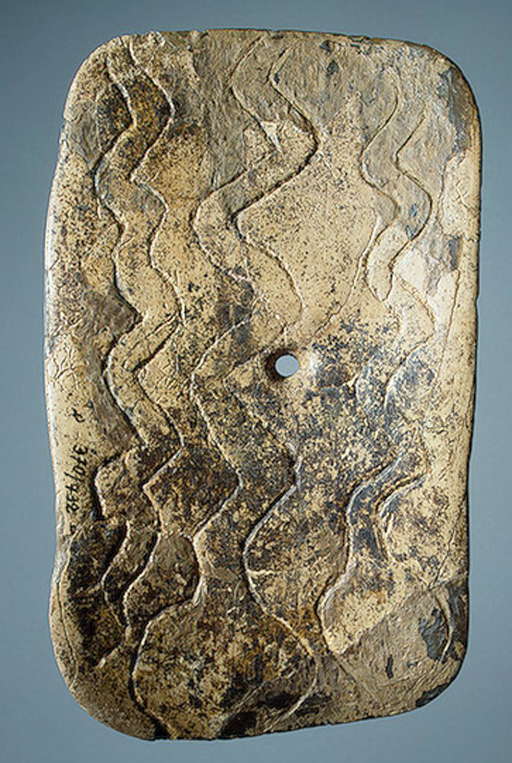
(Mal'ta site had a carving of 3 snakes with large cobra heads)
http://donsmaps.com/images24/maltahermitageplateback.jpg
Compare words: stick/stake/(strength/string) snake/rake/peck/peg/pick/pike/spike/spigot/
dig/pig/pin/punji/punt/poke/push/pull/plug/pluck/plow (bullocks pulling plows originated from pegs driven into soil and sharpened sticks used to pull up tubers, related to pig cloven/claw hoof), and paralleling pig was hog/hock/hoof/hook/crook/hoe/hole/hoick/hoist, related to peg insertion & removal.
Pharoah of Egypt: translated as "great house" or "Dominion of the tent stake" Awtad
"‘Awtad’ comes from the Arabic Root: 'WAW-TA-DAL' [note phonetic similarity to awl, idol & doll] which does indeed mean: Stakes, Pegs, Tent Poles or to drive in a stake (into ground or wall) as a literal understanding."
http://quransmessage.com/articles/pharaoh%20-%20lord%20of%20the%20stakes%20or%20pyramids%20FM3.htm
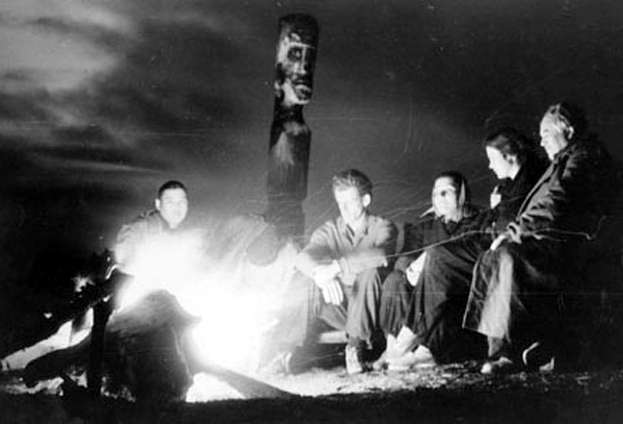
http://donsmaps.com/images11/malta0203.jpg notice photo of people next to "totem pole?" at Mal'ta site.
OBeLisK (OBa [Lith=stone] (am)?), SHiVa LingG(am), Totem pole (OD ooD(em)), Abrams' father Terah's ((O? al?)TeRaPH(im)), similar sounds (doll, idol to "-adal"), all derived from the ancestral humble tent peg (awtad, wAWTaDaL). Note too the similarity in sound in English of mother goddess, mothers' address and home post (-box) & host & guest. Compare Micmac 'aoutem' (kin) to both Eskimo dogsled (komatik) & Cree dog (atim) as that used to pull family's property.
English maypole from maeg bole (kin beam) paralleling Dutch/German mais baum. Bole/bone (rib)/boom/beam used in tents, huts, sleds & boats.
Between Arab awtad and Micmac autim we find English taut/tie/tether (bind) and knot/naut, and in Tamil katu (bind, as in katumaram-catamaran: bound logs) and nao/prahu (boat), and Malay tali (rope) and perau (boat).
Cupola (inverted 'cup-bowl' above roof, chimney cover) relates to BaMbuti mongolu and Sanskrit bungalo dome huts, derived via qupholu/kebhala or so (Persian qupha = bowlboat, Greek hoplon = round shield), where initially the 'cup-bowl' was a portable open round basket & later hidebound roundshield/bullboat.
In Japan, the red Shinto shrine gates are torii, in India, Buddhist temple gates are toran, and in the Jewish torah (see previous post), all represent the (communal) entry (door way/portal), just as the ritually carved symbolic house post/tent peg represented the front door entrance.
Anubis amulets (Amu(rru)/Anu?) of Egypt, probably via Syria/Slovenia:
http://www.flickriver.com/photos/25396001@N04/4248506587/
((D)Anubians: from Blue Danube of Slovenia (Swabia-Slavia) & Anu (Lake Tana & Tana delta) of Blue Nile of Nubia, J(Y)ordan, Sud(d)an, Aldan/Jana rivers of east Siberia, Danes of Denmark, Swedes of Sweden), Ma'dan, Mandan, Dhannu/Denu (OE & Sanskrit) river shore floodplains/terraces/traders.
Compare Anubis 3ka to Lion Man of Hohlenstein (possibly brought from Africa?) cave 32ka:
http://en.wikipedia.org/wiki/File:Anubis_standing.svg
http://www.showcaves.com/english/explain/Archaeology/Loewenfrau.html
Anubis: Associated with funeral/grave/mummification
(Note right hand holds was tent peg remover? Jackal form from older cave lion form (sphynx)?
http://en.wikipedia.org/wiki/Anubis
http://en.wikipedia.org/wiki/Lion_man_of_the_Hohlenstein_Stadel
In N America, the Plains Cree people called the travois-pulling dog atim, [note pole/pull/pulka 1/2sledge-1/2boat of Volga/Bulghar/Saami], the horse misatim "big dog", while the James Bay Cree called the lion misatim. So the Egyptian jackal form of Anubis may have transformed from the ancient cave lion in mythology.
http://moniyawlinguist.wordpress.com/2010/12/27/atimw-animal-that-pulls-your-stuff/
Note bowl/dome basket/hut/boat on travois. Early form of Eskimo sled komatic or Lapp pulka sledge-boat?
http://www.sila.nu/data?atom_id=dogsled_entry&l=en
Komatic: eskimo dog sled ("kam-u-tic")
Kom: (old Dutch) bowl cf kofa/qufa roundboat, koppe/cup
-atic? related to atim?
Northern Plains Cree people called the travois-pulling dog atim ("u-tim")
Choctaw of lower Mississippi: itti homma = boundary marker pole/tree painted red
Muskogee of Florida: yat kitischee = red people (ochre?)
Hebrew, 'staff of life/bread' = matteh lechem http://concordances.org/hebrew/4294.htm
Oldest wheel & axle found in Slovene Ljubjanska/Lyubyana swamp/lake 5.3ka (same neolithic period as Otzi the ice man mummy found 150 miles away), note similarity to travois, but employed "pegs/pins" to hold square axle onto frame allowing rotation of both wheel and axle:
http://www.slovenia.info/pictures%5CTB_attractions%5C1%5C2011%5Ckolo_19.7.2011_351550.jpg
Teraph, Teraphim: Abram's father Terah, before written language, carved figurines represented home dominion & land ownership, later household "idol" or even 'gods', originally from tent pegs.
http://www.biblepicturegallery.com/pictures/pagang/Statuettes%20of%20pagan%20deities%20excavated%20in%20Palestin%20pa.htm
http://www.bible-history.com/ibh/Egyptian+Gods/Teraphims/Teraphim+Figures
(note the was tent peg remover in hand, resemblance to a nail-pulling hammer-claw)
http://jandyongenesis.blogspot.com/2008/12/teraphim-of-genesis-31.html
http://www.google.com/imgres?imgurl=http://www.biblepicturegallery.com/thumbs/la/world/worship/pagan/p_gods/Palestinian%2520Teraphim%2520or%2520household%2520gods.jpg&imgrefurl=http://www.biblepicturegallery.com/pictures/pagang.htm&usg=__u8Adz0orFHKY_J_BhD8Yy4gTstc=&h=120&w=160&sz=4&hl=en&start=3&sig2=4Ph241K-jQfYszCLrj_mCA&zoom=1&tbnid=TvF9HpGyZZ3GwM:&tbnh=74&tbnw=98&ei=TxY8T5HZNo_AtgeCponoCg&prev=/search%3Fq%3Dteraphim%26um%3D1%26hl%3Den%26sa%3DN%26rls%3Dcom.microsoft:en-us%26tbm%3Disch&um=1&itbs=1
(Terah/Terai valley of Nepal terraced taro fields (1st agriculture in Papua) gradually became over run by weedy rice which became the staple, Nepali totems (lingam)
Shivalingam: (note phonetic similarity to 'shaft')
http://en.wikipedia.org/wiki/File:Nepalese_stone_linga_SF_Asian_Art_Museum.JPG
Oba (Yoruba, 'God' cf Russian 'Bog', God)
YHWH/YaHWeH/JeHoVaH (JaH ObaH?)/YesHuWaHa/YesHiVa/Shiva in the same dialectical pattern as we see in LeViTiCus/VaTiCan/VeDiC-MeDiCal/MuSiCal/MyThiCal/MaGiCal; when associated with VeNeTian/VoYaGer/ViKinGer/DaNuBian/PhoeNiCian/PuNiC/FinNiC/AiNu produces a (textile or hide-skinned) summer-tent-based nomadic herd hunting salmon/tuna fishing diaspora with female built sites, peg/post addresses, and a proto-law/medicine system. Veni, Vidi, Vicci!
The letter WaW in Hebrew is a picture of a tent stake, my name in Arab/Hebrew is Daud ~ Dawood which uses WaW after the Da-. In Chinese, Da-wei. In English, David.
Egyptian symbols from nomadic tent past: djed/tet symbol from beduin tent stake, was symbol from tent stake remover, ankh as knot of rope around stake (originally tendon?).
http://www.crystalinks.com/djed.html
Tents derived from hides draped over wigwam/mongolu dome huts where fat & meat was scraped off, then hide was inverted & dried, giving warmth to dwellers in areas outside the tropical rainforests. Tendons/vines held the skins over the wicker frame (first bull/bowl boats), later portable stakes were used/carried in more open tree-less plains country, where the woven wicker frame was replaced by straight poles, pulled behind with the leather cover.
Ancient Hebrew table was a round leather hide on the ground which people sat around.
Is there a link between Komi-Zyrian people of arctic Russia and bowl-boat-using Syrians of Tigris?
http://en.wikipedia.org/wiki/Komi-Zyrian_language
http://llmap.org/languages/kpv.html
related to Finnic & samoyed, name intriguing, related to Hurrian/Assyrian/Syrian?
Syr-yan (cf jor-dan) related to Yana/Jana/Aldana in Siberia etc.?
Did "Sumerian" derive from Su-mer-yana (south mer delta?) or Samoyen/Saamyan? Sumerians are said to have come earlier from the north, they were not Semites.
saami (Lapps of Finland), komi related? three of them are Uralic: Hungarian, Permic Zyrian Komi and Samoyedic Nenets
Beehive dome house of Caddo:
http://caddolegacy.com/grassthatchedhouses.aspx
Investigating whether "Maypole" is a cognate to totem pole/shivalingam/obelisk/tent peg:
apparently so, but the definition changed when Christianity became dominant in Europe. Probably derived from maeg-bole? (cf proto germanic mais baum) "kin tree/beam". The English word tree bole may have been from earlier woven wicker & hide bowl boats (parical/coracle/cup/qufa) being replaced by streamlined shallow dugout canoes cut from tree trunks (compare Dutch kom (bowl) to Dutch boom (tree, pole, beam)
boom (n.)
"long pole," 1540s, from Scottish boun, borrowed from Du. boom "tree, pole, beam," from a M.Du. word analogous to O.E. beam (see beam).
bowsprit
"spar extending from the bow of a ship," late 13c., probably from M.L.G. bochspret, from boch "bow of a ship" (see bow (n.2)) + spret "pole" (cf. O.E. spreot "pole," Du. spriet "spear;" see sprit).
Baton Rouge
city in Louisiana, U.S., a French translation of Choctaw itti homma "red pole," perhaps in reference to a painted boundary marker. [compare to Red Wing & Mississippi river Indians painting red on trees]
yard (2)
"measure of length," O.E. gerd (Mercian), gierd (W.Saxon) "rod, stick, measure of length," from W.Gmc. *gazdijo, from P.Gmc. *gazdaz "stick, rod" (cf. O.S. gerda, O.Fris. ierde, Du. gard "rod;" O.H.G. garta, Ger. gerte "switch, twig," O.N. gaddr "spike, sting, nail"), from PIE *gherdh- "staff, pole" (cf. L. hasta "shaft, staff").
windlass
device for raising weights by winding a rope round a cylinder, c.1400, alteration of wyndase (late 13c.), from Anglo-Fr. windas, and directly from a Scandinavian source such as O.N. vindass, from vinda "to wind" (see wind (v.)) + ass "pole, beam."
totem
animal or natural object considered as the emblem of a family or clan, 1760, from Algonquian (probably Ojibwa) odoodeman "his sibling kin, his group or family," hence, "his family mark;" also attested in French c.1600 in form aoutem among the Micmacs or other Indians of Nova Scotia. Totem pole is 1808, in reference to west coast Canadian Indians.
palanquin
"a covered litter," 1580s, from Port. palanquim (early 16c.), from Malay and Javanese palangki, ultimately from Skt. palyanka-s "couch, bed, litter," from pari "around" + ancati "it bends, curves," related to anka-s "a bend, hook, angle," and meaning, perhaps, "that which bends around the body." Some have noted the "curious coincidence" of Sp. palanca, from L. phalanga "pole to carry a burden."
stake (n)
"pointed stick or post," O.E. staca, from P.Gmc. *stakon (cf. O.N. stiaki, Du. staak, Ger. stake), from PIE root *steg- "pole, stick."
pig
probably from O.E. *picg, found in compounds, ultimate origin unknown. Originally "young pig" (the word for adults was swine). Another O.E. word for "pig" was fearh, related to furh "furrow," from PIE *perk- "dig, furrow" (cf. L. porc-us "pig," see pork).
spigot
late 14c., "plug used to stop the hole of a cask," probably from O.Fr. *espigot (cf. Gascony dialect espigot "core of a fruit, small ear of grain"), dim. of O.Prov. espiga "ear of grain," from L. spica "ear of grain" (see spike (n.2)).
taut
early 14c., tohte, possibly from tog- [compare to 'dog'], pp. stem of O.E. teon "to pull, drag," from P.Gmc. *tugn, from [IMO unlikely] PIE *deuk- "to lead" (see duke).
tone
mid-14c., from O.Fr. ton (13c.), from L. tonus "a sound, tone, accent," lit. "stretching" (in M.L., a term peculiar to music), from Gk. tonos "vocal pitch, raising of voice, accent, key in music," originally "a stretching, taut string," related to teinein "to stretch" (see tenet).
string (n.)
O.E. streng "line, cord, thread," from P.Gmc. *strangiz (cf. O.N. strengr, Dan. streng, M.Du. strenge, Du. streng, O.H.G. strang, Ger. Strang "rope, cord"), from *strang- "taut, stiff," from PIE root *strenk- "tight, narrow; pull tight, twist" (see strain). Gradually restricted by early M.E. to lines that are smaller than a rope. Old English meaning "ligaments, tendons" is preserved in hamstring, heartstrings.
Eskimo skin boat being transported over ice on sleds, childrens, adults:
http://tycoontalk.freelancer.com/photography-forum/148118-children-chasing-a-bowhead-whale.html
St. Laurence island eskimo angyapik umiak boat: http://indigenousboats.blogspot.com/2010_12_01_archive.html
Amur river trading Ainu with 'itaomachip' sewn plank boat and shallow dugout canoe:
http://indigenousboats.blogspot.com/search/label/Ainu
Kanak/Kanaka: Austronesian/Melanesian/Polynesian/Malaysian/Indonesian
http://en.wikipedia.org/wiki/Kanak_people
Kanak Totem poles in New Caledonia, as Great House door posts and roof poles:
http://en.wikipedia.org/wiki/File:Kanak_doorpost_Inv.MH31-50-2.jpg
http://en.wikipedia.org/wiki/File:Kanak_house-2.jpg
Compare the Kanak wood carvings to the Giant Easter Island Moai stone statues:
http://www.easterislandtourism.com/what-to-visit/easter-island-statues/
These Moai had been originally 1 meter tall ("Tiki" in Marquesas isles.), sitting in ahu altars, then enlarged in the same way that US west coast Indians enlarged their totem poles upon establishing sedentary villages and halting nomadism and regulating warfare.
The Maori of New Zealand carved wooden totem poles:
Symbol of 10th month: Pou-tu-te-rangi (pole raise sky, similar to Malay kutub angkat langit)
http://www.astronomynz.org.nz/index.php?option=content&task=view&id=39
Turkish Crescent/jingle/Chinese hat - a long post/walking stick with bells, originally from Central Asian shaman/santa clause
http://en.wikipedia.org/wiki/Turkish_crescent

Manasota canoe in Florida: http://indigenousboats.blogspot.com/search/label/Manasota
http://www.dailymail.co.uk/sciencetech/article-1362138/The-1-000-year-old-canoe-excavated-10-years-discovery-amateur-archaeologist.html
"The Manasota people provided the indigenous culture on the west cost of Florida.
They were a race of hunter-gatherers who lived there from around 550BC until around 900AD.
Weedon Island, where the canoe was discovered, was a key religious ground for the culture, and many people and objects were laid to rest there in sand burial mounds. http://www.dailymail.co.uk/sciencetech/article-1362138/The-1-000-year-old-canoe-excavated-10-years-discovery-amateur-archaeologist.html#ixzz1nhLiniiv
link of manasota to minnesota?
Australian marsh canoes from bark, hand paddled: http://indigenousboats.blogspot.com/2010/05/ten-canoes.html
Yurt & skin boats:
http://skinboatjournal.blogspot.com/2012/02/yurt-or-skin-on-frame-portable-dwelling.html
DDeden
http://www.metmuseum.org/toah/hd/malt/hd_malt.htm
http://en.wikipedia.org/wiki/Mal
http://en.wikipedia.org/wiki/File:Buretj_(venus_figurine).gif
.gif)
http://news.bbc.co.uk/2/hi/south_asia/4381893.stm
"There are many interpretations of the figurines, often based on little argument or fact. Like many prehistoric artifacts, the cultural meaning of these figures may never be known. Archaeologists speculate, however, that they may be emblems of security and success, fertility icons, pornographic imagery, or even direct representations of a mother goddess or various local goddesses. The female figures, as part of Upper Palaeolithic portable art, appear to have no practical use in the context of subsistence. They are mostly discovered in settlement contexts, both in open-air sites and caves; burial contexts are much more rare.
At Gagarino in Russia, seven Venus figurines were found in a hut of 5 m diameter; they have been interpreted as apotropaic amulets, connected with the occupants of the dwelling. At Mal'ta, near Lake Baikal, figurines are only known from the left sides of huts." (wikipedia)
[I think a typical couple's hut had 2, a female venus figurine at left of doorway, a male bird/phallus figurine at right of doorway, both acting as ritual symbolic tent stakes/house posts/totem poles. Possibly the male figurine was kept outside the entry at right, the female figurine just inside at left.]
"unlike those found in Europe, some of the Venus figurines from Mal’ta were sculpted with faces. Most of the figurines were tapered at the bottom, and it is believed that this was done so they could have been stuck into the ground or otherwise placed upright some other way."
This "Tibetan ancient tent peg" has some resemblance to the Mal'ta male & female figurines of ivory, has any similar items been found in Altai or Beringia?
http://alphaclassics.com/product_info.php?cPath=22_31&products_id=136
Except for scale it appears to resemble west coast totem poles:
http://upload.wikimedia.org/wikipedia/commons/thumb/3/32/Wrangell_Kiksadi_Totem_Pole.JPG/250px-Wrangell_Kiksadi_Totem_Pole.JPG

A Tlingit totem pole memorializing a woman (note closed wings, perhaps open wings represent male (cf etymology of ball & wing very similar pali/pari/pela, both fly, both related to 'pair').
http://www.historylink.org/index.cfm?DisplayPage=output.cfm&file_id=2076
" The word totem is derived from the Ojibwe word odoodem, "his kinship group"" (wikipedia) [also odoodeman]
totem
"animal or natural object considered as the emblem of a family or clan, 1760, from Algonquian (probably Ojibwa) odoodeman "his sibling kin, his group or family," hence, "his family mark;" also attested in French c.1600 in form aoutem among the Micmacs or other Indians of Nova Scotia. Totem pole is 1808, in reference to west coast Canadian Indians."
[Very interesting etymology, possibly linked to 'awtad', 'doodad', 'wood', dado (wood cutting blade), dem-duom-domus-home; in many nomad H&G cultures, the woman is responsible for hut/tipi/tent construction, while in sedentary agricultural cultures the man is the home builder while the woman is the caretaker/homemaker.]
The ancient Egyptian djed/tet column was raised annually, symbollically by the Pharoah who had the was staff.
Very likely the European Maypole was based on similar rituals long ago. Compare to the winter yule log and the standing tannenbaum/christmas tree. Perhaps the new (Swedish) midsummerstang/(Dutch/German) maisbaum/(Anglo Saxon) maegbole/(English) maypole was the dried-out tannenbaum of last winter (trimmed of needles and branches and with added symbols/feathers/ribbons), which then became the next winters yule log? This would provide a sensible recycling notion, but I don't know if it was actually done, perhaps authorized and administered by Druids? (Druids: forest-priest watershed managers, see earlier post on Ethiopian church forests). This would parallel the Egyptian priests involved with the Pharoah's djed column raising. The recent cultural practice of girls weaving ribbons around the Maypole might descend from ancestral nomadic (eg. Beduin-like) girls pounding the stakes of the goat-hair tent, while men lifted the poles.
http://en.wikipedia.org/wiki/Yule_log
." James George Frazer in his work on anthropology, The Golden Bough (p. 736) holds that "the ancient fire-festival of the winter solstice appears to survive" in the Yule log custom. Frazer records traditions from England, France, among the South Slavs, in Central Germany (Meiningen) and western Switzerland (the Bernese Jura).
My opinion: Note that tent stake was a kinship signal was traditional for archaic nomadic Hebrew/Arab tent dwellers, and that large totem poles are found only associated with people who lived in split plank houses, not tent/ tipi dwellers. The tent stake signalled "I/we dwell here" (temporary land ownership), and so did the totem pole. Perhaps the narrow figurines indicate active tent use (functional), while fat figurines indicate cave or timber shelters (lost function). Many ornately carved ivory/bone/wood figurines/Venuses/Dakota peace pipes/ritual spears may have originated as kinship signals/symbols, and only later (or never except as interpreted by extra-cultural observers?) became 'spirit/goddess' idol/symbols.
"And, while 18th-century accounts of European explorers along the
coast indicate that poles existed prior to 1800, they were *smaller*
and few in number. The freestanding poles seen by the first European
explorers were likely preceded by a long history of monumental
carving, particularly of interior house posts. The scholar Eddie Malin
has proposed that totem poles progressed from house posts, funerary
containers, and memorial markers into symbols of clan and family
wealth and prestige. He argues that the Haida people of the Queen
Charlotte Islands originated carving of the poles.." (wikipedia)
So were Mal'ta figurines equal to tent stakes & totem poles, or were they dolls, idols or sex objects or what?
Social markers (sign/signal/symbol) identifying spatial/temporal ownership & position within the community seems to be the original function.
Note that at Medit. island of Malta, more venuses existed much later.
Possibly: Mal'ta was old word for "waterside trade dwelling", equal to Ma'dan, Mandan (both used boats & hunted buffalo)
Among great plains Amer Indians, women assembled to craft the Tipi cover, and set it.
Among Beduin tent dwellers: young girls pound in the tent pegs, men lift the poles.
"In Genesis 3:15 God declares that the Woman will bring forth the Seed who will crush the Serpent's head" (just genesis blog)
tent, serpent, tent peg, serpent head ?
(Mal'ta site had a carving of 3 snakes with large cobra heads)
http://donsmaps.com/images24/maltahermitageplateback.jpg
Compare words: stick/stake/(strength/string) snake/rake/peck/peg/pick/pike/spike/spigot/
dig/pig/pin/punji/punt/poke/push/pull/plug/pluck/plow (bullocks pulling plows originated from pegs driven into soil and sharpened sticks used to pull up tubers, related to pig cloven/claw hoof), and paralleling pig was hog/hock/hoof/hook/crook/hoe/hole/hoick/hoist, related to peg insertion & removal.
Pharoah of Egypt: translated as "great house" or "Dominion of the tent stake" Awtad
"‘Awtad’ comes from the Arabic Root: 'WAW-TA-DAL' [note phonetic similarity to awl, idol & doll] which does indeed mean: Stakes, Pegs, Tent Poles or to drive in a stake (into ground or wall) as a literal understanding."
http://quransmessage.com/articles/pharaoh%20-%20lord%20of%20the%20stakes%20or%20pyramids%20FM3.htm
http://donsmaps.com/images11/malta0203.jpg notice photo of people next to "totem pole?" at Mal'ta site.
OBeLisK (OBa [Lith=stone] (am)?), SHiVa LingG(am), Totem pole (OD ooD(em)), Abrams' father Terah's ((O? al?)TeRaPH(im)), similar sounds (doll, idol to "-adal"), all derived from the ancestral humble tent peg (awtad, wAWTaDaL). Note too the similarity in sound in English of mother goddess, mothers' address and home post (-box) & host & guest. Compare Micmac 'aoutem' (kin) to both Eskimo dogsled (komatik) & Cree dog (atim) as that used to pull family's property.
English maypole from maeg bole (kin beam) paralleling Dutch/German mais baum. Bole/bone (rib)/boom/beam used in tents, huts, sleds & boats.
Between Arab awtad and Micmac autim we find English taut/tie/tether (bind) and knot/naut, and in Tamil katu (bind, as in katumaram-catamaran: bound logs) and nao/prahu (boat), and Malay tali (rope) and perau (boat).
Cupola (inverted 'cup-bowl' above roof, chimney cover) relates to BaMbuti mongolu and Sanskrit bungalo dome huts, derived via qupholu/kebhala or so (Persian qupha = bowlboat, Greek hoplon = round shield), where initially the 'cup-bowl' was a portable open round basket & later hidebound roundshield/bullboat.
In Japan, the red Shinto shrine gates are torii, in India, Buddhist temple gates are toran, and in the Jewish torah (see previous post), all represent the (communal) entry (door way/portal), just as the ritually carved symbolic house post/tent peg represented the front door entrance.
Anubis amulets (Amu(rru)/Anu?) of Egypt, probably via Syria/Slovenia:
http://www.flickriver.com/photos/25396001@N04/4248506587/
((D)Anubians: from Blue Danube of Slovenia (Swabia-Slavia) & Anu (Lake Tana & Tana delta) of Blue Nile of Nubia, J(Y)ordan, Sud(d)an, Aldan/Jana rivers of east Siberia, Danes of Denmark, Swedes of Sweden), Ma'dan, Mandan, Dhannu/Denu (OE & Sanskrit) river shore floodplains/terraces/traders.
Compare Anubis 3ka to Lion Man of Hohlenstein (possibly brought from Africa?) cave 32ka:
http://en.wikipedia.org/wiki/File:Anubis_standing.svg

http://www.showcaves.com/english/explain/Archaeology/Loewenfrau.html
Anubis: Associated with funeral/grave/mummification
(Note right hand holds was tent peg remover? Jackal form from older cave lion form (sphynx)?
http://en.wikipedia.org/wiki/Anubis
http://en.wikipedia.org/wiki/Lion_man_of_the_Hohlenstein_Stadel
In N America, the Plains Cree people called the travois-pulling dog atim, [note pole/pull/pulka 1/2sledge-1/2boat of Volga/Bulghar/Saami], the horse misatim "big dog", while the James Bay Cree called the lion misatim. So the Egyptian jackal form of Anubis may have transformed from the ancient cave lion in mythology.
http://moniyawlinguist.wordpress.com/2010/12/27/atimw-animal-that-pulls-your-stuff/
Note bowl/dome basket/hut/boat on travois. Early form of Eskimo sled komatic or Lapp pulka sledge-boat?
http://www.sila.nu/data?atom_id=dogsled_entry&l=en
Komatic: eskimo dog sled ("kam-u-tic")
Kom: (old Dutch) bowl cf kofa/qufa roundboat, koppe/cup
-atic? related to atim?
Northern Plains Cree people called the travois-pulling dog atim ("u-tim")
Choctaw of lower Mississippi: itti homma = boundary marker pole/tree painted red
Muskogee of Florida: yat kitischee = red people (ochre?)
Hebrew, 'staff of life/bread' = matteh lechem http://concordances.org/hebrew/4294.htm
Oldest wheel & axle found in Slovene Ljubjanska/Lyubyana swamp/lake 5.3ka (same neolithic period as Otzi the ice man mummy found 150 miles away), note similarity to travois, but employed "pegs/pins" to hold square axle onto frame allowing rotation of both wheel and axle:
http://www.slovenia.info/pictures%5CTB_attractions%5C1%5C2011%5Ckolo_19.7.2011_351550.jpg

Teraph, Teraphim: Abram's father Terah, before written language, carved figurines represented home dominion & land ownership, later household "idol" or even 'gods', originally from tent pegs.
http://www.biblepicturegallery.com/pictures/pagang/Statuettes%20of%20pagan%20deities%20excavated%20in%20Palestin%20pa.htm
http://www.bible-history.com/ibh/Egyptian+Gods/Teraphims/Teraphim+Figures
(note the was tent peg remover in hand, resemblance to a nail-pulling hammer-claw)
http://jandyongenesis.blogspot.com/2008/12/teraphim-of-genesis-31.html
http://www.google.com/imgres?imgurl=http://www.biblepicturegallery.com/thumbs/la/world/worship/pagan/p_gods/Palestinian%2520Teraphim%2520or%2520household%2520gods.jpg&imgrefurl=http://www.biblepicturegallery.com/pictures/pagang.htm&usg=__u8Adz0orFHKY_J_BhD8Yy4gTstc=&h=120&w=160&sz=4&hl=en&start=3&sig2=4Ph241K-jQfYszCLrj_mCA&zoom=1&tbnid=TvF9HpGyZZ3GwM:&tbnh=74&tbnw=98&ei=TxY8T5HZNo_AtgeCponoCg&prev=/search%3Fq%3Dteraphim%26um%3D1%26hl%3Den%26sa%3DN%26rls%3Dcom.microsoft:en-us%26tbm%3Disch&um=1&itbs=1

(Terah/Terai valley of Nepal terraced taro fields (1st agriculture in Papua) gradually became over run by weedy rice which became the staple, Nepali totems (lingam)
Shivalingam: (note phonetic similarity to 'shaft')
http://en.wikipedia.org/wiki/File:Nepalese_stone_linga_SF_Asian_Art_Museum.JPG

Oba (Yoruba, 'God' cf Russian 'Bog', God)
YHWH/YaHWeH/JeHoVaH (JaH ObaH?)/YesHuWaHa/YesHiVa/Shiva in the same dialectical pattern as we see in LeViTiCus/VaTiCan/VeDiC-MeDiCal/MuSiCal/MyThiCal/MaGiCal; when associated with VeNeTian/VoYaGer/ViKinGer/DaNuBian/PhoeNiCian/PuNiC/FinNiC/AiNu produces a (textile or hide-skinned) summer-tent-based nomadic herd hunting salmon/tuna fishing diaspora with female built sites, peg/post addresses, and a proto-law/medicine system. Veni, Vidi, Vicci!
The letter WaW in Hebrew is a picture of a tent stake, my name in Arab/Hebrew is Daud ~ Dawood which uses WaW after the Da-. In Chinese, Da-wei. In English, David.
Egyptian symbols from nomadic tent past: djed/tet symbol from beduin tent stake, was symbol from tent stake remover, ankh as knot of rope around stake (originally tendon?).
http://www.crystalinks.com/djed.html
Tents derived from hides draped over wigwam/mongolu dome huts where fat & meat was scraped off, then hide was inverted & dried, giving warmth to dwellers in areas outside the tropical rainforests. Tendons/vines held the skins over the wicker frame (first bull/bowl boats), later portable stakes were used/carried in more open tree-less plains country, where the woven wicker frame was replaced by straight poles, pulled behind with the leather cover.
Ancient Hebrew table was a round leather hide on the ground which people sat around.
Is there a link between Komi-Zyrian people of arctic Russia and bowl-boat-using Syrians of Tigris?
http://en.wikipedia.org/wiki/Komi-Zyrian_language
http://llmap.org/languages/kpv.html
related to Finnic & samoyed, name intriguing, related to Hurrian/Assyrian/Syrian?
Syr-yan (cf jor-dan) related to Yana/Jana/Aldana in Siberia etc.?
Did "Sumerian" derive from Su-mer-yana (south mer delta?) or Samoyen/Saamyan? Sumerians are said to have come earlier from the north, they were not Semites.
saami (Lapps of Finland), komi related? three of them are Uralic: Hungarian, Permic Zyrian Komi and Samoyedic Nenets
Beehive dome house of Caddo:
http://caddolegacy.com/grassthatchedhouses.aspx
Investigating whether "Maypole" is a cognate to totem pole/shivalingam/obelisk/tent peg:
apparently so, but the definition changed when Christianity became dominant in Europe. Probably derived from maeg-bole? (cf proto germanic mais baum) "kin tree/beam". The English word tree bole may have been from earlier woven wicker & hide bowl boats (parical/coracle/cup/qufa) being replaced by streamlined shallow dugout canoes cut from tree trunks (compare Dutch kom (bowl) to Dutch boom (tree, pole, beam)
boom (n.)
"long pole," 1540s, from Scottish boun, borrowed from Du. boom "tree, pole, beam," from a M.Du. word analogous to O.E. beam (see beam).
bowsprit
"spar extending from the bow of a ship," late 13c., probably from M.L.G. bochspret, from boch "bow of a ship" (see bow (n.2)) + spret "pole" (cf. O.E. spreot "pole," Du. spriet "spear;" see sprit).
Baton Rouge
city in Louisiana, U.S., a French translation of Choctaw itti homma "red pole," perhaps in reference to a painted boundary marker. [compare to Red Wing & Mississippi river Indians painting red on trees]
yard (2)
"measure of length," O.E. gerd (Mercian), gierd (W.Saxon) "rod, stick, measure of length," from W.Gmc. *gazdijo, from P.Gmc. *gazdaz "stick, rod" (cf. O.S. gerda, O.Fris. ierde, Du. gard "rod;" O.H.G. garta, Ger. gerte "switch, twig," O.N. gaddr "spike, sting, nail"), from PIE *gherdh- "staff, pole" (cf. L. hasta "shaft, staff").
windlass
device for raising weights by winding a rope round a cylinder, c.1400, alteration of wyndase (late 13c.), from Anglo-Fr. windas, and directly from a Scandinavian source such as O.N. vindass, from vinda "to wind" (see wind (v.)) + ass "pole, beam."
totem
animal or natural object considered as the emblem of a family or clan, 1760, from Algonquian (probably Ojibwa) odoodeman "his sibling kin, his group or family," hence, "his family mark;" also attested in French c.1600 in form aoutem among the Micmacs or other Indians of Nova Scotia. Totem pole is 1808, in reference to west coast Canadian Indians.
palanquin
"a covered litter," 1580s, from Port. palanquim (early 16c.), from Malay and Javanese palangki, ultimately from Skt. palyanka-s "couch, bed, litter," from pari "around" + ancati "it bends, curves," related to anka-s "a bend, hook, angle," and meaning, perhaps, "that which bends around the body." Some have noted the "curious coincidence" of Sp. palanca, from L. phalanga "pole to carry a burden."
stake (n)
"pointed stick or post," O.E. staca, from P.Gmc. *stakon (cf. O.N. stiaki, Du. staak, Ger. stake), from PIE root *steg- "pole, stick."
pig
probably from O.E. *picg, found in compounds, ultimate origin unknown. Originally "young pig" (the word for adults was swine). Another O.E. word for "pig" was fearh, related to furh "furrow," from PIE *perk- "dig, furrow" (cf. L. porc-us "pig," see pork).
spigot
late 14c., "plug used to stop the hole of a cask," probably from O.Fr. *espigot (cf. Gascony dialect espigot "core of a fruit, small ear of grain"), dim. of O.Prov. espiga "ear of grain," from L. spica "ear of grain" (see spike (n.2)).
taut
early 14c., tohte, possibly from tog- [compare to 'dog'], pp. stem of O.E. teon "to pull, drag," from P.Gmc. *tugn, from [IMO unlikely] PIE *deuk- "to lead" (see duke).
tone
mid-14c., from O.Fr. ton (13c.), from L. tonus "a sound, tone, accent," lit. "stretching" (in M.L., a term peculiar to music), from Gk. tonos "vocal pitch, raising of voice, accent, key in music," originally "a stretching, taut string," related to teinein "to stretch" (see tenet).
string (n.)
O.E. streng "line, cord, thread," from P.Gmc. *strangiz (cf. O.N. strengr, Dan. streng, M.Du. strenge, Du. streng, O.H.G. strang, Ger. Strang "rope, cord"), from *strang- "taut, stiff," from PIE root *strenk- "tight, narrow; pull tight, twist" (see strain). Gradually restricted by early M.E. to lines that are smaller than a rope. Old English meaning "ligaments, tendons" is preserved in hamstring, heartstrings.
Eskimo skin boat being transported over ice on sleds, childrens, adults:
http://tycoontalk.freelancer.com/photography-forum/148118-children-chasing-a-bowhead-whale.html
St. Laurence island eskimo angyapik umiak boat: http://indigenousboats.blogspot.com/2010_12_01_archive.html
Amur river trading Ainu with 'itaomachip' sewn plank boat and shallow dugout canoe:
http://indigenousboats.blogspot.com/search/label/Ainu
Kanak/Kanaka: Austronesian/Melanesian/Polynesian/Malaysian/Indonesian
http://en.wikipedia.org/wiki/Kanak_people
Kanak Totem poles in New Caledonia, as Great House door posts and roof poles:
http://en.wikipedia.org/wiki/File:Kanak_doorpost_Inv.MH31-50-2.jpg

http://en.wikipedia.org/wiki/File:Kanak_house-2.jpg

Compare the Kanak wood carvings to the Giant Easter Island Moai stone statues:
http://www.easterislandtourism.com/what-to-visit/easter-island-statues/
These Moai had been originally 1 meter tall ("Tiki" in Marquesas isles.), sitting in ahu altars, then enlarged in the same way that US west coast Indians enlarged their totem poles upon establishing sedentary villages and halting nomadism and regulating warfare.
The Maori of New Zealand carved wooden totem poles:
Symbol of 10th month: Pou-tu-te-rangi (pole raise sky, similar to Malay kutub angkat langit)
http://www.astronomynz.org.nz/index.php?option=content&task=view&id=39
Turkish Crescent/jingle/Chinese hat - a long post/walking stick with bells, originally from Central Asian shaman/santa clause
http://en.wikipedia.org/wiki/Turkish_crescent
Manasota canoe in Florida: http://indigenousboats.blogspot.com/search/label/Manasota
http://www.dailymail.co.uk/sciencetech/article-1362138/The-1-000-year-old-canoe-excavated-10-years-discovery-amateur-archaeologist.html
"The Manasota people provided the indigenous culture on the west cost of Florida.
They were a race of hunter-gatherers who lived there from around 550BC until around 900AD.
Weedon Island, where the canoe was discovered, was a key religious ground for the culture, and many people and objects were laid to rest there in sand burial mounds. http://www.dailymail.co.uk/sciencetech/article-1362138/The-1-000-year-old-canoe-excavated-10-years-discovery-amateur-archaeologist.html#ixzz1nhLiniiv
link of manasota to minnesota?
Australian marsh canoes from bark, hand paddled: http://indigenousboats.blogspot.com/2010/05/ten-canoes.html
Yurt & skin boats:
http://skinboatjournal.blogspot.com/2012/02/yurt-or-skin-on-frame-portable-dwelling.html
DDeden
Wednesday, February 8, 2012
amazing drops, plops & props
Drop Art
Corrie White, the artist behind Liquid Drop Art, has a talent for capturing the surreal impact of a water droplet. White’s photographs allow viewers to see something that would normally be “invisible to the human eye.” Most of the water droplets were created with a medicine dropper and food dyes. According to the White’s bio, the “forms of water and milk shapes are pure and unedited.”
link
Corrie White, the artist behind Liquid Drop Art, has a talent for capturing the surreal impact of a water droplet. White’s photographs allow viewers to see something that would normally be “invisible to the human eye.” Most of the water droplets were created with a medicine dropper and food dyes. According to the White’s bio, the “forms of water and milk shapes are pure and unedited.”
link
Friday, January 20, 2012
Ancient Jews in Japan?
http://www5.ocn.ne.jp/~magi9/isracame.htm
http://biblicalanthropology.blogspot.com/2012/01/abrahams-anu-ancestors.html
"Abraham was the son of Terah and the name Terah (Tera) was found among the rulers of the Anu people who inhabited the Upper Nile and migrated widely between 15,000 and 10,000 years ago.... The Anu (Annu or Ainu) were aboriginal peoples of the Upper Nile. They were the first rulers of the Lower Nile. One of their sanctuaries was called Annu, the original name for Heliopolis, to which the great pyramids were aligned. The Anu were seafarers and had a written language which they introduced to the lands where they traveled and settled. The first peoples of Japan were Anu. The Anu alphabet became the basis for the Hebrew and Japanese alphabets." from Biblical Anthropology blog
I find this credible, based on the commonality of anu & dan for river valleys of the ancient trade network. I view it highly probable that the Terai valley of Nepal was connected to both Terah (father of Abraham of the Chaldees) and terraced taro (and later the domesticated weed, rice) floodplains; Terai being linked to Papuan languages & genetics (via Kusunda), and exchange point of sugar cane & taro to Papua.
Anu: Anu existed in Sumerian cosmogony as a sky dome that covered the flat earth (cf Bambuti 'endu' = interior of dome hut)
anu/-dan-/vene/phoeni/dene/tene/finni/den/Lena/Yana river & coastal peoples trading, tuna or salmon fishing, salt mining/brining (Ma'dan - Persian mining town), with dialects of dhanu/dnieper/don/(R or T replaced D: Rhine/Rhone/Thames-temez)
interesting parallels between Hebrew (Yahudi) and Japanese (Nihoni) Shinto culture & script language, and genetic linkage (including Tibet as well).
Perhaps more accurate, Anu that became Phoenician/Venician/Vennicones/Veneti/Fennic/Venne/Vinland voyagers/vikings (from way-go-n/vaya-/vika-/vector-/via-duct)* were a maritime/river trading people that used phonetic script in syllabary form (like Japanese) which was later adapted as alphabetical by western languages & Hebrew. First using wicker & hide punted roundboats (from inverted dome basket huts), then streamlined paddled rafts/canoes/umiaks & dogs, then ribbed-decked-keeled sailing vessels (with livestock) & then wagons/camel caravans, these marine technologies allowed fast dispersals around the old world and then the new world.
http://www.linguistics.ucsb.edu/faculty/gordon/gradation.pdf
Finnish roof: katto (resembles kota, a Lapp conic tent cf tipi)
http://en.wikipedia.org/wiki/Finnic_languages
http://www.paabo.ca/uirala/Farfarers.html
Note: Dan/Jordan/Sudan, anu/ainu, Sweden/Denmark, Danube/Don/Dniester, Fennu/Finn, Khotan/Turpan Turpan oasis (China) means 'the lowest place' in Uygur Language and 'the fertile land' in Turki [a schoolmate of mine from Finland was named Pannu, perhaps related to water voyager?)
Note: Ra/Rhone/Rhine, Dan/Den/Don, Finn/Fenn/Uenn refer to River/Coast valley way, and their harbor trading posts: Samar/Somal/Sumer/Suma, House: Dama/Duomo/Domus.
Dan: honorific "master of" [see Bucky Fuller's navigator-priests], c.1300, from O.Fr. dan/don from dominus; ancient northern Israel tribe Dan; Danaid: Greek myth daughter of Danaus, Argos king, condemned to draw water perpetually in bottomless buckets (origin of watermill?).
Danube: river of Europe (Ger. Donau, Hungarian Duna, Rus. Dunaj), from L. Danuvius, from Celtic *danu(w)-yo-, from PIE *danu- "river" (cf. Don, Dnieper, Dniester).
Dane: "native of Denmark," Daner, (replacing O.E. Dene (pl.) Perhaps ultimately from a source related to O.H.G. tanar "sand bank," [Sanskrit dhanu "sand shore"] or from P.Gmc. *den- "low ground", OE dhennu "river valley", cf anu
Dhanab (serpentine "tail"), Sudan, Red Sea shallows: http://itouchmap.com/?c=su&UF=-4747&UN=-6844&DG=RSV
dene "bare, sandy tract by the sea," late 13c., of uncertain origin, perhaps connected to dune, but the sense difference is difficult. "small valley," from O.E. denu "valley" (see den), PIE den/dan "down, low ground". Dendro (tree) probably related as serpentine form to both tail and river valley.
Before wheeled carts, traders would invert their skinboats to roof their stone/log foundationed market wares ashore along calm shallow waters.
"Note in the following map, the names Vennicones in the British north and Vennicni (obviously an abbreviation of the same Vennicones) in the north of Ireland. I see them as settlements of traders, handling wares from "Picts" on the one hand and visiting VENNE trader ships from "Scythia" on the other"
Rhobogdi: "(We bear in mind that Estonian has a very strong sea-trader tradition and would qualify as being located on the coast of "Scythia"!) The Rho at the front, would be the RA found in Rhone, Rhine, etc. which means 'way, path' and is often seen in the names of the earlier trade waterways (Ptolemy named the Volga Rha) but more often ot appeared as a suffix: Lige-RA, Wese-RA, Od-RA, etc.
There probably were two types of historic Picts. One type were sea-harvesters and used skin boats made from walrus hides, lived nomadically on outer shores and islands, and lived in semi buried circular rock shelters (like igloos, but made of rock and covered with sod)."
From the Bambuti leaf-shingled dome huts to sod-shingled domes to snow-block domes...
* annual: L. annalis form of annus "year," from PIE *at-no-, from base *at- "to go," on notion of "period gone through" (cf. Skt. atati "goes, wanders," as opposed to vasati static/stable/sedentary "stays")
stay: Gk. hestia "hearth," from PIE base *wes- "to dwell, stay" (cf. Skt. vasati "stays, dwells," Goth. wisan, O.E., O.H.G. wesan "to be").
PIE *stai- "stone," also "to thicken, stiffen" (cf. Skt. styayate "curdles, becomes hard;" Avestan stay- "heap;" Gk. stear "fat, tallow," stia, stion "pebble;" O.C.S. stena "wall").
http://biblicalanthropology.blogspot.com/2012/01/abrahams-anu-ancestors.html
"Abraham was the son of Terah and the name Terah (Tera) was found among the rulers of the Anu people who inhabited the Upper Nile and migrated widely between 15,000 and 10,000 years ago.... The Anu (Annu or Ainu) were aboriginal peoples of the Upper Nile. They were the first rulers of the Lower Nile. One of their sanctuaries was called Annu, the original name for Heliopolis, to which the great pyramids were aligned. The Anu were seafarers and had a written language which they introduced to the lands where they traveled and settled. The first peoples of Japan were Anu. The Anu alphabet became the basis for the Hebrew and Japanese alphabets." from Biblical Anthropology blog
I find this credible, based on the commonality of anu & dan for river valleys of the ancient trade network. I view it highly probable that the Terai valley of Nepal was connected to both Terah (father of Abraham of the Chaldees) and terraced taro (and later the domesticated weed, rice) floodplains; Terai being linked to Papuan languages & genetics (via Kusunda), and exchange point of sugar cane & taro to Papua.
Anu: Anu existed in Sumerian cosmogony as a sky dome that covered the flat earth (cf Bambuti 'endu' = interior of dome hut)
anu/-dan-/vene/phoeni/dene/tene/finni/den/Lena/Yana river & coastal peoples trading, tuna or salmon fishing, salt mining/brining (Ma'dan - Persian mining town), with dialects of dhanu/dnieper/don/(R or T replaced D: Rhine/Rhone/Thames-temez)
interesting parallels between Hebrew (Yahudi) and Japanese (Nihoni) Shinto culture & script language, and genetic linkage (including Tibet as well).
Perhaps more accurate, Anu that became Phoenician/Venician/Vennicones/Veneti/Fennic/Venne/Vinland voyagers/vikings (from way-go-n/vaya-/vika-/vector-/via-duct)* were a maritime/river trading people that used phonetic script in syllabary form (like Japanese) which was later adapted as alphabetical by western languages & Hebrew. First using wicker & hide punted roundboats (from inverted dome basket huts), then streamlined paddled rafts/canoes/umiaks & dogs, then ribbed-decked-keeled sailing vessels (with livestock) & then wagons/camel caravans, these marine technologies allowed fast dispersals around the old world and then the new world.
http://www.linguistics.ucsb.edu/faculty/gordon/gradation.pdf
Finnish roof: katto (resembles kota, a Lapp conic tent cf tipi)
http://en.wikipedia.org/wiki/Finnic_languages
http://www.paabo.ca/uirala/Farfarers.html
Note: Dan/Jordan/Sudan, anu/ainu, Sweden/Denmark, Danube/Don/Dniester, Fennu/Finn, Khotan/Turpan Turpan oasis (China) means 'the lowest place' in Uygur Language and 'the fertile land' in Turki [a schoolmate of mine from Finland was named Pannu, perhaps related to water voyager?)
Note: Ra/Rhone/Rhine, Dan/Den/Don, Finn/Fenn/Uenn refer to River/Coast valley way, and their harbor trading posts: Samar/Somal/Sumer/Suma, House: Dama/Duomo/Domus.
Dan: honorific "master of" [see Bucky Fuller's navigator-priests], c.1300, from O.Fr. dan/don from dominus; ancient northern Israel tribe Dan; Danaid: Greek myth daughter of Danaus, Argos king, condemned to draw water perpetually in bottomless buckets (origin of watermill?).
Danube: river of Europe (Ger. Donau, Hungarian Duna, Rus. Dunaj), from L. Danuvius, from Celtic *danu(w)-yo-, from PIE *danu- "river" (cf. Don, Dnieper, Dniester).
Dane: "native of Denmark," Daner, (replacing O.E. Dene (pl.) Perhaps ultimately from a source related to O.H.G. tanar "sand bank," [Sanskrit dhanu "sand shore"] or from P.Gmc. *den- "low ground", OE dhennu "river valley", cf anu
Dhanab (serpentine "tail"), Sudan, Red Sea shallows: http://itouchmap.com/?c=su&UF=-4747&UN=-6844&DG=RSV
dene "bare, sandy tract by the sea," late 13c., of uncertain origin, perhaps connected to dune, but the sense difference is difficult. "small valley," from O.E. denu "valley" (see den), PIE den/dan "down, low ground". Dendro (tree) probably related as serpentine form to both tail and river valley.
Before wheeled carts, traders would invert their skinboats to roof their stone/log foundationed market wares ashore along calm shallow waters.
"Note in the following map, the names Vennicones in the British north and Vennicni (obviously an abbreviation of the same Vennicones) in the north of Ireland. I see them as settlements of traders, handling wares from "Picts" on the one hand and visiting VENNE trader ships from "Scythia" on the other"
Rhobogdi: "(We bear in mind that Estonian has a very strong sea-trader tradition and would qualify as being located on the coast of "Scythia"!) The Rho at the front, would be the RA found in Rhone, Rhine, etc. which means 'way, path' and is often seen in the names of the earlier trade waterways (Ptolemy named the Volga Rha) but more often ot appeared as a suffix: Lige-RA, Wese-RA, Od-RA, etc.
There probably were two types of historic Picts. One type were sea-harvesters and used skin boats made from walrus hides, lived nomadically on outer shores and islands, and lived in semi buried circular rock shelters (like igloos, but made of rock and covered with sod)."
From the Bambuti leaf-shingled dome huts to sod-shingled domes to snow-block domes...
* annual: L. annalis form of annus "year," from PIE *at-no-, from base *at- "to go," on notion of "period gone through" (cf. Skt. atati "goes, wanders," as opposed to vasati static/stable/sedentary "stays")
stay: Gk. hestia "hearth," from PIE base *wes- "to dwell, stay" (cf. Skt. vasati "stays, dwells," Goth. wisan, O.E., O.H.G. wesan "to be").
PIE *stai- "stone," also "to thicken, stiffen" (cf. Skt. styayate "curdles, becomes hard;" Avestan stay- "heap;" Gk. stear "fat, tallow," stia, stion "pebble;" O.C.S. stena "wall").
Tuesday, January 10, 2012
Bowl boats & Bull boats
Vietnamese bamboo bowl boat
http://www.extrasleepy.com/photo/pages/photo-bowl-boat.html
Mandan willow-frame buffalo skin boat
http://www.minnehahacounty.org/museums/exhibits/l_c_gifts_mandan/teachers/artifact_pages/32_buffalo_bull_boat.htm
http://en.wikipedia.org/wiki/File:Catlin_mandan_village.jpg
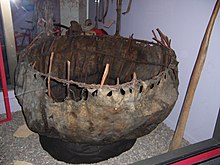
Tibetan willow-frame yak skin boat (kudru) w/ yak butter grease (ghee) waterproofing
http://upload.wikimedia.org/wikipedia/commons/thumb/0/0e/Kudru.jpg/220px-Kudru.jpg
http://www.theoi.com/Gallery/T17.5.html
-
Large baskets from Yosemite valley Paiute/Miwok (Pen-uti-an) woman:
http://content.cdlib.org/ark:/13030/kt9199q6g6/?layout=metadata&brand=calisphere
http://content.cdlib.org/ark:/13030/kt809nd0gr/ (baskets)
http://content.cdlib.org/ark:/13030/kt15801729/ (Yosemite valley flooded)
http://www.aboutnevadacounty.com/history/maidu/
Words in Penutian, Maidun (water: momim ~ omi -danubian/Yoruba; miwok - kiku/liwa)
http://www.native-languages.org/fampen_words.htm
Penutian from pen (2) and uti (2), not an original tribal name.
http://www.jstor.org/pss/1265869
British Celtic mai-dun, meaning a "great hill." (maidun hill fort, British south coast)
Situla: 7th c BC bronze age bucket/pail (Etruscan, Slovene, Egypt (mammaeform bottom cf Polynesian kavakava coconut bowl), probably derived from pitch-lined basket bowl cf shield)
http://en.wikipedia.org/wiki/Situla_(vessel)
Slovene: adjacent to Venice, 'origin' of Venetian/Veneti/Finnic/Uenn/Phoenician/Punic/Punt/Pun (red sea Ochre trade), linked via Danube to Nile Anu/danubia, always bordering empires (Rome, Austria, Ottoman), had Uralic languages.
http://en.wikipedia.org/wiki/Slovenia
http://en.wikipedia.org/wiki/Slovenia
mapiloa(N)=point/show with finger
Malays point with thumb, not finger (rude)
Maples have hand-like leaves (pentadactyle)
thumbs/fools/uei mapipiltin(N)who shone at small tlacuicuiliztli(N)=sculpture,=taquiyya(Arab)=
sweeping [no tree bark in desert, so cairns/stone markings/sweeping (also Peru)]
similar to shaving/sco(lpt)ring/scrap(pt)ing/stripping bark(beaver/bear/moose/mammoth), possibly related to first scripting/writing/runes/cuneiforms not stamped, cf alif/alpha/elf/eleve/vette|i(spade)
(tre/a/uck-travel/ois-trade-drag-troika) trunk/kudru(tibet coracle)/thung chai(Viet coracle)/thumb; first tropical coracle/hut-tent from plants, first ex-tropical coracle/hut-tent) may have been mammoth/elephant pelt, only much later defurred waxed/yak-buttered sewn leathers.
-
Giant art gallery yacht, Seafair, stops in Miami: http://www.expoships.com/
http://www.extrasleepy.com/photo/pages/photo-bowl-boat.html
Mandan willow-frame buffalo skin boat
http://www.minnehahacounty.org/museums/exhibits/l_c_gifts_mandan/teachers/artifact_pages/32_buffalo_bull_boat.htm
http://en.wikipedia.org/wiki/File:Catlin_mandan_village.jpg

Tibetan willow-frame yak skin boat (kudru) w/ yak butter grease (ghee) waterproofing
http://upload.wikimedia.org/wikipedia/commons/thumb/0/0e/Kudru.jpg/220px-Kudru.jpg
http://www.theoi.com/Gallery/T17.5.html
-
Large baskets from Yosemite valley Paiute/Miwok (Pen-uti-an) woman:
http://content.cdlib.org/ark:/13030/kt9199q6g6/?layout=metadata&brand=calisphere
http://content.cdlib.org/ark:/13030/kt809nd0gr/ (baskets)
http://content.cdlib.org/ark:/13030/kt15801729/ (Yosemite valley flooded)
http://www.aboutnevadacounty.com/history/maidu/
Words in Penutian, Maidun (water: momim ~ omi -danubian/Yoruba; miwok - kiku/liwa)
http://www.native-languages.org/fampen_words.htm
Penutian from pen (2) and uti (2), not an original tribal name.
http://www.jstor.org/pss/1265869
British Celtic mai-dun, meaning a "great hill." (maidun hill fort, British south coast)
Situla: 7th c BC bronze age bucket/pail (Etruscan, Slovene, Egypt (mammaeform bottom cf Polynesian kavakava coconut bowl), probably derived from pitch-lined basket bowl cf shield)
http://en.wikipedia.org/wiki/Situla_(vessel)
Slovene: adjacent to Venice, 'origin' of Venetian/Veneti/Finnic/Uenn/Phoenician/Punic/Punt/Pun (red sea Ochre trade), linked via Danube to Nile Anu/danubia, always bordering empires (Rome, Austria, Ottoman), had Uralic languages.
http://en.wikipedia.org/wiki/Slovenia
http://en.wikipedia.org/wiki/Slovenia
mapiloa(N)=point/show with finger
Malays point with thumb, not finger (rude)
Maples have hand-like leaves (pentadactyle)
thumbs/fools/uei mapipiltin(N)who shone at small tlacuicuiliztli(N)=sculpture,=taquiyya(Arab)=
sweeping [no tree bark in desert, so cairns/stone markings/sweeping (also Peru)]
similar to shaving/sco(lpt)ring/scrap(pt)ing/stripping bark(beaver/bear/moose/mammoth), possibly related to first scripting/writing/runes/cuneiforms not stamped, cf alif/alpha/elf/eleve/vette|i(spade)
(tre/a/uck-travel/ois-trade-drag-troika) trunk/kudru(tibet coracle)/thung chai(Viet coracle)/thumb; first tropical coracle/hut-tent from plants, first ex-tropical coracle/hut-tent) may have been mammoth/elephant pelt, only much later defurred waxed/yak-buttered sewn leathers.
-
Giant art gallery yacht, Seafair, stops in Miami: http://www.expoships.com/
Wednesday, November 30, 2011
Humans & Huts, Apes & Nests, Monkeys & Masses
'Conch-shell' dome hut of bamboo and rice straw:
http://dornob.com/deformed-dome-bamboo-hut-builds-on-a-modeling-mistake/
77ka bedding with insecticide:
http://www.sciencemag.org/content/334/6061/1388.abstract
-
56ma- Opposable big toe/thumb allows clinging to twigs, (no claws for
trunk climbing, no lemur leaping)
52ma- Noct to diurnal, increased sociality (group noct. sleep, less insectivory, more leaves & fruit)
35ma- OWM/apes got color vision (canopy sleep - snakes-raptor detection,
more frugivory)
23ma- TRP2 pheromone signal disabled (olf. neural switch to RAM?),
increased visual sexual signaling in hominoids
20ma- Morotopith vertebrae - orthogrady, twig weaving bowl nests (all
extant great apes) anti-raptor mimicry
16ma- family coherance/bonding - increased altriciality & neural complexity?
-
50ma: nocturnal slow-climbing insecti-folio-frugi-omni-vorous, scent-dominant (slow-loris -like)primates become diurnal/social binocular-color-sight-sound dominant, night-sleeping in plucked-leaf-cushioned tree-forks or enmassed-bunch ("snoozing-bear" mimic) defence against predators.
Opposable thumb allows clinging to twigs, sharp nails grasps trunks:
A 56 MILLION-YEAR-OLD skeleton found in Wyoming shows that one of the
earliest primate ancestors had an opposable big toe, allowing it to creep
to the outermost branches of trees to hunt nuts and fruit.
Because Carpolestes combines features of the earlier plesiadapiforms with
primate-like features, it begins to answer the question of what order these
traits evolved, and for what purpose. The study is published in the November
22 issue of the journal Science. ...
The Carpolestes, which weighed about 4 ounces (100 grams), had a long tail,
and a body about 14 inches (35 centimeters) long, shared some, but not all of
the characteristics of modern primates, and thus can be viewed as a
transitional animal. It had very primate like teeth that were highly
specialized for eating flowers, seeds, and fruit. The opposable big toe gave
it a grasping ability that indicates it spent most of its time climbing trees.
Carpolestes also had a nail on its big toe, but its eyes were not forward
facing, and it did not have the bone structure that would allow for
specialized leaping, like some of the earliest primates.
http://www.bbc.co.uk/news/science-environment-15600357
The team pinpointed the shift from non-social to social living to about 52 million years ago; a switch that appears to have happened in one step, and coincided with a move into daylight.
An analysis of over 200 primate species by a University of Oxford team suggests that our ancestors gave up their solitary existence when they shifted from being nocturnal creatures to those that are active during the day. It is likely communal living was adopted to protect against day time predators, the researchers say.
"If you are a small animal active at night then your best strategy to avoid predation is to be difficult to detect," explained Oxford's Suzanne Shultz, who led the study.
"Once you switch to being active during the day, that strategy isn't very effective, so an alternative strategy to reduce the risk of being eaten is to live in social groups," she told BBC News.
Dr Shultz thinks that the move to day-time living in ancient primates allowed animals to find food more quickly, communicate better, and travel faster through the forest.
female bonding emerged much later at about 16 million years ago.
http://www.ns.umich.edu/Releases/2003/Jun03/r061603.html
35ma- OWM got color vision but lost pheromone detection (replaced by RAM?)
Even our humble mammal cousin, the mouse, was found to have 140 genes just for pheromone receptors when its genome was completely sequenced earlier this year.
But humans are clueless when it comes to pheromone signals, according to University of Michigan evolutionary biologist Jianzhi “George” Zhang. He believes color vision put our pheromones out of business.
Zhang said. In fact, though humans and these apes still carry genes that should create pheromone receptors in our noses "Some pheromone detection genes don't function. There is considerable evidence that there are nasal receptors for pheromones in humans which affect behaviour, though their signals are not registered consciously." This may be origin of RAM memory in humans, via olfaction neural network.
A pheromone attaches to a water molecule, drifts about in the air currents and finally lands on the proper receptor in someone else’s nose. The receiver can’t immediately be sure who sent it, where it came from or when. But with sexual swelling, everyone in the troop can see precisely when and where the signal is, even at a significant distance.
Sexual swelling occurs in about 10 percent of all primate species, but only in the Old World species of Africa and Asia, which is where humans probably originated, as well.
To test their idea, Zhang’s team zeroed in on a human gene called TRP2, which makes an ion channel that is unique to the pheromone signaling pathway. They found that in humans and Old World primates, this gene suffered a mutation just over 23 million years ago that rendered it dysfunctional. But because we could use color vision for mating, it didn’t hurt us. In turn, the pheromone receptor genes that rely on this ion channel fell into disuse, and in a random fashion, mutated to a dysfunctional state because they haven’t experienced any pressure from natural selection.
34ma: New World monkeys transit Atlantic Ocean on floating vegetative raft, Red Sea opens, Antarctica freezes, equatoreal-Tethys currents changing affects forest seasonality.
20ma: Hominoids become sub-canopy open-bowl-nesting (eagle-nest mimic, outreached hooked hand = raptors' hooked beak, red scalp hair = danger sign to predator in flight, infant coo-ing = eagle chick cheeps), orthograde upright branch-hanging/standing/hand-plucking apes eg. morotopithecus, ardipithecus; development of deeper larynx and laryngeal air sac improved both upright vocalization in rainforest canopy and face-up upper-body buoyancy while wade-foraging (cf finger-raking surface-growing hydrocharis seaweed by Ndoki gorilla) in shallow forest wetlands and coastal mangroves, some slow open-ground upright bipedalism (cf siamang) with only little (above-branch) pronograde quadrupedalism.
5ma: Chromosome 2 inversion/fusion [Photic sneeze reflex activated, Iodine & Iron metabolism changes] in human ancestors, humans invert (dimple) the standard woven great ape sub-canopy open-bowl nest (leaf-lined interior) into small fully-enclosed-dome-hut with mosquito-proof/waterproof leaf-shingled exterior (reduced natural selection for fur coat), entire dome was lifted for access. Photic sneeze was advantageous against predation, eg. a leopard (or human enemy) at daybreak lifting the dome shell would flood it with sunlight, causing an explosive solar-powered sneeze (accompanied by a sharp stick) in the snout.
3.3ma: Gorilla louse transferred to humans and became human pubic louse, (possibly indicating that African Australopiths (eg. Lucy) starting at that period were HG hybrids?), Africa tropical rainforest reduced, humans more waterside and ground based. Apes (chimps, gorillas) independently develop knuckle-walking quadrupedalism to transit more open woodlands, while bipedal humans develop kneecrawling to enter/exit dome huts (no doorways yet, just lightweight dome shell).
2.6ma: First Oldawan sharp stone tools used to cut sedges/wicker/nuts/meat, reducing need for large sharp teeth, but molars enlarged for more chewing. Air sacs gradually lost, with increased submerged-face foraging (wading/swimming) in shallows for benthic rhyzomes and soft shelled seafoods along with shrub berries, herbs, eggs, larvae, etc.
1.8ma: Humans forage more often in coastal areas, develop denser bones and paranasal sinuses as result of deeper benthic gathering of shellfish, crustaceans. Females made slightly larger domes to contain small infants while foraging nearby so as to keep both hands free, males made smaller portable domes as hunting blinds/roundshields which females valued for use as baskets, these roundshields may have covered open hatchways at night to signal female's domes companionship. Likely seafoods, mangrove honey and mangrove salt-crystal leaf exudates were collected, consumed and brought inland seasonally, perhaps exchanging with inland groups. Bifacial hand axes were improved for cutting, used as bait traps when inserted into fish or animal organs to bait crocs, bears, big cats & wolves near shore.
120ka?: Humans invent portable roundshield-door-roundboat, modify hut (cone & drum), add doorway hatch.
25ka?: Humans invent orthogonal linear buildings, villages evolve from seasonal camps
DDeden
-
Article from New Scientist: http://www.newscientist.com/article/dn21258-earliest-human-bedding-didnt-let-the-bedbugs-bite.html
After a hard day hunting and gathering, humans 77,000 years ago could count on a good night's mosquito-free sleep on a comfy bed of grass and leaves. Archaeologists have discovered the oldest evidence of humans using plant bedding, 50,000 years before it appears anywhere else.
Many animals make beds for themselves, says lead author Lyn Wadley of the University of the Witwatersrand in Johannesburg, South Africa, but what's interesting in the new find is the way the owners managed their bedding. To keep it clean and pest-free, they burned it.
Wadley's team has spent the past decade excavating a rock shelter called Sibudu, situated high in a cliff surrounded by forest and near the Uthongathi river in South Africa. People lived there on and off between 80,000 and 38,000 years ago, in a complex society that used stone tools and even made glue and simple ornaments.
Wadley found layers of plant material on the cave floor that date from 77,000 years ago onwards – mostly grasses, sedges and rushes. These could not have grown in the dry shelter, so people probably collected them near the river.
Burning the beds
Wadley thinks the bedding was used to make a clean area for sitting, working, eating and sleeping. Tools and other artefacts were found buried within it.
Intriguingly, all the layers of bedding that are 73,000 years old or younger show signs of burning, which Wadley suggests may have been the result of routine cleaning. Burning the plants would have killed pests and diseases. That the cave's occupants needed to do this, he says, may suggest they spent extended periods of time in the shelter, so had to keep it clean.
It seems the bed-makers were selective about the plants they would sleep on. A range of trees grow in the region, but only the Cape laurel (Cryptocarya woodii) was used.
Cape laurel leaves give off insecticidal chemicals, so they would have repelled insects and their larvae – including malarial mosquitoes. That would make the cave bedding the earliest evidence of humans using medicinal plants, although other animals have similar tricks: common starlings often use insecticidal plants in their nests to repel blood-sucking insects.
Old knowledge
The behaviours may have started sooner than this site shows. "I would guess that right back until the earliest anatomically modern humans, people would have known which plant to choose," says Wadley.
Chimpanzees also build nests, and there is some evidence that they too include insecticidal plants. Fiona Stewart of the University of Cambridge, UK, spent several nights sleeping in chimp nests, and found that insects bit her less than when she slept on the ground.
"Perhaps this purpose of bedding has been continuous throughout human evolution," Stewart suggests.
Journal reference: Science, DOI: 10.1126/science.1213317
Note: I have written in an earlier post about medicinal and insecticidal plants used by archaic humans.
http://www.plantzafrica.com/plantcd/crytocarwood.htm
A bedding dated from the Lower Paleolithic, 130 000 years ago, was discovered by
Henry de Lumley. It was the home of the Lazaret Man near Nice in southern
France. The site was a construction, eleven feet long and twelve feet wide,
consisting of a frame of vertical posts resting against the wall of the cave, on
which were arranged skins falling to the ground. A partition separated the
interior activity areas and one area was containing the remains of a bedding.
The men of the Lazaretto rest and sleep on thick litter of dried kelp.
http://independent.academia.edu/pfpuech/Papers/212001/Enamel_Pits_of_the_Lazaret_Man
1) 52ma from noct to diur primates -> social group (little/no aquatic
foraging, surface swim)
2) 20ma from branch to open nest, prono to orthograde locom./forag.
(wade, face-up float, surface forage)
3) 5ma phot. sneeze reflex - from open nest to dome, (subsurface
forage)
4) 100ka-50ka roundboats (super-surface forage)
5) 20ka? longboats dugout/tied raft
My time chart:
0) pre-52ma small primate size, individual/infant tree hollow sleeping
(bushbaby, tupaia), little surface swimming
1) 52ma from noct to diur primates -> social group (little/no aquatic
foraging, surface swimming) (group sleeping on branches?(proconsul))
2) 20ma from branch to large open nest, (morotopith, raptor-mimic
nest) from prono to orthograde locom./forag.
(wade, face-up float, surface forage)
3) 5ma phot. sneeze reflex - from open nest to dome, (subsurface
forage, HP split, #2 chrom. fusion)
4) 100ka-50ka roundboats (super-surface forage) qufa
5) 20ka? longboats dugout/tied raft
-
Chufa = suph = sedge
Chum: Chinook - dog salmon, Siberian - cone tent (proto-tipi) for summer fishing?
Ket/a: Russian - dog salmon, Ket people of Yenisei R,
Kot/a: Saami/Lapp conic tent, Kot people of Yenisei R.
http://dornob.com/deformed-dome-bamboo-hut-builds-on-a-modeling-mistake/
77ka bedding with insecticide:
http://www.sciencemag.org/content/334/6061/1388.abstract
-
56ma- Opposable big toe/thumb allows clinging to twigs, (no claws for
trunk climbing, no lemur leaping)
52ma- Noct to diurnal, increased sociality (group noct. sleep, less insectivory, more leaves & fruit)
35ma- OWM/apes got color vision (canopy sleep - snakes-raptor detection,
more frugivory)
23ma- TRP2 pheromone signal disabled (olf. neural switch to RAM?),
increased visual sexual signaling in hominoids
20ma- Morotopith vertebrae - orthogrady, twig weaving bowl nests (all
extant great apes) anti-raptor mimicry
16ma- family coherance/bonding - increased altriciality & neural complexity?
-
50ma: nocturnal slow-climbing insecti-folio-frugi-omni-vorous, scent-dominant (slow-loris -like)primates become diurnal/social binocular-color-sight-sound dominant, night-sleeping in plucked-leaf-cushioned tree-forks or enmassed-bunch ("snoozing-bear" mimic) defence against predators.
Opposable thumb allows clinging to twigs, sharp nails grasps trunks:
A 56 MILLION-YEAR-OLD skeleton found in Wyoming shows that one of the
earliest primate ancestors had an opposable big toe, allowing it to creep
to the outermost branches of trees to hunt nuts and fruit.
Because Carpolestes combines features of the earlier plesiadapiforms with
primate-like features, it begins to answer the question of what order these
traits evolved, and for what purpose. The study is published in the November
22 issue of the journal Science. ...
The Carpolestes, which weighed about 4 ounces (100 grams), had a long tail,
and a body about 14 inches (35 centimeters) long, shared some, but not all of
the characteristics of modern primates, and thus can be viewed as a
transitional animal. It had very primate like teeth that were highly
specialized for eating flowers, seeds, and fruit. The opposable big toe gave
it a grasping ability that indicates it spent most of its time climbing trees.
Carpolestes also had a nail on its big toe, but its eyes were not forward
facing, and it did not have the bone structure that would allow for
specialized leaping, like some of the earliest primates.
http://www.bbc.co.uk/news/science-environment-15600357
The team pinpointed the shift from non-social to social living to about 52 million years ago; a switch that appears to have happened in one step, and coincided with a move into daylight.
An analysis of over 200 primate species by a University of Oxford team suggests that our ancestors gave up their solitary existence when they shifted from being nocturnal creatures to those that are active during the day. It is likely communal living was adopted to protect against day time predators, the researchers say.
"If you are a small animal active at night then your best strategy to avoid predation is to be difficult to detect," explained Oxford's Suzanne Shultz, who led the study.
"Once you switch to being active during the day, that strategy isn't very effective, so an alternative strategy to reduce the risk of being eaten is to live in social groups," she told BBC News.
Dr Shultz thinks that the move to day-time living in ancient primates allowed animals to find food more quickly, communicate better, and travel faster through the forest.
female bonding emerged much later at about 16 million years ago.
http://www.ns.umich.edu/Releases/2003/Jun03/r061603.html
35ma- OWM got color vision but lost pheromone detection (replaced by RAM?)
Even our humble mammal cousin, the mouse, was found to have 140 genes just for pheromone receptors when its genome was completely sequenced earlier this year.
But humans are clueless when it comes to pheromone signals, according to University of Michigan evolutionary biologist Jianzhi “George” Zhang. He believes color vision put our pheromones out of business.
Zhang said. In fact, though humans and these apes still carry genes that should create pheromone receptors in our noses "Some pheromone detection genes don't function. There is considerable evidence that there are nasal receptors for pheromones in humans which affect behaviour, though their signals are not registered consciously." This may be origin of RAM memory in humans, via olfaction neural network.
A pheromone attaches to a water molecule, drifts about in the air currents and finally lands on the proper receptor in someone else’s nose. The receiver can’t immediately be sure who sent it, where it came from or when. But with sexual swelling, everyone in the troop can see precisely when and where the signal is, even at a significant distance.
Sexual swelling occurs in about 10 percent of all primate species, but only in the Old World species of Africa and Asia, which is where humans probably originated, as well.
To test their idea, Zhang’s team zeroed in on a human gene called TRP2, which makes an ion channel that is unique to the pheromone signaling pathway. They found that in humans and Old World primates, this gene suffered a mutation just over 23 million years ago that rendered it dysfunctional. But because we could use color vision for mating, it didn’t hurt us. In turn, the pheromone receptor genes that rely on this ion channel fell into disuse, and in a random fashion, mutated to a dysfunctional state because they haven’t experienced any pressure from natural selection.
34ma: New World monkeys transit Atlantic Ocean on floating vegetative raft, Red Sea opens, Antarctica freezes, equatoreal-Tethys currents changing affects forest seasonality.
20ma: Hominoids become sub-canopy open-bowl-nesting (eagle-nest mimic, outreached hooked hand = raptors' hooked beak, red scalp hair = danger sign to predator in flight, infant coo-ing = eagle chick cheeps), orthograde upright branch-hanging/standing/hand-plucking apes eg. morotopithecus, ardipithecus; development of deeper larynx and laryngeal air sac improved both upright vocalization in rainforest canopy and face-up upper-body buoyancy while wade-foraging (cf finger-raking surface-growing hydrocharis seaweed by Ndoki gorilla) in shallow forest wetlands and coastal mangroves, some slow open-ground upright bipedalism (cf siamang) with only little (above-branch) pronograde quadrupedalism.
5ma: Chromosome 2 inversion/fusion [Photic sneeze reflex activated, Iodine & Iron metabolism changes] in human ancestors, humans invert (dimple) the standard woven great ape sub-canopy open-bowl nest (leaf-lined interior) into small fully-enclosed-dome-hut with mosquito-proof/waterproof leaf-shingled exterior (reduced natural selection for fur coat), entire dome was lifted for access. Photic sneeze was advantageous against predation, eg. a leopard (or human enemy) at daybreak lifting the dome shell would flood it with sunlight, causing an explosive solar-powered sneeze (accompanied by a sharp stick) in the snout.
3.3ma: Gorilla louse transferred to humans and became human pubic louse, (possibly indicating that African Australopiths (eg. Lucy) starting at that period were HG hybrids?), Africa tropical rainforest reduced, humans more waterside and ground based. Apes (chimps, gorillas) independently develop knuckle-walking quadrupedalism to transit more open woodlands, while bipedal humans develop kneecrawling to enter/exit dome huts (no doorways yet, just lightweight dome shell).
2.6ma: First Oldawan sharp stone tools used to cut sedges/wicker/nuts/meat, reducing need for large sharp teeth, but molars enlarged for more chewing. Air sacs gradually lost, with increased submerged-face foraging (wading/swimming) in shallows for benthic rhyzomes and soft shelled seafoods along with shrub berries, herbs, eggs, larvae, etc.
1.8ma: Humans forage more often in coastal areas, develop denser bones and paranasal sinuses as result of deeper benthic gathering of shellfish, crustaceans. Females made slightly larger domes to contain small infants while foraging nearby so as to keep both hands free, males made smaller portable domes as hunting blinds/roundshields which females valued for use as baskets, these roundshields may have covered open hatchways at night to signal female's domes companionship. Likely seafoods, mangrove honey and mangrove salt-crystal leaf exudates were collected, consumed and brought inland seasonally, perhaps exchanging with inland groups. Bifacial hand axes were improved for cutting, used as bait traps when inserted into fish or animal organs to bait crocs, bears, big cats & wolves near shore.
120ka?: Humans invent portable roundshield-door-roundboat, modify hut (cone & drum), add doorway hatch.
25ka?: Humans invent orthogonal linear buildings, villages evolve from seasonal camps
DDeden
-
Article from New Scientist: http://www.newscientist.com/article/dn21258-earliest-human-bedding-didnt-let-the-bedbugs-bite.html
After a hard day hunting and gathering, humans 77,000 years ago could count on a good night's mosquito-free sleep on a comfy bed of grass and leaves. Archaeologists have discovered the oldest evidence of humans using plant bedding, 50,000 years before it appears anywhere else.
Many animals make beds for themselves, says lead author Lyn Wadley of the University of the Witwatersrand in Johannesburg, South Africa, but what's interesting in the new find is the way the owners managed their bedding. To keep it clean and pest-free, they burned it.
Wadley's team has spent the past decade excavating a rock shelter called Sibudu, situated high in a cliff surrounded by forest and near the Uthongathi river in South Africa. People lived there on and off between 80,000 and 38,000 years ago, in a complex society that used stone tools and even made glue and simple ornaments.
Wadley found layers of plant material on the cave floor that date from 77,000 years ago onwards – mostly grasses, sedges and rushes. These could not have grown in the dry shelter, so people probably collected them near the river.
Burning the beds
Wadley thinks the bedding was used to make a clean area for sitting, working, eating and sleeping. Tools and other artefacts were found buried within it.
Intriguingly, all the layers of bedding that are 73,000 years old or younger show signs of burning, which Wadley suggests may have been the result of routine cleaning. Burning the plants would have killed pests and diseases. That the cave's occupants needed to do this, he says, may suggest they spent extended periods of time in the shelter, so had to keep it clean.
It seems the bed-makers were selective about the plants they would sleep on. A range of trees grow in the region, but only the Cape laurel (Cryptocarya woodii) was used.
Cape laurel leaves give off insecticidal chemicals, so they would have repelled insects and their larvae – including malarial mosquitoes. That would make the cave bedding the earliest evidence of humans using medicinal plants, although other animals have similar tricks: common starlings often use insecticidal plants in their nests to repel blood-sucking insects.
Old knowledge
The behaviours may have started sooner than this site shows. "I would guess that right back until the earliest anatomically modern humans, people would have known which plant to choose," says Wadley.
Chimpanzees also build nests, and there is some evidence that they too include insecticidal plants. Fiona Stewart of the University of Cambridge, UK, spent several nights sleeping in chimp nests, and found that insects bit her less than when she slept on the ground.
"Perhaps this purpose of bedding has been continuous throughout human evolution," Stewart suggests.
Journal reference: Science, DOI: 10.1126/science.1213317
Note: I have written in an earlier post about medicinal and insecticidal plants used by archaic humans.
http://www.plantzafrica.com/plantcd/crytocarwood.htm
A bedding dated from the Lower Paleolithic, 130 000 years ago, was discovered by
Henry de Lumley. It was the home of the Lazaret Man near Nice in southern
France. The site was a construction, eleven feet long and twelve feet wide,
consisting of a frame of vertical posts resting against the wall of the cave, on
which were arranged skins falling to the ground. A partition separated the
interior activity areas and one area was containing the remains of a bedding.
The men of the Lazaretto rest and sleep on thick litter of dried kelp.
http://independent.academia.edu/pfpuech/Papers/212001/Enamel_Pits_of_the_Lazaret_Man
1) 52ma from noct to diur primates -> social group (little/no aquatic
foraging, surface swim)
2) 20ma from branch to open nest, prono to orthograde locom./forag.
(wade, face-up float, surface forage)
3) 5ma phot. sneeze reflex - from open nest to dome, (subsurface
forage)
4) 100ka-50ka roundboats (super-surface forage)
5) 20ka? longboats dugout/tied raft
My time chart:
0) pre-52ma small primate size, individual/infant tree hollow sleeping
(bushbaby, tupaia), little surface swimming
1) 52ma from noct to diur primates -> social group (little/no aquatic
foraging, surface swimming) (group sleeping on branches?(proconsul))
2) 20ma from branch to large open nest, (morotopith, raptor-mimic
nest) from prono to orthograde locom./forag.
(wade, face-up float, surface forage)
3) 5ma phot. sneeze reflex - from open nest to dome, (subsurface
forage, HP split, #2 chrom. fusion)
4) 100ka-50ka roundboats (super-surface forage) qufa
5) 20ka? longboats dugout/tied raft
-
Chufa = suph = sedge
Chum: Chinook - dog salmon, Siberian - cone tent (proto-tipi) for summer fishing?
Ket/a: Russian - dog salmon, Ket people of Yenisei R,
Kot/a: Saami/Lapp conic tent, Kot people of Yenisei R.
Saturday, October 15, 2011
Videos
Incredible videos: mussel hunting under ice during low tide, others
http://www.youtube.com/watch_popup?v=Z0qGvC3vqaA
Amazing pendulum waves of Mach:
http://sciencedemonstrations.fas.harvard.edu/icb/icb.do?keyword=k16940&pageid=icb.page80863&pageContentId=icb.pagecontent341734&state=maximize&view=view.do&viewParam_name=indepth.html#a_icb_pagecontent341734
http://www.youtube.com/watch_popup?v=Z0qGvC3vqaA
Amazing pendulum waves of Mach:
http://sciencedemonstrations.fas.harvard.edu/icb/icb.do?keyword=k16940&pageid=icb.page80863&pageContentId=icb.pagecontent341734&state=maximize&view=view.do&viewParam_name=indepth.html#a_icb_pagecontent341734
Tuesday, September 6, 2011
Ancient predator traps
Update of this post: http://the-arc-ddeden.blogspot.com/2007/12/aechulian-hand-axe-or-bifacial-bait.html
http://news.yahoo.com/giant-crocodile-captured-alive-philippines-134625838.html
http://lawnchairanthropology.blogspot.com/2011/08/how-old-is-acheulian-tool-industry-and.html
What exactly were Acheulian "hand-axes" (with their very specific forms) for?--marc
DDeden: multi-functional knives, including use as predator bait traps, inserted into flesh of prey and set at waterside to kill crocs, sharks, wolves, lions, etc. They are most commonly found near former waterside areas, (per Mikey Brass at Paleoanthro) they were made with sharp edges all around (so inconvenient for handling unless partly covered), swallowed by predators that had a habit of 'wolfing' down chunks of flesh quickly.
http://news.sciencemag.org/sciencenow/2011/08/why-did-early-humans-leave-afric.html?ref=hp
Why Did Early Humans Leave Africa Without the Latest Gadgets?Brian Switek 31.8.11In ancient sediments near Kenya's Lake Turkana, archaeologists have foundstone hand axes dating to 1.76 Ma - the oldest examples yet found of theAcheulian stone-tool technology.People love to get their hands on the latest & greatest technology, andscientists had long believed that early humans were no exception.Paleontologists theorized that our ancestors didn't start leaving Africauntil they had developed advanced hand axes.But a new study finds that early humans began to migrate out of thecontinent with more primitive tools, even though better technology hadbeen invented. Over time, various groups of ancient humans have made various types ofstone tools. The oldest & most rudimentary instruments (sharp-edged stones created bybanging rounded rocks against larger stone "anvils") belong to the Oldowanculture ~2.6-1.7 Mao.From the Oldowan, a more complex tool culture developed called theAcheulian ~1.6 Ma. These are more complicated tools, such as teardrop-shaped hand axes,created by striking carefully selected stones with other rocks calledhammer-stones. These tools were useful for a wider range of tasks than the Oldowan ones.It was the Acheulian culture that first spread farthest around the globe,and it persisted until ~100 ka.
http://news.yahoo.com/giant-crocodile-captured-alive-philippines-134625838.html
http://lawnchairanthropology.blogspot.com/2011/08/how-old-is-acheulian-tool-industry-and.html
What exactly were Acheulian "hand-axes" (with their very specific forms) for?--marc
DDeden: multi-functional knives, including use as predator bait traps, inserted into flesh of prey and set at waterside to kill crocs, sharks, wolves, lions, etc. They are most commonly found near former waterside areas, (per Mikey Brass at Paleoanthro) they were made with sharp edges all around (so inconvenient for handling unless partly covered), swallowed by predators that had a habit of 'wolfing' down chunks of flesh quickly.
http://news.sciencemag.org/sciencenow/2011/08/why-did-early-humans-leave-afric.html?ref=hp
Why Did Early Humans Leave Africa Without the Latest Gadgets?Brian Switek 31.8.11In ancient sediments near Kenya's Lake Turkana, archaeologists have foundstone hand axes dating to 1.76 Ma - the oldest examples yet found of theAcheulian stone-tool technology.People love to get their hands on the latest & greatest technology, andscientists had long believed that early humans were no exception.Paleontologists theorized that our ancestors didn't start leaving Africauntil they had developed advanced hand axes.But a new study finds that early humans began to migrate out of thecontinent with more primitive tools, even though better technology hadbeen invented. Over time, various groups of ancient humans have made various types ofstone tools. The oldest & most rudimentary instruments (sharp-edged stones created bybanging rounded rocks against larger stone "anvils") belong to the Oldowanculture ~2.6-1.7 Mao.From the Oldowan, a more complex tool culture developed called theAcheulian ~1.6 Ma. These are more complicated tools, such as teardrop-shaped hand axes,created by striking carefully selected stones with other rocks calledhammer-stones. These tools were useful for a wider range of tasks than the Oldowan ones.It was the Acheulian culture that first spread farthest around the globe,and it persisted until ~100 ka.
Wednesday, August 10, 2011
The Line of the Archer, the Biologist & the Polymath
At Catalogue of Organisms biology blog, [http://coo.fieldofscience.com/2011/08/red-lined-wings-of-south-america.html?showComment=1312665778549#comment-c4532519180935840235 ] I made a comment regarding the original measure of the word "line", following his description : "A 'line' is a unit of measurement used by a number of 18th and 19th century biologists. The exact length of a line seems to have varied somewhat between countries (see this page for explanations), though it seems to have generally been a little more than 2 mm. Linnaeus apparently defined a line in the introduction to Philosophia Botanica as the length of a lunule (the white half-moon at the base of a fingernail) on any finger other than the thumb." (italics mine)
my comment: perhaps originally 'line' represented the diameter or thickness of a taut bowstring on an archer's bow? I'd think it fits in this way:
L-ine singlet, a-lign (ligament/tendon) (parallel fiber, straight or single coil)
Tw-ine duplet, div-ide, twisted lines -> X (double helix)
Tr-ine triplet, tri-plait, braided lines -> * (offset & interwoven)
See the picture in my earlier post here: http://the-arc-ddeden.blogspot.com/2010/05/archae-numeric.html
Note that in the 123 sequence, Roman numerals are vertical lines, Chinese numerals are horizontal lines and Indi-Arabic numerals are vertical cursively attached lines.
Per Bucky Fuller, there are no mathematically straight lines in nature, there are only progressively less non-straight lines as vector edges between and enclosing events.
http://www.rwgrayprojects.com/synergetics/synergetics.htmlhttp://en.wikipedia.org/wiki/Synergetics_(Fuller)
Wednesday, June 8, 2011
Vertebrates "are" Invertebrates
I asked the following questions to Christopher at his blog Catalogue of Organisms, in his post on moths.
PPS. Insect wings appear to be homologs to a vertebrate rib "shell", that is, the delicate forewings of a butterfly are equivalent evolutionarily to the hyperdense ribcage of a dugong, the aftwings of a moth to a sauropod pelvis, the fly's vestigial flight knobs to a giant blue whales vestigial pelvis.
- Are the pharyngeal arches in vertebrates homologous to the first pair of true legs in insects?
- Are the abdomenal prolegs in holometabolous caterpillars homologous to the ventral mammae & milk line in mammals? (both involve fluid-dynamic flow rather than muscle movement, and woulld explain presence of most male mammals retaining vestigial nipples).
I suspect so, in both cases. Having just read The Secret Life of Lobsters by Trevor Corson, I see that female lobsters secrete protein glue (for egg attachment) from cement ducts on their caudalmost swimmerettes (homologous to caudalmost prolegs & mammae secreting casein glue-rich milk IMO). They fold their tails like crabs and deposit thousands of eggs within the folded area, protecting them from exposure. Marsupials seem to have retained this trait, except the marsupial embryo escapes the egg and womb and crawls by forelimbs to the mammae which are protected from exposure by a skin fold (pouch). The echidna, an egg laying primitive monotreme mammal with a pouch, has no external nipples, the hatched infant licks the abdomen to get milk. It appears to be a homology between these distinct taxa.
Aaron Filler's book on Vertebrae called The Upright Ape goes into detail on the spine & vertebrae as archetype, but does not mention this: Lobsters inside their eggs molt 35 times, changing their 'skin'. (After leaving the egg, lobsters eat their shed 'skin'.) The 35 molts produce the somites which form the vertebral column (in vertebrates), internally similar to the external rattles of the molting rattlesnake, I'd say. (Unlike lobsters, snakes never eat their shed skin AFAIK.) It is my contention that the 35 molts are, geometrically, 7 episodes of pentameric (5-way split) distribution, resulting in, for example, 7 cervical vertebrae in mammals, etc.
DDeden
PS. Insect wings and bird/dinosaur feathers appear to be homologous to lobster swimmerettes, (and more distantly to caterpillar prolegs and mammalian mammae). Imagine that! Nature Rules!PPS. Insect wings appear to be homologs to a vertebrate rib "shell", that is, the delicate forewings of a butterfly are equivalent evolutionarily to the hyperdense ribcage of a dugong, the aftwings of a moth to a sauropod pelvis, the fly's vestigial flight knobs to a giant blue whales vestigial pelvis.
http://coo.fieldofscience.com/2011/06/colour-vs-crypsis.html#comments
http://www.amazon.com/Secret-Life-Lobsters-Scientists-Unraveling/dp/0060555580
Also interesting to compare human embryos and giant sauropod dinosaurs:
and the tentacles of squid ((4 + 1) x 2) with the typical prolegs of a caterpillar ((4 + 1) x 2)...
=================================================================
Church forests of Lake Tana, Ethiopia 'Trees are the jewels of God"
http://blogs.plos.org/blog/2011/02/25/church-forest/
They function similarly to the European tradition of Royal Forest. Interesting the name of the island forests is Coptic Forest, similar to Coppice Forest.
Tuesday, June 7, 2011
Monday, June 6, 2011
Hushai the Archite - Friend of King David
Various interpretations are given to the epithet "The Archite." According to one opinion it was because he was one of David's highest officials (from the Greek archē, "chief of government"); according to another it is the name of his birthplace; and others that he was so called "because through him the house of David was to be put on a firm footing, and through him the house of David was to be kept in good repair," the word ארך in Aramaic meaning to keep in good order (Mid. Ps. 3:3).
The name Hushai itself is most probably a short form of the name Ahishai, Ahushai.
http://www.goisrael.com/Tourism_Eng/Tourist+Information/Ethnic+Groups/Druze/The+Tomb+of+Hushai+the+Archite+in+Yirka.htm
https://www.cia.gov/library/center-for-the-study-of-intelligence/kent-csi/vol13no2/html/v13i2a04p_0001.htm
Hushai
From Wikipedia, the free encyclopedia
Jump to: navigation, search
Hushai or Chusai was a friend of David and a spy according to the Hebrew Bible.
Hushai was an Archite, that is, possibly a native of Archi, a place south of the portion of Ephraim, near Bethel (Joshua 16:2). He is called in 1 Chronicles 27:33 "the king's friend". This title is similar to that of counselor given to Ahitophel, or that of leader of the army to Joab. We see a like use of the term in 1 Kings 4:5. In the Books of the Maccabees it is an official title given by the Seleucids to persons of confidence who have important military or civil functions (1 Maccabees 2:18; 3:38; 6:10, 14, 28; 7:6-8; etc.). It is likely then, that Hushai's title of "friend" of King David does not imply the intimate relations suggested by the term.
Nevertheless, the account that is given of him during Absalom's rebellion (2 Samuel 15-17) shows that in his case the title was not merely official. Just after David has heard of the treason of his counselor Ahitophel, he is met, on his way up the Mount of Olives by Hushai, whose garments are rent and whose head is covered with dust. He is probably an old man, for David tells him he would be a burden in the flight. But the king does honour to Hushai's cleverness by sending him to Jerusalem to "defeat the counsel of Ahitophel". Hushai persuades Absalom to take him into his confidence, and, in the council held shortly afterwards in regard to the measures to be taken against David, he obtains a delay which secures the safety of the king. He is able likewise to convey information to David through Zadok, Abiathar, and their sons.
[edit] References
This article incorporates text from a publication now in the public domain: Herbermann, Charles, ed (1913). "Chusai". Catholic Encyclopedia. Robert Appleton Company. The original article was by Joseph P. Thomas.
http://en.wikipedia.org/wiki/Archi_language
The name Hushai itself is most probably a short form of the name Ahishai, Ahushai.
http://www.goisrael.com/Tourism_Eng/Tourist+Information/Ethnic+Groups/Druze/The+Tomb+of+Hushai+the+Archite+in+Yirka.htm
https://www.cia.gov/library/center-for-the-study-of-intelligence/kent-csi/vol13no2/html/v13i2a04p_0001.htm
Hushai
From Wikipedia, the free encyclopedia
Jump to: navigation, search
Hushai or Chusai was a friend of David and a spy according to the Hebrew Bible.
Hushai was an Archite, that is, possibly a native of Archi, a place south of the portion of Ephraim, near Bethel (Joshua 16:2). He is called in 1 Chronicles 27:33 "the king's friend". This title is similar to that of counselor given to Ahitophel, or that of leader of the army to Joab. We see a like use of the term in 1 Kings 4:5. In the Books of the Maccabees it is an official title given by the Seleucids to persons of confidence who have important military or civil functions (1 Maccabees 2:18; 3:38; 6:10, 14, 28; 7:6-8; etc.). It is likely then, that Hushai's title of "friend" of King David does not imply the intimate relations suggested by the term.
Nevertheless, the account that is given of him during Absalom's rebellion (2 Samuel 15-17) shows that in his case the title was not merely official. Just after David has heard of the treason of his counselor Ahitophel, he is met, on his way up the Mount of Olives by Hushai, whose garments are rent and whose head is covered with dust. He is probably an old man, for David tells him he would be a burden in the flight. But the king does honour to Hushai's cleverness by sending him to Jerusalem to "defeat the counsel of Ahitophel". Hushai persuades Absalom to take him into his confidence, and, in the council held shortly afterwards in regard to the measures to be taken against David, he obtains a delay which secures the safety of the king. He is able likewise to convey information to David through Zadok, Abiathar, and their sons.
[edit] References
This article incorporates text from a publication now in the public domain: Herbermann, Charles, ed (1913). "Chusai". Catholic Encyclopedia. Robert Appleton Company. The original article was by Joseph P. Thomas.

http://en.wikipedia.org/wiki/Archi_language
Friday, June 3, 2011
steps
http://ngm.nationalgeographic.com/2011/06/gobekli-tepe/musi-photography
http://www.uprightape.net/Image_Pages/UA_Fig3-2_DjedDrawing.html
Note similarity of the T pillar at Gobleki Tepe 9ka and the Djed column in Ancient Egypt (fig. B), both have hands extended forward, both have bench (or ladder rungs) below and T (or multiple Ts) above.
Note similarity of vertebrae, mastaba (mammae + stepped pyramid), stupa/pagoda, stair, stele/tel/tepe...
cf Greek 'step' = "be'ma" (speakers stand or judgement seat at trial)
The first dwelling of humanity was the triangularly woven geodesic dome of branches with a waterproof external coil of inserted leaf shingles (cf modern BaMbuti mongolu dome hut constructed by Pygmy women from intertwined branches.), an inversion of the great ape nest (which had been naturally selected due to its effective mimicry of the raptors large canopy open nest, with internal leaves inserted for lining). The dome hut occurred after the #2 chromosome inversion/fusion in humans, when human ancestors (46 chromosomes) permanently separated from apes (48 chromosomes) and exchanged open-nest-tree-canopy dwelling for enclosed-dome-ground dwelling. From this, humans expanded from their forest origins outwards omnidirectionally, modifying their dome huts. This included changing from a coil of large leaves to a coil of grass or reed bundles (more insulating), clumps of clay-roots (first Jericho huts) or slate-slabs or rocks (more permanent, eg. Natufian) or even mammoth skulls & bones covered by animal furs or tree bark or grass bundles, depending on availability of leaves etc. and amount of rain and temperature changes. The partly buried sod dome (at first hand-pulled root-soil clumps, then serrated-blade-obsidian-knife-cut square clods and later sawn snowblocks for dome igloos (eg. Alaskan Eskimo Inuit) and sundried clay-straw bricks (eg. Sudan Nile huts, India Harappa) were derived gradually. (By this time the original all-branch geodesic frame was replaced by tied-stick frame, knots/lashings and glues more recent than weaving.) Nomads following herd seasonal migrations developed the cone (stick-hide Saami kota, Dakota tipi) in areas with few trees, and the stilted coned column (stick-lathe-felt yurt, stick-lather-manure-clay roundhouse hut) followed in seasonally semi-permanent villages. Then square base huts and longhouses formed due to population pressure, round huts became "squished" and straightened by permanent fences/walls/roads and more concentration, height became functional for growth, usable for open canopy-covered patios (stick stepladders), areas not flood-prone would allow subground cool storeroom cellars (stone stairs), houses above floodprone areas had shaded patios and animal pens below.
See post on round basket craft, dome huts & round basket boats:
http://the-arc-ddeden.blogspot.com/2008/12/crescent.html
Le Tuc d'Audoubert cave, rotunda contains 2 clay sculted bison, outer chamber contains dripping stalactites (a poet referred to them as 'milky tits'), which links stalactite to galact to melt, molassis & Moses (drawn from water in a papyrus ark/teba coated in bitumen tar, as was the earlier Egyptian Horus) later getting water from stone in the land of milk (PIE melug, galact) & honey (mahdu, mead).
http://cd0901-2.blogspot.com/2009/01/birth-of-art-paleolithic-art.html
The holy sacred texts of ancient cultures speak of village squares, temples and 2 story buildings in towns & cities and fabricated tents of nomads, this dates them to long after the early human habitat of woven-branch dome shelters in small forest camps, rings of small huts (Saami kota, Malay mahakota = crown) around the central cooking/drying campfire (Mbuti apa = fire = camp, Malay api = fire, kampong = camp).
http://anthropology.net/2010/02/22/gobekli-tepe-temple-in-turkey-predates-the-pyramids-of-giza/#comment-25079
See beehive houses of Sanlurfia nearby:
http://images.travelpod.com/users/sallycousens/1.1244889872.bee-hive-houses.jpg
Compare to neolithic huts of Ban P'o site in 7ka China:
http://hilbertspaces.com/photos/china/xian/banpo/dscn1346.jpg
"Majority of them were semi subterranean, 3-5m (10-16ft) in diameter, and with floors almost a meter beneath the ground surface. Every house had timber beams that placed on stone bases, whereby they gave support to precipitously pitched roof. Moreover, the interior walls and floors were plastered with straw and clay". http://www.articlelisted.com/Art/41928/185/Neolithic-Village-Ban-po-ts-un.html
Basically a tied tipi top above ground and supported columnar bottom in or at ground level, typical for pre-brick neolithic small village settlements throughout Eurasia & Africa amongst transitional hunter-gatherer - permanent agriculturalists.
The igloo instead combined the coiled shingle unit (mongongo/pandanus leaf -> clay-straw clump (later brick) -> sod clod block -> snow block) and semi-subterranean depth with raised bed, but discarded the (scarce) wood branch geodesic framework, relying on the melt-freeze cycling of snow for rigid blocks similar to sun dried clay-straw bricks.
"Iglu is the Inuit word for a house or home built out of any material,[1] and is not restricted exclusively to snowhouses, but includes traditional tents, sod houses, homes constructed of driftwood and modern buildings.[2][3] The hole left in the snow where the blocks are cut from is usually used as the lower half of the shelter" (Similar to the semi-subterranean dome & cone structures elsewhere, inside was lower except in flood-prone areas where stilts were used.)Animal skins were used as door flaps to keep warm air in. Igloos used as winter shelters had beds made of snow, covered with twigs and caribou furs. (Furs were never used to cover the dome, only the doorway and bed.) Architecturally, the igloo is unique in that it is a dome that can be raised out of independent blocks leaning on each other and polished to fit without an additional supporting structure during construction. (Thus the wood frame was lost. In areas where snow was unreliable for blocks, huts of whale ribs and hides were built, surrounded by compacted snow for insulation.)
http://en.wikipedia.org/wiki/File:Igloo_spirale.svg (similar to leaf coiling of BaMbuti dome)
http://upload.wikimedia.org/wikipedia/commons/b/b3/EskimoIglooDrawing.jpeg
Earlier, I had speculated that the igloo had been derived from Lake Baikal seal air holes which are snow pile domes. In inuit these snowpiles are called aglu. But there is no coiled block construction, so I think the term aglu is derived from the igloo, which is surely derived from coiled sod clod domes derived from geodesic branch & coiled leaf domes (mongolu)
Where trees grew or driftwood was available, a pole & sod house was built:
http://pubs.aina.ucalgary.ca/arctic/Arctic45-2-199.pdf
Note that the ceiling was held up by either inverted forked roots or branch forks. [The T pillars of G. Tepe may have served a similar function, holding up a canopy, ceiling or dome above the central pair of Tees.] Some Siberian people had a tipi-like structure, but the smokehole was also the access hole, while a ladder was used for entry. In colder climates, the access hole was dug underground and covered. [Catal Hoyuk and other neolithic settlements also often used ceiling ladders rather than floor-level doorways or subterranean tunnels.]
Siberian yaranga (arctic yurt): http://en.wikipedia.org/wiki/Yaranga
Saami goahti*/kota/lavu: http://en.wikipedia.org/wiki/Goahti (peat & birch bark cover)
Siberian summer chum tipi tent: http://en.wikipedia.org/wiki/Chum_(tent)
Siberian winter pyramidal golomo uten**: http://www.grida.no/prog/polar/siberia2003/people/evenk/evenk.htm
nenet huts http://www.culturecenternorthernasia.org/housetypes.jpg
Siberian Koryak winter step hut: http://www.koryaks.net/history.html
* goahti (wide tipi) similar to: kota/cote/cottage/coat/hut/court
** golomo uten (wooden pyramid roof cabin) similar to: mongolu/igloo/harigolu/ma-gulu, uten similar to hut/wooden/hutan/(endu = interior of hut)/endura = forest interior)
DDeden
http://www.uprightape.net/Image_Pages/UA_Fig3-2_DjedDrawing.html
Note similarity of the T pillar at Gobleki Tepe 9ka and the Djed column in Ancient Egypt (fig. B), both have hands extended forward, both have bench (or ladder rungs) below and T (or multiple Ts) above.
Note similarity of vertebrae, mastaba (mammae + stepped pyramid), stupa/pagoda, stair, stele/tel/tepe...
cf Greek 'step' = "be'ma" (speakers stand or judgement seat at trial)
The first dwelling of humanity was the triangularly woven geodesic dome of branches with a waterproof external coil of inserted leaf shingles (cf modern BaMbuti mongolu dome hut constructed by Pygmy women from intertwined branches.), an inversion of the great ape nest (which had been naturally selected due to its effective mimicry of the raptors large canopy open nest, with internal leaves inserted for lining). The dome hut occurred after the #2 chromosome inversion/fusion in humans, when human ancestors (46 chromosomes) permanently separated from apes (48 chromosomes) and exchanged open-nest-tree-canopy dwelling for enclosed-dome-ground dwelling. From this, humans expanded from their forest origins outwards omnidirectionally, modifying their dome huts. This included changing from a coil of large leaves to a coil of grass or reed bundles (more insulating), clumps of clay-roots (first Jericho huts) or slate-slabs or rocks (more permanent, eg. Natufian) or even mammoth skulls & bones covered by animal furs or tree bark or grass bundles, depending on availability of leaves etc. and amount of rain and temperature changes. The partly buried sod dome (at first hand-pulled root-soil clumps, then serrated-blade-obsidian-knife-cut square clods and later sawn snowblocks for dome igloos (eg. Alaskan Eskimo Inuit) and sundried clay-straw bricks (eg. Sudan Nile huts, India Harappa) were derived gradually. (By this time the original all-branch geodesic frame was replaced by tied-stick frame, knots/lashings and glues more recent than weaving.) Nomads following herd seasonal migrations developed the cone (stick-hide Saami kota, Dakota tipi) in areas with few trees, and the stilted coned column (stick-lathe-felt yurt, stick-lather-manure-clay roundhouse hut) followed in seasonally semi-permanent villages. Then square base huts and longhouses formed due to population pressure, round huts became "squished" and straightened by permanent fences/walls/roads and more concentration, height became functional for growth, usable for open canopy-covered patios (stick stepladders), areas not flood-prone would allow subground cool storeroom cellars (stone stairs), houses above floodprone areas had shaded patios and animal pens below.
See post on round basket craft, dome huts & round basket boats:
http://the-arc-ddeden.blogspot.com/2008/12/crescent.html
Le Tuc d'Audoubert cave, rotunda contains 2 clay sculted bison, outer chamber contains dripping stalactites (a poet referred to them as 'milky tits'), which links stalactite to galact to melt, molassis & Moses (drawn from water in a papyrus ark/teba coated in bitumen tar, as was the earlier Egyptian Horus) later getting water from stone in the land of milk (PIE melug, galact) & honey (mahdu, mead).
http://cd0901-2.blogspot.com/2009/01/birth-of-art-paleolithic-art.html
The holy sacred texts of ancient cultures speak of village squares, temples and 2 story buildings in towns & cities and fabricated tents of nomads, this dates them to long after the early human habitat of woven-branch dome shelters in small forest camps, rings of small huts (Saami kota, Malay mahakota = crown) around the central cooking/drying campfire (Mbuti apa = fire = camp, Malay api = fire, kampong = camp).
http://anthropology.net/2010/02/22/gobekli-tepe-temple-in-turkey-predates-the-pyramids-of-giza/#comment-25079
See beehive houses of Sanlurfia nearby:
http://images.travelpod.com/users/sallycousens/1.1244889872.bee-hive-houses.jpg

Compare to neolithic huts of Ban P'o site in 7ka China:
http://hilbertspaces.com/photos/china/xian/banpo/dscn1346.jpg

"Majority of them were semi subterranean, 3-5m (10-16ft) in diameter, and with floors almost a meter beneath the ground surface. Every house had timber beams that placed on stone bases, whereby they gave support to precipitously pitched roof. Moreover, the interior walls and floors were plastered with straw and clay". http://www.articlelisted.com/Art/41928/185/Neolithic-Village-Ban-po-ts-un.html
Basically a tied tipi top above ground and supported columnar bottom in or at ground level, typical for pre-brick neolithic small village settlements throughout Eurasia & Africa amongst transitional hunter-gatherer - permanent agriculturalists.
The igloo instead combined the coiled shingle unit (mongongo/pandanus leaf -> clay-straw clump (later brick) -> sod clod block -> snow block) and semi-subterranean depth with raised bed, but discarded the (scarce) wood branch geodesic framework, relying on the melt-freeze cycling of snow for rigid blocks similar to sun dried clay-straw bricks.
"Iglu is the Inuit word for a house or home built out of any material,[1] and is not restricted exclusively to snowhouses, but includes traditional tents, sod houses, homes constructed of driftwood and modern buildings.[2][3] The hole left in the snow where the blocks are cut from is usually used as the lower half of the shelter" (Similar to the semi-subterranean dome & cone structures elsewhere, inside was lower except in flood-prone areas where stilts were used.)Animal skins were used as door flaps to keep warm air in. Igloos used as winter shelters had beds made of snow, covered with twigs and caribou furs. (Furs were never used to cover the dome, only the doorway and bed.) Architecturally, the igloo is unique in that it is a dome that can be raised out of independent blocks leaning on each other and polished to fit without an additional supporting structure during construction. (Thus the wood frame was lost. In areas where snow was unreliable for blocks, huts of whale ribs and hides were built, surrounded by compacted snow for insulation.)
http://en.wikipedia.org/wiki/File:Igloo_spirale.svg (similar to leaf coiling of BaMbuti dome)

http://upload.wikimedia.org/wikipedia/commons/b/b3/EskimoIglooDrawing.jpeg

Earlier, I had speculated that the igloo had been derived from Lake Baikal seal air holes which are snow pile domes. In inuit these snowpiles are called aglu. But there is no coiled block construction, so I think the term aglu is derived from the igloo, which is surely derived from coiled sod clod domes derived from geodesic branch & coiled leaf domes (mongolu)
Where trees grew or driftwood was available, a pole & sod house was built:
http://pubs.aina.ucalgary.ca/arctic/Arctic45-2-199.pdf
Note that the ceiling was held up by either inverted forked roots or branch forks. [The T pillars of G. Tepe may have served a similar function, holding up a canopy, ceiling or dome above the central pair of Tees.] Some Siberian people had a tipi-like structure, but the smokehole was also the access hole, while a ladder was used for entry. In colder climates, the access hole was dug underground and covered. [Catal Hoyuk and other neolithic settlements also often used ceiling ladders rather than floor-level doorways or subterranean tunnels.]
Siberian yaranga (arctic yurt): http://en.wikipedia.org/wiki/Yaranga
Saami goahti*/kota/lavu: http://en.wikipedia.org/wiki/Goahti (peat & birch bark cover)
Siberian summer chum tipi tent: http://en.wikipedia.org/wiki/Chum_(tent)
Siberian winter pyramidal golomo uten**: http://www.grida.no/prog/polar/siberia2003/people/evenk/evenk.htm
nenet huts http://www.culturecenternorthernasia.org/housetypes.jpg

Siberian Koryak winter step hut: http://www.koryaks.net/history.html
* goahti (wide tipi) similar to: kota/cote/cottage/coat/hut/court
** golomo uten (wooden pyramid roof cabin) similar to: mongolu/igloo/harigolu/ma-gulu, uten similar to hut/wooden/hutan/(endu = interior of hut)/endura = forest interior)
DDeden
Sunday, May 1, 2011
urartu sailing?
Did first controlled sailing occur at these lakes for reliable trade?
[Urartu/Ararat empire that became Armenia, parts of Iran/Georgia/Turkey.
Khalde = Chaldean?, Van = Levant = Lebanon, Van - Venetia/Phoenecia/Venice/Veneti?]
The wheel is found earliest here and Poland, from dragged triangular travoix to pulled sleds to sleds with pole rollers to detachable disc wheels (droga (drag/draw)/traga to wagon/tobagon/truck/(Thai) tuktuk)) with mast-pole axle. See bottom. Only areas with snow and ice would develop this method of trade locomotion. Africa had hoops but no wheels. Controlled sailing = controlled mast 360 degrees = axle on cart.
Phoenicians originally from these "high" seas, first sailers to learn to sail against the wind?
The seas of Armenia, Lake Van, Lake Sevan, Lake Urmia
This area was extraordinarily rich in trade (eg. mined flint, lapis lazuli) with Sumeria, Med. /Red/Black/Caspian seacoasts, Tigris-Euphrates rivers, early middle east towns. Bible refers to Abraham from Ur of the Chaldees, may link to Ur (city) of Urartu and the local god Khaldi. Did controlled sailing first begin in these mountain brackish lakes for ferrying products across? Nile sailboats furled sails when the current brought them downstream and unfurled sails when the winds brought them upstream, so no advantage to have tack-ability. The oceans were too rough for early sailboats. Rivers, wetlands and ponds required paddling or punt poling. Legend of Noahs' ark landing at Mount Ararat may have come from ancient Urartu lake original controlled sailing. Perhaps these seas had mountain passes which brought consistent breezes, where control of sail power was rewarded and long distance paddling was hard work due to low oxygen level?
[The Kingdom of Armenia (or Greater Armenia) was an independent kingdom from 190 BC to AD 387 and a client state of the Roman and Persian empires until 428, stretching from the Caspian to Mediterranean seas.
The predecessor of the kingdom was the Satrapy of Armenia Armenia
("Armina" in Old Persian, "Harminuya" in Elamite, and "Urartu" in the Bablylonian parts of Behistun Inscription
The Behistun Inscription is a multi-lingual inscription authored by Darius the Great, king of the Persian Empire, the successor state of the Median Empire, ruling over significant portions of what would become Greater Iran
The Orontid Dynasty was the first known Armenian dynasty and the successor state to the Kingdom of Ararat... (with Macedonian influence). ]
Tushpa, the capital of Urartu, was located near the shores of Lake Van, on the site of what became medieval Van's castle, west of present-day Van city.
Lake Van was the centre of the Armenian kingdom of Ararat from about 1000 BC, afterwards of the Satrapy of Armina, Kingdom of Greater Armenia, and the Armenian Kingdom of Vaspurakan.
Along with Lake Sevan in today's Armenia and Lake Urmia in today's Iran, Van was one of the three great lakes of the Armenian Kingdom, referred to as the seas of Armenia (in ancient Assyrian sources: "tâmtu ša mât Nairi" (Upper Sea of Nairi), the Lower Sea being Lake Urmia).
Armenian: Lake Sevan = Sevana Lich
the etymology of word "Sevan" was found in Teyseba (the cuneiform inscription by Rusa I (730—714 B.C.)). the etymology of "Sevan" is similar to Yerevan's etymology. http://en.wikipedia.org/wiki/Yerevan
it is likely that the city's name is derived from the Urartian military fortress of Erebuni (Էրեբունի), which was founded on the territory of modern-day Yerevan in 782 BC by Argishti I.[6] As elements of the Urartian language blended with that of the Armenian one, the name eventually evolved into Yerevan (Erebuni = Erevani = Erevan = Yerevan). Scholar Margarit Israelyan notes these changes when comparing inscriptions found on two cuneiform tablets at Erebuni:
The transcription of the second cuneiform bu [original emphasis] of the word was very essential in our interpretation as it is the Urartaean b that has been shifted to the Armenian v (b > v). The original writing of the inscription read «er-bu-ni»; therefore the prominent Armenianologist-orientalist Prof. G. A. Ghapantsian justly objected, remarking that the Urartu b changed to v at the beginning of the word (Biani > Van) or between two vowels (ebani > avan, Zabaha > Javakhk)....In other words b was placed between two vowels. The true pronunciation of the fortress-city was apparently Erebuny.[7]
So Van and Sevan were perhaps eban and seban, compare to Lebanon and venice...remarkably similar!
the western part of the Urmia Lake has been a center of attention of the prehistoric nations, the evidence of which are the numerous ancient hills in the area, such as Gouy Tapeh, 6 kilometers southeast of the lake which competes with the oldest hills of Mesopotamia, Asia the Minor, and the Iranian Plateau. Many old Islamic historians have acknowledged Urmia as the birthplace of prophet Zoroaster.
The Catholic Encyclopedia mentions Urmia as the seat of a Chaldean diocese.[7]
Turkish: Lake Van = Van Golu
Wheel:
The earliest examples of wheeled vehicles were little more than sleds with 2 attached solid wheels, but this was an enormous improvement over dragging. Early examples of these wheeled vehicles were found within a region between Lake Van in eastern Asia Minor and Lake Urmia in northern Iran, an area no more than 1,200 mi. across. This evidence indicates that these wheeled vehicles emerged more than 5,000 years ago, during the final centuries of the 4th Millennium. The remains of later vehicles, both carts and wagons, often survive as nothing more than stains in the soil, such as those found in the royal tombs at Kish and Ur, in Mesopotamia. Evidence was found during the mid-1960s in the region between the Black and Caspian seas of the U.S.S.R. that disk-wheeled vehicles flourished during the Kura-Araxes culture, beginning about 3000 B.C. Here pottery models of vehicles with wellmarked, hubbed, disk wheels were found that were identical to the vehicles buried at a later date in Kish and Ur.
http://dev.laptop.org/~arael/preview/wikislice-en/wikislice-en.xol/articles/Wheel.htm
Spoked wheels (cart/chariot/car/(Malay) kereta) were later, for lightweight/speed (using goats and donkeys as much as oxen) rather than heavy loads.
[Urartu/Ararat empire that became Armenia, parts of Iran/Georgia/Turkey.
Khalde = Chaldean?, Van = Levant = Lebanon, Van - Venetia/Phoenecia/Venice/Veneti?]
The wheel is found earliest here and Poland, from dragged triangular travoix to pulled sleds to sleds with pole rollers to detachable disc wheels (droga (drag/draw)/traga to wagon/tobagon/truck/(Thai) tuktuk)) with mast-pole axle. See bottom. Only areas with snow and ice would develop this method of trade locomotion. Africa had hoops but no wheels. Controlled sailing = controlled mast 360 degrees = axle on cart.
Phoenicians originally from these "high" seas, first sailers to learn to sail against the wind?
The seas of Armenia, Lake Van, Lake Sevan, Lake Urmia
This area was extraordinarily rich in trade (eg. mined flint, lapis lazuli) with Sumeria, Med. /Red/Black/Caspian seacoasts, Tigris-Euphrates rivers, early middle east towns. Bible refers to Abraham from Ur of the Chaldees, may link to Ur (city) of Urartu and the local god Khaldi. Did controlled sailing first begin in these mountain brackish lakes for ferrying products across? Nile sailboats furled sails when the current brought them downstream and unfurled sails when the winds brought them upstream, so no advantage to have tack-ability. The oceans were too rough for early sailboats. Rivers, wetlands and ponds required paddling or punt poling. Legend of Noahs' ark landing at Mount Ararat may have come from ancient Urartu lake original controlled sailing. Perhaps these seas had mountain passes which brought consistent breezes, where control of sail power was rewarded and long distance paddling was hard work due to low oxygen level?
[The Kingdom of Armenia (or Greater Armenia) was an independent kingdom from 190 BC to AD 387 and a client state of the Roman and Persian empires until 428, stretching from the Caspian to Mediterranean seas.
The predecessor of the kingdom was the Satrapy of Armenia Armenia
("Armina" in Old Persian, "Harminuya" in Elamite, and "Urartu" in the Bablylonian parts of Behistun Inscription
The Behistun Inscription is a multi-lingual inscription authored by Darius the Great, king of the Persian Empire, the successor state of the Median Empire, ruling over significant portions of what would become Greater Iran
The Orontid Dynasty was the first known Armenian dynasty and the successor state to the Kingdom of Ararat... (with Macedonian influence). ]
Tushpa, the capital of Urartu, was located near the shores of Lake Van, on the site of what became medieval Van's castle, west of present-day Van city.
Lake Van was the centre of the Armenian kingdom of Ararat from about 1000 BC, afterwards of the Satrapy of Armina, Kingdom of Greater Armenia, and the Armenian Kingdom of Vaspurakan.
Along with Lake Sevan in today's Armenia and Lake Urmia in today's Iran, Van was one of the three great lakes of the Armenian Kingdom, referred to as the seas of Armenia (in ancient Assyrian sources: "tâmtu ša mât Nairi" (Upper Sea of Nairi), the Lower Sea being Lake Urmia).
Armenian: Lake Sevan = Sevana Lich
the etymology of word "Sevan" was found in Teyseba (the cuneiform inscription by Rusa I (730—714 B.C.)). the etymology of "Sevan" is similar to Yerevan's etymology. http://en.wikipedia.org/wiki/Yerevan
it is likely that the city's name is derived from the Urartian military fortress of Erebuni (Էրեբունի), which was founded on the territory of modern-day Yerevan in 782 BC by Argishti I.[6] As elements of the Urartian language blended with that of the Armenian one, the name eventually evolved into Yerevan (Erebuni = Erevani = Erevan = Yerevan). Scholar Margarit Israelyan notes these changes when comparing inscriptions found on two cuneiform tablets at Erebuni:
The transcription of the second cuneiform bu [original emphasis] of the word was very essential in our interpretation as it is the Urartaean b that has been shifted to the Armenian v (b > v). The original writing of the inscription read «er-bu-ni»; therefore the prominent Armenianologist-orientalist Prof. G. A. Ghapantsian justly objected, remarking that the Urartu b changed to v at the beginning of the word (Biani > Van) or between two vowels (ebani > avan, Zabaha > Javakhk)....In other words b was placed between two vowels. The true pronunciation of the fortress-city was apparently Erebuny.[7]
So Van and Sevan were perhaps eban and seban, compare to Lebanon and venice...remarkably similar!
Lake Urmia is named after the provincial capital city of Urmia, originally a Syriac name meaning city (ur) of water (mia). OR The name Urmia is a compound. The first element--"ur" standing for 'city', is Sumerian. Ur per se, was a principal Sumerian city. The second element, "mia" is Aramaic Syriac meaning "water." Hence Urmia
In the ancient times, the west bank of Urmia lake was called Gilzan (gol-van?), and in the ninth century B.C. an independent government ruled there which later joined the Urartu or Mana empire;the western part of the Urmia Lake has been a center of attention of the prehistoric nations, the evidence of which are the numerous ancient hills in the area, such as Gouy Tapeh, 6 kilometers southeast of the lake which competes with the oldest hills of Mesopotamia, Asia the Minor, and the Iranian Plateau. Many old Islamic historians have acknowledged Urmia as the birthplace of prophet Zoroaster.
The Catholic Encyclopedia mentions Urmia as the seat of a Chaldean diocese.[7]
Turkish: Lake Van = Van Golu
Wheel:
The earliest examples of wheeled vehicles were little more than sleds with 2 attached solid wheels, but this was an enormous improvement over dragging. Early examples of these wheeled vehicles were found within a region between Lake Van in eastern Asia Minor and Lake Urmia in northern Iran, an area no more than 1,200 mi. across. This evidence indicates that these wheeled vehicles emerged more than 5,000 years ago, during the final centuries of the 4th Millennium. The remains of later vehicles, both carts and wagons, often survive as nothing more than stains in the soil, such as those found in the royal tombs at Kish and Ur, in Mesopotamia. Evidence was found during the mid-1960s in the region between the Black and Caspian seas of the U.S.S.R. that disk-wheeled vehicles flourished during the Kura-Araxes culture, beginning about 3000 B.C. Here pottery models of vehicles with wellmarked, hubbed, disk wheels were found that were identical to the vehicles buried at a later date in Kish and Ur.
http://dev.laptop.org/~arael/preview/wikislice-en/wikislice-en.xol/articles/Wheel.htm
Spoked wheels (cart/chariot/car/(Malay) kereta) were later, for lightweight/speed (using goats and donkeys as much as oxen) rather than heavy loads.
Saturday, April 23, 2011
Can you hear the thunder
some rough samples of my (unpolished) songs here http://www.myspace.com/neweurekans/music
Friday, September 3, 2010
root names
The name Dedan (identical to Deden) comes possibly from (dwd 410) the root for beloved (aunt, uncle, even the name David).
A clay tablet from Elba from 7,000 years ago had the name daud-um, which meant, land of daud/david.
There's a town near Mecca & Medina along the Red Sea coast named Dedan, mentioned in bible books. Deden & Dedan would be the same, since the vowels were not elucidated until more recently.
-
Reversed words:
May/Mar (Arabic, Sea)~ Yam (Hebrew, Sea)
Madrasa (Arabic, College) ~ Asrama (Malay, College) ~ Ashram (Hindu, Guru center)
Rome ~ Meroe
Remus ~ Sumer
Samar, Samaria ~ Rama
Derived from Oromo, (Ethiopian tribe who have an ancient legend of Adam)?
Adam (man in Hebrew)...Abram...Abraham...Brahmasutra...Ahuramazda...Urheimat
Oraham (Chaldean)...T/ora/h...K/ora/n...Oracle...Oralstories...Origins...Ur
Satan (adversary in Hebrew)
Analects of Confucius, Book One, 1st Saying: "That friends should come to one from afar, is that not after all delightful?"
A clay tablet from Elba from 7,000 years ago had the name daud-um, which meant, land of daud/david.
There's a town near Mecca & Medina along the Red Sea coast named Dedan, mentioned in bible books. Deden & Dedan would be the same, since the vowels were not elucidated until more recently.
-
Reversed words:
May/Mar (Arabic, Sea)~ Yam (Hebrew, Sea)
Madrasa (Arabic, College) ~ Asrama (Malay, College) ~ Ashram (Hindu, Guru center)
Rome ~ Meroe
Remus ~ Sumer
Samar, Samaria ~ Rama
Derived from Oromo, (Ethiopian tribe who have an ancient legend of Adam)?
Adam (man in Hebrew)...Abram...Abraham...Brahmasutra...Ahuramazda...Urheimat
Oraham (Chaldean)...T/ora/h...K/ora/n...Oracle...Oralstories...Origins...Ur
Satan (adversary in Hebrew)
Analects of Confucius, Book One, 1st Saying: "That friends should come to one from afar, is that not after all delightful?"
Friday, August 20, 2010
mans origins
Jerry Randal Bauer wrote:
> I've just read "Genesis Revisited" by Glenn G. Strickland. (1979)
> (ISBN: 0-8037-2828-X)
>
> I didn't like it, but I recommend it anyway.
>
> I didn't like it because the author adopts a very arrogant attitude
> toward anthropologists. He has figured out the answers to all the
> mysteries of human evolution; they have not, because they are unable
> to think rationally. He has been able to do this because he is
> (trumpet flourish here) a _RETIRED OPERATIONS RESEARCHER_!
>
> I didn't like it because the author failed to convince me of the
> validity of several of his conclusions. This is, in part, because he
> has made a definite effort to avoid anything the least bit technical.
> However, I think that many of his arguments just are not well thought
> out.
>
> His central thesis is that humankind developed where the Mediterranean
> Sea is now. Evidence exists that between 10 and 20 million years ago,
> the Mediterranean was dry. Tectonic forces had closed Gibraltar, and
> the sea had evaporated. The author posits that around each river
> "delta", where the river fell into the basin to evaporate, an
> ecological community developed, and that these areas were conducive to
> the development of our ancestors.
>
> This is why, even though I found the book flawed in content and
> presentation, I recommend it. This thesis is intriguing. The
> drying-up of the Mediterranean is well-supported by geological
> evidence beyond that given in this book. It happened at the time our
> ancestors were developing, according to some chronologies. It seems
> that such a situation could not but have some effect.
>
> So I would say read it. Some of the points raised within are quite
> original, and may serve to spark more effectively supportable
> theories.
>
> But, please, if you are or aspire to be an author, avoid any
> temptation to adopt Mr. Strickland's hubris.
>
> Jerry Randal Bauer
> I've just read "Genesis Revisited" by Glenn G. Strickland. (1979)
> (ISBN: 0-8037-2828-X)
>
> I didn't like it, but I recommend it anyway.
>
> I didn't like it because the author adopts a very arrogant attitude
> toward anthropologists. He has figured out the answers to all the
> mysteries of human evolution; they have not, because they are unable
> to think rationally. He has been able to do this because he is
> (trumpet flourish here) a _RETIRED OPERATIONS RESEARCHER_!
>
> I didn't like it because the author failed to convince me of the
> validity of several of his conclusions. This is, in part, because he
> has made a definite effort to avoid anything the least bit technical.
> However, I think that many of his arguments just are not well thought
> out.
>
> His central thesis is that humankind developed where the Mediterranean
> Sea is now. Evidence exists that between 10 and 20 million years ago,
> the Mediterranean was dry. Tectonic forces had closed Gibraltar, and
> the sea had evaporated. The author posits that around each river
> "delta", where the river fell into the basin to evaporate, an
> ecological community developed, and that these areas were conducive to
> the development of our ancestors.
>
> This is why, even though I found the book flawed in content and
> presentation, I recommend it. This thesis is intriguing. The
> drying-up of the Mediterranean is well-supported by geological
> evidence beyond that given in this book. It happened at the time our
> ancestors were developing, according to some chronologies. It seems
> that such a situation could not but have some effect.
>
> So I would say read it. Some of the points raised within are quite
> original, and may serve to spark more effectively supportable
> theories.
>
> But, please, if you are or aspire to be an author, avoid any
> temptation to adopt Mr. Strickland's hubris.
>
> Jerry Randal Bauer
Friday, August 13, 2010
The arc of the universe
The Arc of the Universe Is Long But It Bends Towards Justice
On April 4, 2008, then-Senator Barack Hussein Obama, speaking on the 40th anniversary of the assassination of Dr. Martin Luther King, declared:
"Dr. King once said that the arc of the moral universe is long but it bends towards justice. It bends towards justice, but here is the thing: it does not bend on its own. It bends because each of us in our own ways put our hand on that arc and we bend it in the direction of justice...."
(My birthday is April 4th)
On April 4, 2008, then-Senator Barack Hussein Obama, speaking on the 40th anniversary of the assassination of Dr. Martin Luther King, declared:
"Dr. King once said that the arc of the moral universe is long but it bends towards justice. It bends towards justice, but here is the thing: it does not bend on its own. It bends because each of us in our own ways put our hand on that arc and we bend it in the direction of justice...."
(My birthday is April 4th)
Subscribe to:
Posts (Atom)