Monday, September 15, 2014

Black Sea Flood: Deluge & Diaspora?


From Ian Wilson's book: Before the Flood
(Click on pic to enlarge)


- - -
Update: Map from Bernard's blog on IE origins, compare to post-glacial marine incursion of 7.7ka Black Sea Oasis "Deluge" above:
http://secher.bernard.free.fr/blog/index.php?category/Linguistique

- - -
https://archaeologynewsnetwork.blogspot.com/2017/02/genetic-data-show-mainly-men-migrated.html#ItBJx0gbkhZh3YUE.97

A new study, looking at the sex-specifically inherited X chromosome of prehistoric human remains, shows that hardly any women took part in the extensive migration from the Pontic-Caspian Steppe approximately 5,000 years ago. The great migration that brought farming practices to Europe 4,000 years earlier, on the other hand, consisted of both women and men. The difference in sex bias suggests that different social and cultural processes drove the two migrations.


image: https://blogger.googleusercontent.com/img/b/R29vZ2xl/AVvXsEix5CjWC-YvgUNZREl7A7h2jhjoZ-TmlM8maOFsdd9OKfpWY22D5kfGJUze4PwB10ZR-VvzCp6mCQ2qV5gOsp_f2BgeT0FWCQtdkmeB5DdeOHQ8M4hCtHJT-sj2rvODMzPr09E8OKTMJFAR/s1600/pontic_steppe-1.jpg
Genetic data show mainly men migrated from the Pontic steppe to Europe 5,000 years ago
Male (blue) and female (red) contribution during the early Neolithic and later 
Neolithic/Bronze Age migrations [Credit: Mattias Jakobsson]
Genetic data suggest that modern European ancestry represents a mosaic of ancestral contributions from multiple waves of prehistoric migration events. Recent studies of genomic variation in prehistoric human remains have demonstrated that two mass migration events are particularly important to understanding European prehistory: the Neolithic spread of agriculture from Anatolia starting around 9,000 years ago, and migration from the Pontic-Caspian Steppe around 5,000 years ago. These migrations are coincident with large social, cultural, and linguistic changes, and each has been inferred to have replaced more than half of the contemporaneous gene pool of resident Central Europeans.

Read more at https://archaeologynewsnetwork.blogspot.com/2017/02/genetic-data-show-mainly-men-migrated.html#SOfROtTdBXWEmpq3.99


Wednesday, October 30, 2013

Punt pole - dog/horse yoke - coracle paddle

have you seen these strange paddles anywhere else? are they inverted shepherd's staffs? I think they might derived from ancient dog-yokes.
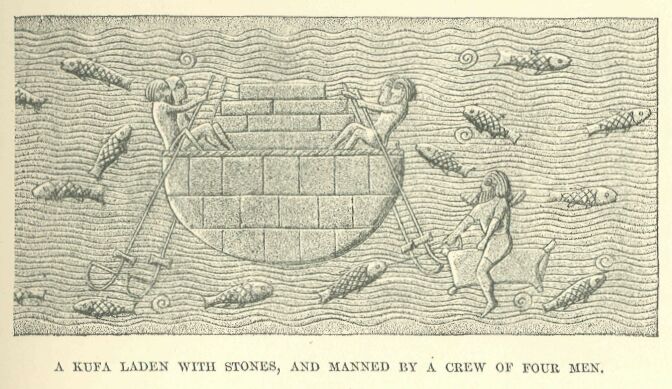
010.jpg a Kufa Laden With Stones, and Manned by A Crew Of Four Men.
     Drawn by Faucher-Gudin, from a bas-relief at Koyunjik.
     Behind the kufa may be seen a fisherman seated astride on
     an inflated skin with his fish-basket attached to his neck.
"He split it in two as one does a fish for drying; then he hung up one of the halves on high, which became the heavens; the other half he spread out under his feet to form the earth, and made the universe such as men have since known it. As in Egypt, the world was a kind of enclosed chamber balanced on the bosom of the eternal waters.* The earth, which forms the lower part of it, or floor, is something like an overturned boat in appearance, and hollow underneath, not like one of the narrow skiffs in use among other races, but a kufa, or kind of semicircular boat such as the tribes of the Lower Euphrates have made use of from earliest antiquity down to our own times."
Another:
Assyrian coracle carrying a chariot
compare to Tibetan horse lassos at other post:
 
Tibetan high plains: Khampa-Tsaaten horsemen use poles with ropes/loops to yoke/lasso horses...
perhaps from earlier dog/horse/deer hooked (crook/collar/corral/kraal) punt pole to pull bowlboat in deep water... khampa ~ xyambua-tlaya ~ champa
similar to tigris coracle paddles
Khampa horseman in Kham region near Tibet


Tsaatan horsemen looping/yoking a horse

Thursday, August 15, 2013

Phu Quoc = Pulku(ph) = Pull Cup = Pickup Truck

  1. First domestic dogs, Ridgebacks,  were naturally inbred naive native island wolves of Phu Quoc Island.
  2. Phuquoc = pulku (dogsled/boat of EurAsia used in transport long before horse/ox)
    phuquoc/pulku/kupha/parical = pulled cup, bowlboat, coracle, komatim, tobogan

http://cuevadelapileta.blogspot.com/2013/08/worlds-oldest-temple-built-to-worship.html?utm_source=feedburner&utm_medium=feed&utm_campaign=Feed%3A+PiletaDePrehistoria+%28Pileta+de+Prehistoria%29

Oldest known temple on Earth is attributed to dog. Dog Star, Sirius, was seen at Gobekli Tepe. Note vocal similarity to Syria/Assyria/Ashur/Suriya(Sun in Hindi)/Hurrians. The circular walls may have symbolized cup/bowl/barge/bark boats, the small T pillars may have supported dome caps (copa, kippah(Hebrew skull cap). See my older post on Stonehenge, Gobleke tepe and the Antikthera mechanism regarding a possible chronological/cyclo(ck)/calender function. My research indicates that West Asian, Middle Eastern, and African regions had a brotherhood/priesthood caste of waterway controllers (canals, ferryboats, bridges) that collected tolls/tithes/taxes/tariffs (Pharaoh Queen Hatsheput referred to them as parasitical middlemen and bypassed them by sending expeditions directly through the Red Sea to Punt). The Euphrates River (earlier Qupharites) seems to have been named in relation to this (Pharisee, Horite, Harwa) caste, as can be seen by the following words:  (Q)upha, Pharisee, Farsi, Parsee, freight, rate, piracy, conspiracy, que, Horus,  ari,  etc.). Note that ridgeback dogs (Ari) were bred to become boat-sled pulling dogs (TSM Tx(u)em/Tesem, SLK Tslu(e)ki/Saluki) long before long paddles and keeled sailboats evolved (pariah, patriarch, ferry, tariff derived from "ari").

  (Note: Alice Linsley at Biblical Anthropology has in-depth studies of Horites caste).

Sirius worship
    World's oldest temple built to worship the dog star
    Pillars at Göbekli Tepe in southern Turkey seem to align with the rising of Sirius, hinting that the bright star may have triggered a frenzy of religious construction
    Sirius worship
    Image 2 of 2
    Available thumbnails
    The original star sign? <i>(Image: Vincent J. Musi/ National Geographic Stock)</i>Sirius worship

    Share This


Wednesday, June 12, 2013

Sinama-Sama-Bajau-Moken

Chaldeans, e.g., Atlacatl(Aztec nauhuatl language)=water bodies, Sea people, sailors;
Isaias (Isaiah) 43:14
... the Chaldeans glorying in their ships.
Chaldia (north - Caucasus/Black Sea/Armenia) Ur-Artu = Ur-Halde(God)?
& Chaldea (south - Assyria to Babylon to Ur)
Did the Lateen sail & keeled ships (decked fishing houseboats) develop in the highland windswept seas of Armenia, and then move through the Indian Ocean towards Korea, sailed by
Chal(i)dyan/Khalibyan/Xyambuatlyan/?
Sea Peoples: west of Malaya: Moken;
Sea Peoples: east of Malaya: Bajau/Sama/Sinama of So. China/Sulu Sea[~ Tihama of Red Sea]
Before splitting, Moken = Bajau, so called Mboakja/Mbuatlya, + Shams(sun) seek = Xambuatlya
Xambuatlaya = Chaldyatl or Atlacatl?
Moken x Bajau = Mboakja (B/Paekje(Korean founders of Japan = Yayoi), Boati, XyaMbuatl [Xyam = sunbowl/solar disk/bark eg Shamash/Shams sun symbol of justice/balance/ballast]


http://theaquaticape.org/2013/02/25/the-placenta-is-thrown-into-the-ocean/ Bajau Laut: the ancestors (mag’mbo’) cf ebu gogo(Flores) abu/ibu/ebu(Malay) Sama/Sinam = Bajau/Badjao(east of borneo, Philippines, Sulawesi in Sulu Sea) ~ Moken(west of Malaya in Andaman Sea) Tribes of sea going Austronesian people, living in houseboats or in stilt houses along shores around island South East Asia... Xyambuatlaya/sinambajau Deya/muaken(aya) kaumansama: The idea from my understanding is that once a year the mbo’ require a sacrifice that involves returning to the land you were born and offering a financial offering that is usually dropped in the ocean. Returning to the land you were born would make sense along the lines that it is the place where your placenta was disposed of. Sama Deya [land dayak?] according to my wife would be horrified at the idea of putting the placenta in the ocean. For them it has to be buried Sinama or Sama or Bajau

Word List of Sinama:

Sasak: fence [Sakai (Mal. asli tribe), Sasak (Indo. tribe), Rampasasa(Flores descendants of Ebu Gogo]

Pala'u: boat dweller [Mal. perahu: boat; Egyptian: pharaoh?] Luwa'an: outsider

ka'a(m)(Sinama): you(English) awak/enkau/kamu/anda/saudarai(Malay) ikaw/ka/kayo(Tagalog-Phil.)


aku(S):I(E) aku/saya(M) ako(T)

sai(S) who(E) siapa(M) sino(T)

ai(S) what(E) apa(M) ano(T)

aheka(S) many(E) banyak(M) marami

(T) daing(S) fish(E) ikan(M) isda

(T) ero’(S) dog(E) anjing, asu, kuyuk(M)

 aso(T) kutu louse kutu kuto sowa
snake ular ahas/sawa
kalog worm cacing/ulat uod/bulati

kayu tree pokok/pohon puno/punung-kahoy talun forest hutan/rimba gubat batang stick batang patpat

Tuesday, June 4, 2013

Tail-holding propulsion

"This is a film of a girl raised by bushmen, showing her toying with wild lions and cheetahs." Heather Sweet at AAT

==================================================================

Yes, I have conjectured that early H sapiens used the islanded Phu Quoc ridgeback dog (derived from the Asian wolf) to pull their bowl boat coracles in water too deep for their punt poles, first by holding the tail, later by yoking them with a leash attached to a pole in the same manner as deer/horses etc. were restrained as part of hunt-herd pre-domestication (see photos in previous post).

Thursday, April 18, 2013

Xiamptlya/Khambadru/Congo

Interesting linguistic links indicate early dog-horse semi-domestication Xyambuatlaya/Xambotlaya/Khambodiya/Siam-Athalaya/Khan+/Kampong(ma)laya/kampot/kamchatka/Bimbetke/Bimbache(Can Isle Hierra)/Himba(ghee hair matriarch, W Africa cattle herders)/Himalaya-Tibet/Thimbu(Bhutan river-capital) Biscayne/Vizcainya/ cave of Askondo (← aitz-ondo = (Basque) near the rock) 25ka red-painting of horse//Sunduki (black mountain, ideal plains-herd-hunt hill-top mesa (atalaya=watchtower/castlemount) Khakassia, Altai) 16ka white-carving of horse (Altaic people hut tipi-shaped ayyal (hex pyramid wood vs cf urt (tipi-yurt) of nomadic Tsatan people), sunduki/askondo/saluki/swat/semliki/baluchi Saluki (Pharaoh doggy)/Xolo-itzcuintli (/ʃoʊloʊ.iːtsˈkwiːntli/ SHOH-loh-eets-KWEENT-lee) Mex hairless jungle dog;Tepeizeuintli dingo = anjing(Mal) + gou(Ch) = anjingo... saluki/swatluki/xmuatluhi suatluki ~ semliki|||shamuatliki ~ shambuatlaya(molimoli/muatslimuatsli - askundwoki, swantluhi, sholocuintzli) http://siberiantimes.com/other/others/news/is-this-the-oldest-astronomical-observatory-in-the-world-dating-back-16000-years/ http://forwhattheywereweare.blogspot.com/2013/05/echoes-from-past-may-9-2013.html http://forwhattheywereweare.blogspot.com/2013/05/askondo-cave-art-is-25000-years-old.html Beleuka Altai(Rus white mtns?) baluchistan/Beluga(white)/luci-(light); lyse(loosen, untie/split); lykos(Grk wolf/lobo, lupus) byeluka(Rus white vs Rus black cher-/schwartz vs beltz(basque black, Malay gelap dark, bakar char)) yam/yaw: http://religion.wikia.com/wiki/Yam_(god) http://en.wikipedia.org/wiki/Jehovah luba - bantu tribe south congo//lu - tai tribe in SW Yunnan//luo - Nilotic tribe pastoral//luorawetlan[loo-awr-uh-vet-luhn, lwawr-] - NE Siberia Chukchi/Koryak/kamchadal lang (proper man)//lubra - native name in Tasmania & Aust aborig girl-woman//bemba - bantu tribe Rhodesia, Afr (bembantu/bembache/bambuti)//belone (Grk) needle (balloon/balleen?) http://theaquaticape.org/2013/02/25/the-placenta-is-thrown-into-the-ocean/ Nice post about the Sama and their practices with the placenta. Though I’ve lived and worked with Sama for quite sometime, I still admit to understanding little about their practices that involve the ancestors (mag’mbo’). I was in a discussion about it once though where they were connecting the placenta with the ancestors that they revere. The idea from my understanding is that once a year the mbo’ require a sacrifice that involves returning to the land you were born and offering a financial offering that is usually dropped in the ocean. Returning to the land you were born would make sense along the lines that it is the place where your placenta was disposed of. Sama Deya according to my wife would be horrified at the idea of putting the placenta in the ocean. For them it has to be buried, but it is definitely clear that in the Sama worldview much importance is put on the placenta and its connection to the spirit world. March 15, 2013 at 7:23 am Reply • Erik Abrahamsson Hi, thanks for you comment! Yes, the placenta plays an important role in Sama cosmology, throughout Philippines, Malaysia and Indonesia … In Wakatobi I met the translator of the movie “The Mirror Never Lies”, a Sama man called Sadar, and he told me that it is still practise to put the placenta into the ocean after giving birth – and this is part of a ritual (the word “thrown” is probably wrong in this context, it should rather be “put into the ocean”). The practice to throw the placenta into the sea might be foreign for most Sama in Malaysia and Philippines, but we must keep in mind that the Sama group in southern Indonesia has been separated from their northern relatives for at least 100 years. Hence, it is not surprising that some elements in their belief systems are partly different. misogi(J)=ceremony of purification(in a river), e.g, the river Styx=Chiconauhpan(N)=river of the 9 vados/wadings[vase/vessel/punt~feet/punchwater] with boatman who rows one across to Mictlan), michimichi(J)=on one's way, as one goes along, all the way, e.g., one walks to Mictlan after the river crossing in company of a brown Xoloitcuintli[saluki/sh-(ua/oi)(t)luk(u)i...ki (earth/land) = tli/chi Mazatl(N/7)=deer,=matou(J)=wrap, wear, put on (matou~kudu(antelope)(fishbaskettrap)(coracle) cf enduerre (Latin) put on Austere = (Malay) haus: thirst balteus (grk) belt/girdle, (belt also beat related to bat/pukul/pugil/peal?) sith(Scot)=cú sith=cueitl(N)=skirt/dog=fairy cur/burial mound dog. ah, yes, Síle na gCioc (Irish)=Xilé na gCC(i)[tletl] 45k bce-10k bce, when we all were deer tribes following=Xolotl(N)=dogging Tlaloc Tesem(Egypt) =tececemelti(Nauatl)=funny, amenable, recreative, who likes people,= cecemetlia(N/freq.)=cemeltia(N)=play with someone, give them pleasure,= cemelli(N)=pleasure, happiness,=cemelle(N/adj/adv)before negative, e.g., aic cemelle(N)=with happiness, tranquility, lit., not alone,=ceme(N)= plural of ce(N)=one, e.g., cea(N)=not one,=say(E)=de-s/cea-r=desear(sp)= desire(E)=decir(sp),=Ce(r)nechi(Malta/Fra Abela, 1647)=Kelb-tal-Fenek, Pharoah hound of Malta,=Cirneco dell'Etna(Sicily)=Tsm/Tesem(Egypt)=first Pharoah dog, comestible, relieved as Pharoah dog by Saluki sight hound= Alco(N)=Techichi(N)=rock dog,=Tesem(Egypt)=Anubis(Egypt)=Xolotl(N)= Evening star, twin of Quetzalcoatl, son of wind weaver Venus shuttle/ xiotl(N)star, Ehecatl(N/2 Tonalamatl)/Hecate, Tobacco Deity of Mexico, and the Fool=Xolo=follow in Tarot=Taroc/Tarocco(Ital)=Tlaloc, rain Deity of Nomad Deer Age, 45k BCE-10k BCE, paired with St. Michael=Miquiztli(N/6 Tonalamatl)=Death Lord of dogs, and finally, the Devil. ...Abuwtiyuw/Abutiu(Egypt)=royal guard dog of the 6th dynasty, 2345-2181BC, died before 2182, buried sumptuously at Giza Necropolis, =Abuw-=Tlapoalli -tiyuw(Egypt)=-tiuhtli(N)= Tlapo-tiuhtli(N)=counted/tlapoalli tiuhtli/as Lord, for he was embalmed and buried as a Noble" {tletl} Kamchadal language (ethnonym: Itelmen cf luorawetlan, The Itelmens use the self-designation itenme'n-itelmen which means 'an inhabitant of dry land, a human being') is distantly related to Chukchi and Koryak, and together they form the Chukotko-Kamchatkan language family Kamchatka kamchadal/itelman(river settlement?) - labor was very clearly divided based on gender, though many tasks were shared. When fishing, the men and women paddled together, however only the men fished while the women performed all related tasks such as cleaning and drying the fish and collecting the eggs. In home construction, men performed all the wood work, digging and carpentry while the women performed the task of thatching the straw roof and cutting the straw with bone sickles made from bear shoulder blades. The women prepare the whole fish supply, except fermented fish and dog food, which is left to the men. The women perform all the tasks of gathering seeds, berries and fireweed, which is used as a type of tea. From grass they construct mats, bags, baskets and boxes for storage and transportation. Dog and reindeer skins are tanned, dyed and sewn into the various garments worn by men and women.[4]
Cathaya, the Chief Kingdome of Great Cam/Kublai Khan" to the northeast of China. On his map, he placed Xandu east of the "Cathayan metropolis" Cambalu
Khampa horseman in Kham region near Tibet


Tsaatan horsemen looping/yoking a horse


Tsaatan in front of urt (tripod-based tipi of skins, felt or birch bark)


A Tsaatan woman (also shaman) milking reindeer, note very small nose and large cheekbones
 
This photo of an Apatani women from India shows her tribal nose-plugs and tattoo, her epicanthic eyelids rise to her forehead [All photos from Tribal Asia, excellent book on Asian tribal traditions]
 

Xambotlaya/Ksyambodlia/Khampot/Thimbu/Himbalaya... Atalaya (Sp): watchtower http://news.nationalgeographic.com/news/2013/13/130425-indus-civilization-discoveries-harappa-archaeology-science/?utm_source=feedburner&utm_medium=feed&utm_campaign=Feed%3A+ng%2FNews%2FNews_Main+%28National+Geographic+News+-+Main%29 Bones from about 1900 to 1700 B.C.—more than a millennium later than those examined by Kenoyer—make it clear that at least some Harappan residents were subjected to savage violence. The skull of a child between four and six years old was cracked and crushed by blows from a club-like weapon. An adult woman was beaten so badly—with extreme force, according to researchers—that her skull caved in. A middle-aged man had a broken nose as well as damage to his forehead inflicted by a sharp-edged, heavy implement. Mace wielding horsemen or road accident with horse carts? Siberia 3.5ma warmer, forested, no ice cap http://siberiantimes.com/science/casestudy/news/global-warming-sensation-arctic-land-masses-were-once-warm-forested-and-the-north-pole-had-no-ice-cover/